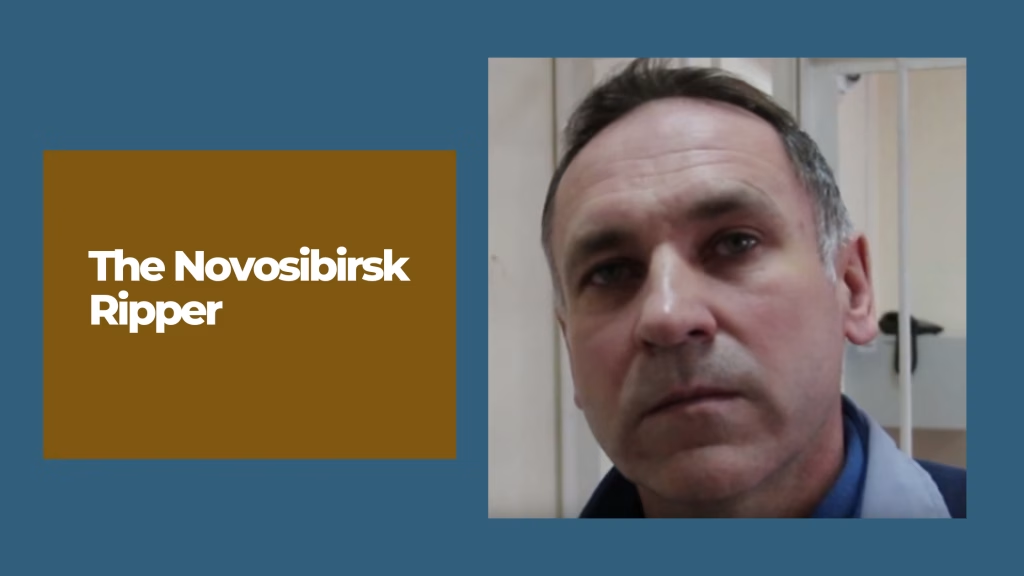
On November 19th, 1998, investigators found a headless torso in a garbage dump just beyond the Novosibirsk city limits. Nearby lay the severed head. The victim was never identified. Without a name or leads, the case went cold.
Police treated it as a one-off killing. It wasn’t.
Over the next six years, bodies would appear on the outskirts of Russia’s third-largest city, hidden in tree lines, dumped along roadsides, stuffed into trash piles. Many were decapitated or dismembered. Some had internal organs missing. On certain victims, pentagrams had been carved into the skin. Amulets were left beside bodies. Severed heads were placed inside hoods, staging scenes to look like ritual killings.
For years, investigators believed they were hunting a satanic cult. Local whispers spoke of black masses in the Siberian woods, of underground sects sacrificing women.
The truth was both simpler and more terrifying. The killer wasn’t a cult member. He was a police officer, one of the men paid to protect the very women he was murdering.
This is the story of Yevgeny Alexandrovich Chuplinsky, the Novosibirsk Ripper, a cop by day and killer by night who murdered at least 19 women before DNA evidence finally brought him down 18 years after his first kill.
The Model Soviet Citizen
Yevgeny Alexandrovich Chuplinsky was born on March 14th, 1965, in Novosibirsk. Little is known about his parents, but his family lived modestly without major social problems. In school, he was an average student who kept to himself, tried to do well, and never showed aggression or criminal behavior.
In the biographies of many serial killers, investigators often find signs of childhood trauma, abusive parents, violence, or constant conflict. But in Chuplinsky’s case, there was nothing like that. By all accounts, he grew up a normal child without any obvious warning signs.
This is what makes his case so unsettling. There was no horrific backstory, no clear red flags that something was deeply wrong.
Those who remembered Chuplinsky from his army days and later in the police often said he was always eager to please his superiors. During his service in the border troops from 1984 to 1987, fellow soldiers noticed the considerable effort he put into keeping his officers satisfied. He was diligent and eager to maintain the image of a proper Soviet young man, earning multiple commendations.
After his military service, Chuplinsky joined the police. He started as a simple patrol officer in Novosibirsk and later worked in the Leninsky District department. Colleagues called him “Chupa Chups,” Russian slang for someone who constantly sucks up to their bosses.
On paper, he looked like a model officer: dozens of letters of commendation, even a medal for service excellence. But behind this mask of a perfect policeman was the man who would become one of Siberia’s most notorious serial killers.
The Protection Racket
While serving in the Leninsky District Police, Chuplinsky became involved in what locals called “the protection of sex workers.” Together with other officers, he would patrol their spots, not to stop the trade, but to collect money in exchange for protection.
Prostitutes paid to be left alone, to avoid arrest. This made them vulnerable. The police knew their faces, knew where they worked, and could easily exploit their position.
And Chuplinsky knew it all. He knew the women by name. He knew which corners they worked, when they appeared, and when they were most vulnerable. More importantly, he knew the system itself: when patrols were scheduled, when reports were due, and when nobody would be watching.
It allowed him to choose the perfect time to strike.
Think about the power dynamic here. These women were already in a vulnerable position, engaging in illegal work. The very man they paid for protection was the one who would eventually kill them. They trusted him because he wore a badge. That trust would prove fatal.
The First Kill
On November 19th, 1998, Chuplinsky struck for the first time. In that garbage dump beyond the city limits, investigators found the headless torso and severed head. The victim was never identified.
Without a name or leads, the case went nowhere. At the time, police treated it as a one-off killing. But it was only the beginning.
Chuplinsky had learned he could kill and get away with it.
Then came the second killing. In February 1999, part of the victim’s body was found: two severed feet discovered on wasteland. Later in April, the torso and head were located in another location just beyond the city.
Crucially, this victim was identified via fingerprint records. That fact shifted the investigation. One murder without a name had been dismissed. Now the second had a face.
But Chuplinsky didn’t stop at two murders. As time went on, investigators would uncover a staggering total of 19 victims. Some even suspect the real count could be higher.
The Ritualistic Presentation
What made many of these crimes particularly chilling was their almost ritualistic presentation. On the bodies of certain victims, investigators discovered pentagrams carved right into the skin. Next to some corpses, there were amulets, odd trinkets, and charms meticulously arranged as if they were part of a dark ceremony.
In the most horrifying instances, severed heads were tucked away inside hoods, creating the unsettling illusion of occult executions.
For years, this led investigators astray. Was Novosibirsk truly under the grip of a satanic cult?
Local whispers spread like wildfire, fueling panic. Some spoke of black masses taking place in the Siberian woods. Others believed an underground sect was sacrificing women.
Yet the reality was far more sinister and straightforward. Chuplinsky was deliberately staging crime scenes to mislead investigators. The pentagrams, the amulets, the hoods—all of it was theater, a calculated misdirection to make police chase shadows instead of him.
The impact was devastating. It made people feel as though they were facing something supernatural, something beyond comprehension. And all the while, Chuplinsky continued his hunt.
The Trigger
Chuplinsky didn’t kill without a reason. He needed a trigger, most often an insult from a woman or a remark about a venereal disease. That’s when he would snap and move on to murder.
He later described the feeling as “her life was leaving her and flowing into me.” This reveals the sadistic, almost vampiric nature of his actions.
He constantly refined his methods of killing and disposing of bodies, showing cold-blooded calculation and precision. During the investigation, he underwent a psychological and psychiatric evaluation.
The conclusion: homicidomania, a pathological urge to kill. He had a sadistic craving for control, humiliation, and violence.
At the same time, he was found to be fully sane. He understood his actions and was capable of controlling them. This wasn’t a man driven by uncontrollable impulses or mental illness. He chose to kill. He enjoyed it. And he was organized enough to get away with it for years.
The Transfer
By 2000, the protection scheme had become too obvious. Chuplinsky’s superiors could no longer ignore it. He was given a choice: resign or accept a transfer.
He was reassigned to the Leninsky District Department, officially explained as “closer to home.” But in reality, it was a discreet way to move a compromised officer out of sight.
On paper, everything looked respectable. Chuplinsky continued his service, received commendations, and maintained the image of a model policeman. In truth, however, he was sinking deeper into his double life.
By day, a uniformed officer. By night, a predator hunting the very women he once claimed to protect.
The Investigation That Went Nowhere
By the year 2000, it had become clear that a serial killer was operating in Novosibirsk. The local homicide unit created a permanent task force to study the crimes, but cases were still filed under different district prosecutors and often suspended.
The real reason was darker. No one in the regional leadership wanted to admit that a serial killer was operating on their watch. It was easier to stall investigations, to bury them in paperwork, than to publicly face the truth.
And while bureaucracy paralyzed the system, Chuplinsky kept hunting.
It wasn’t until 2005 that prosecutors finally decided to gather all the cases under a single investigator. He was assigned to review every missing person report involving women who had worked in prostitution.
On his desk lay 16 case files with human remains, along with dozens of reports of missing women. The first analysis suggested that all the crimes were likely committed by the same person or possibly a small group who had been operating for years, refining their methods with each attack.
Additional forensic tests were ordered, and witnesses were questioned again. But in 2006, the investigation was suspended once more, officially due to a lack of a concrete suspect.
Only after the creation of the Investigative Committee in 2007 was the case reopened. And this time it never stopped.
The Phone That Started Everything
Within a few months, investigators compiled a list of 18 possible suspects. Among them was Yevgeny Chuplinsky.
But at that stage, there was no hard evidence linking him to the murders.
Investigators first noticed Chuplinsky not because of a body, but because of a missing woman. Her remains were never found, but her phone was.
In the summer of 2004, the woman’s mother reported her missing. When police checked the records, they saw something suspicious. That very night, her phone had been activated with a new SIM card registered to Yevgeny Chuplinsky.
When questioned, he calmly explained that he was doing side work as a cab driver and two passengers had supposedly left the phone in his car. As a former police officer, his story sounded believable, and investigators let it go.
But when it came time to give an official statement, his version changed. Now he claimed the same men had tried to rob him. A fight broke out, he said, and in the chaos, they dropped the phone. He picked it up but insisted he was ready to hand it over to the authorities.
At the time, no one pushed further. But this strange story left a mark, and investigators quietly noted his name. Later, it would resurface, and this time, he wouldn’t slip away so easily.
The Web of Lies
Two years later, in 2006, when investigators finally pulled together all the unsolved cases, troubling coincidences began to surface.
Yevgeny Chuplinsky had always claimed he didn’t know one of the missing women. By then, however, investigators had proof she was a sex worker and that she was acquainted with him.
When they began talking to his former colleagues, a darker picture emerged. Rumors circulated that Chuplinsky had been protecting the very women who worked the so-called “Drunken Road,” the strip where many prostitutes had disappeared.
The deeper they dug, the more inconsistencies piled up in his statements. Authorities decided it was time to act.
Chuplinsky was taken into custody, this time as a suspect in the killings. For three months, he sat behind bars while investigators combed through his life.
Witnesses confirmed the same story. Many women told investigators that after they were questioned by the Investigative Committee, Chuplinsky would press them for details: what questions had been asked, and whether his name had come up.
He later explained this away as fear of being exposed for corruption. But to investigators, the excuse seemed oddly convenient, especially for a retired officer.
The Cadaver Dog
Then came a dramatic moment: a search of one of his garages with the help of a cadaver dog.
The animal walked in, lay down on the floor, and refused to move. To the detectives, it looked like bodies were buried beneath the concrete. They tore up the floor but found nothing.
Later, a dog handler explained: “Such a reaction can also be triggered by traces of old human blood.”
At the time, though, investigators dismissed it. After three months, with no solid evidence, Chuplinsky was released with apologies.
But suspicion never went away. Investigators privately remained convinced he was behind the disappearances.
The DNA Breakthrough
For years, the case stalled. Victims’ remains were too decomposed to identify weapon marks, and many women were never identified at all. Without names, there were no connections, no witnesses to retrace their last days.
The turning point came a decade later, in 2016, when a modern DNA laboratory finally opened in Novosibirsk.
Lead investigator Igor Shashayev ordered fresh forensic tests on every scrap of evidence. Suddenly, cases began to light up.
Biological traces, skin under victims’ fingernails, semen on clothing, even fragments preserved from crime scenes were matched to one man: Yevgeny Chuplinsky.
In April 2016, 18 years after his first known murder, he was arrested again. This time, the evidence was overwhelming.
The Slip-Up
At his very first interrogation, Chuplinsky slipped up, revealing details he shouldn’t have known. He quickly realized his mistake and tried to backpedal.
He insisted his contact with sex workers had always been official business, gathering intelligence for reports, nothing more. He explained away his collection of knives as an innocent hobby, even though he admitted an obsession with blades.
But investigators were patient. They gave him only the minimum information required by law, forcing him to talk. Time and again, Chuplinsky revealed details only the killer could have known.
The DNA results crushed his defense.
Realizing what he was facing, Chuplinsky and his lawyer made a calculated move. In June 2016, they agreed to a pre-trial cooperation deal. Under Russian law, this could reduce his sentence to no more than two-thirds of the maximum if he fully disclosed every crime he had committed.
For investigators, this was a breakthrough. Chuplinsky began talking and revealed far more murders than police had even suspected.
The Method
According to his own accounts, it always began the same way. He cruised the “Drunken Road” in his car and picked up a woman. They would drive off, often drinking alcohol he brought along.
Then came the trigger: an insult, a mention of disease, or anything that pricked his pride. That’s when he turned violent.
His first killing, he admitted, had been messy and chaotic. But after that, he perfected a method. From behind, he would lock his arm around the victim’s throat, lift her off the ground, and wait.
He described it in chilling detail: “When her legs started to twitch and then went still, I knew she was gone. It felt like her life was leaving her and flowing into me.”
Later, he would mutilate bodies, sometimes carving them, sometimes using scissors to cut soft tissue from skulls to delay identification. Each killing was more precise, more calculated than the last.
Yet even after agreeing to the deal, Chuplinsky never fully admitted guilt. He painted himself as a victim, claiming the women provoked him or that he was carrying out punishment.
At one point, he tried shifting blame to a former colleague who had conveniently died years earlier.
Investigators were ready. Every session was filmed. Experts later confirmed there was no coercion, no planted words. Chuplinsky was telling the truth, though never the whole truth.
The Trial
Fearing that incomplete confessions might void his deal, Chuplinsky and his lawyer eventually withdrew from the agreement. He now denied everything, claiming he’d been forced into confessions.
In the end, he demanded a jury trial, believing he could sway ordinary citizens more easily than a professional judge.
The gamble failed.
On March 6th, 2018, after weeks of testimony, the Novosibirsk Regional Court delivered its verdict. The jury had unanimously found him guilty and undeserving of mercy.
Chuplinsky was convicted of murdering and dismembering 19 women between 1998 and 2004. Twelve of them remain unidentified to this day.
Local media dubbed him the Novosibirsk Ripper.
On September 15th, 2019, he was transferred to IK-6A, a special regime penal colony where he remains to this day.
The Women Who Were Forgotten Twice
One of the most heartbreaking aspects of the Novosibirsk Ripper case is how little we know about his victims. Twelve of the 19 women he murdered remain unidentified to this day.
They were prostitutes working the “Drunken Road,” women whose disappearances were initially overlooked because of who they were and what they did. Society had already marginalized them. Their murders simply made them invisible.
These women had families. They had children, mothers, brothers, and sisters who waited for them to come home. They had reasons for doing what they did, stories that led them to those streets.
But because they were sex workers, because they existed on society’s margins, their disappearances didn’t raise immediate alarms. When bodies started appearing, investigations were stalled by bureaucracy and denial.
The very system that should have protected them failed them twice: first by allowing corruption that put them at the mercy of predatory police officers, and second by refusing to acknowledge a serial killer was operating for years.
Evil in Uniform
What makes Yevgeny Chuplinsky’s case so disturbing isn’t just the brutality of his crimes or the number of victims. It’s the betrayal of trust.
He was a police officer. He wore a badge. He was supposed to protect and serve. Instead, he used his position to identify vulnerable women, learn their routines, and exploit the protection racket to get close to them.
The women paid him for safety. He gave them death.
His fellow officers called him “Chupa Chups” because he constantly sucked up to superiors. He collected commendations. He maintained the image of a model policeman. All while carving pentagrams into dead women and staging crime scenes to look like satanic rituals.
The scariest part? There were no warning signs. No abusive childhood. No obvious red flags. Just a normal man who discovered he liked killing and was smart enough to use his position to get away with it for 18 years.
The Systemic Failures
The Novosibirsk Ripper case exposes deep systemic failures in how Russian law enforcement handled serial crimes in the early 2000s.
Bureaucratic Paralysis: Cases were filed under different district prosecutors and routinely suspended. Regional leadership refused to admit a serial killer was operating, choosing to bury investigations in paperwork rather than face public scrutiny.
Corruption: The protection racket that allowed Chuplinsky access to victims was an open secret. Instead of being arrested, he was quietly transferred. The system protected itself, even when evidence suggested that serious crimes had occurred.
Lack of Resources: For years, victims’ remains couldn’t be properly analyzed. DNA evidence existed, but couldn’t be processed until a modern laboratory opened in 2016, a decade after Chuplinsky’s killing spree ended.
Victim Marginalization: Because the victims were prostitutes, their disappearances didn’t trigger the same response as missing “respectable” women. This allowed Chuplinsky to operate undetected for years.
Read more: The Wolf of Moscow: Vasili Komaroff
If investigators had acted more decisively in 2000, when the pattern became clear, how many lives could have been saved?
The DNA Revolution
The Novosibirsk Ripper case demonstrates how advances in forensic science can finally bring justice, even decades after crimes were committed.
When the modern DNA laboratory opened in Novosibirsk in 2016, lead investigator Igor Shashayev ordered fresh tests on every piece of evidence from unsolved cases. Biological traces that had been collected but never properly analyzed suddenly became the key to solving multiple murders.
Skin under fingernails. Semen on clothing. Fragments preserved from crime scenes. All of it pointed to one man: Yevgeny Chuplinsky.
This is why proper evidence collection and preservation matter, even when immediate testing isn’t possible. Technology advances. New methods emerge. Evidence that seems useless today might solve a case tomorrow.
The 2016 DNA breakthrough didn’t just solve the Novosibirsk Ripper case. It sent a message to other cold case killers: time doesn’t erase evidence, and justice might be delayed, but it’s coming.
Lessons from the Novosibirsk Ripper
The case of Yevgeny Chuplinsky offers several important lessons:
Trust but verify. Just because someone wears a uniform doesn’t mean they’re trustworthy. Police corruption enabled these murders and delayed justice for years.
Protect the vulnerable. Marginalized populations, particularly sex workers, are at the highest risk for violence. Their safety matters, and their disappearances deserve serious investigation.
Recognize patterns. By 2000, the pattern was clear: women were disappearing from the same area, and bodies were appearing with similar characteristics. Bureaucratic denial allowed the killing to continue.
Preserve evidence. DNA technology that didn’t exist in 1998 solved this case in 2016. Proper evidence collection and storage can bring justice decades later.
Question convenient narratives. The “satanic cult” theory distracted investigators for years. The truth was simpler: a calculating killer staging crime scenes to mislead police.
Where Evil Wears an Ordinary Face
The story of Yevgeny Chuplinsky stays with you long after you’ve heard it. It carves itself into memory and chills you to the bone.
The most terrifying part is that we can never know for sure. Someone just like him could be living nearby. That person in the crowd. That man is sitting at a café table. Evil often wears an ordinary face, and that’s what makes it truly terrifying.
Chuplinsky had no horrific backstory. He wasn’t abused as a child. He didn’t suffer obvious trauma. He was just a normal man who discovered he enjoyed killing and was smart enough to hide it behind a badge and a smile.
For 18 years, he walked free. He collected commendations. He maintained the image of a model officer. And all the while, he was hunting women on the outskirts of Novosibirsk, staging ritualistic crime scenes, and refining his methods with each kill.
Today, Novosibirsk is Russia’s third-largest city, home to more than 1.5 million people. It sits at the heart of Siberia, known for its harsh climate, long winters, and the icy Ob River that cuts the city in two.
The “Drunken Road” still exists. Women still work there. But now they know that sometimes the most dangerous person isn’t a stranger in the shadows.
Sometimes it’s the cop who promises to keep you safe.
What aspect of the Novosibirsk Ripper case disturbs you most: that he was a police officer, that bureaucracy allowed him to kill for years, or that 12 victims remain unidentified? Share your thoughts below.