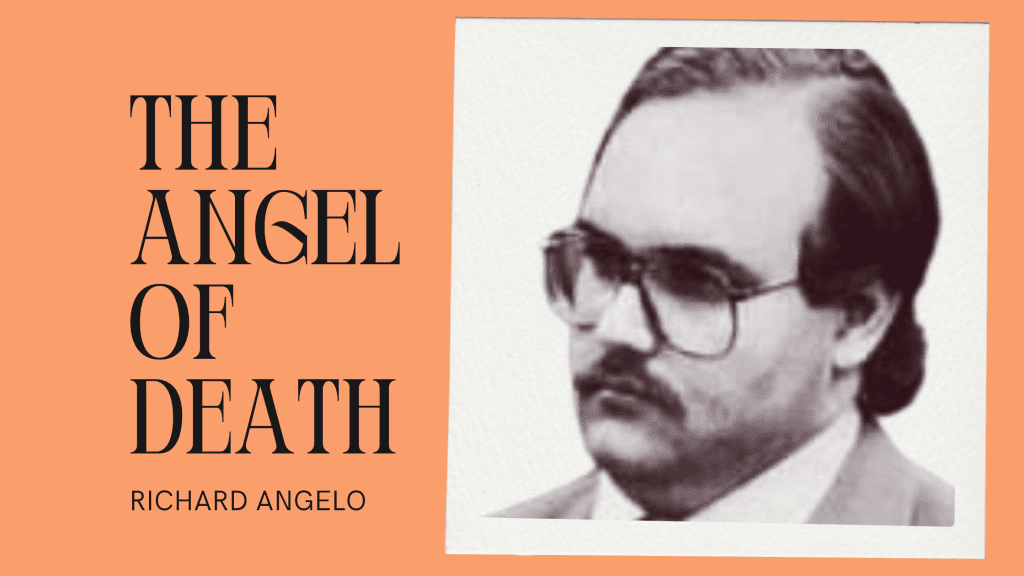
When you check into a hospital, you place your life in the hands of medical professionals. You trust that the nurse monitoring your vitals wants you to get better. You assume the person adjusting your IV is there to help, not harm.
Between 1985 and 1987, patients at Good Samaritan Hospital in New York made that same assumption about Richard Angelo. They had no way of knowing that the quiet, competent nurse working the night shift was secretly injecting them with paralyzing drugs—bringing them to the edge of death just so he could “heroically” save them.
Except he didn’t always save them. Of the 37 patients Angelo poisoned, only 12 survived. Twenty-five people died, not from their illnesses, but because an insecure nurse craved recognition so desperately that he was willing to play God with human lives.
This is the story of Richard Angelo, the “Angel of Death,” and the chilling psychology behind his crimes.
A Childhood Starved for Attention
Richard Angelo was born on August 29, 1962, in West Islip, New York, an only child to Joseph and Alice Angelo. From the outside, his childhood looked unremarkable—maybe even privileged. His father worked as a guidance counselor at a high school, and his mother taught home economics. They weren’t poor. They weren’t abusive. But something was missing.
Both parents were consumed by their work. Joseph spent long hours at the high school. When Alice came home, she focused on household chores and cooking, then retreated into her books during any free time. Richard was expected to fend for himself, to complete his responsibilities without praise or acknowledgment. Everything he did was simply what was expected—nothing more, nothing less.
For an only child, this lack of attention created a deep void. While other kids craved toys or freedom, Richard craved something more intangible: recognition. He wanted someone to notice him, to tell him he mattered, to say he was special.
Neighbors described the Angelo family as pleasant and normal. Richard was quiet but polite, the kind of kid who didn’t cause trouble. But beneath that calm exterior, a dangerous need was forming—a hunger for validation that would eventually cost people their lives.
The Quiet Student Who Became a Nurse
Richard threw himself into his studies with single-minded focus. If his parents wouldn’t praise him at home, maybe academic excellence would finally get their attention. He kept to himself, rarely making friends, but consistently excelled in his coursework.
In 1980, Angelo graduated from Saint John the Baptist Catholic High School and enrolled at the State University of Stony Brook. After two years, he transferred to Farmingdale State College, where he was accepted into a two-year nursing program. Throughout his education, the pattern continued: Richard made the Dean’s List every semester, but remained socially isolated. Teachers knew him as shy but reliable, someone who always had the right answers but never stuck around to chat after class.
In 1985, Angelo graduated with good standing and landed his first job as a registered nurse in the burn unit at Nassau County Medical Center in East Meadow. But he never got comfortable. He bounced between positions—Nassau County, Brunswick Hospital in Amityville, then a three-month stint in Florida, where his parents had relocated. Nothing felt right. He struggled with the social aspects of nursing, the constant communication and collaboration the job required.
After returning to New York, Angelo finally found a position that seemed to fit: the Intensive Care Unit at Good Samaritan Hospital in West Islip, working the graveyard shift from 11 PM to 7 AM.
The Perfect Storm: Trust, Competence, and Isolation
The ICU night shift turned out to be ideal for Richard Angelo. His calm demeanor worked well in high-stress situations. He could handle critical cases with steady hands and a level head. Most importantly, there were fewer supervisors around at night, less oversight, and patients who were often unconscious or too ill to communicate clearly.
His colleagues began to trust him. When emergencies arose, they knew Richard would be there, competent and focused. But that trust created a new problem—one that would prove fatal.
As Richard proved his reliability, people began piling more work on him. It’s a common phenomenon: the competent get burdened while others slack off. Instead of speaking up about feeling overwhelmed or underappreciated, Richard stayed quiet. He took on the extra work, never complained, never asked for help.
But inside, resentment was building. He felt taken for granted. All this work, all this responsibility, and still nobody truly saw him. Nobody called him a hero. Nobody praised his skills the way he desperately craved.
So Richard decided to create situations where they would have no choice but to recognize his brilliance.
The Twisted Plan: Creating Emergencies to Become the Hero
Sometime in 1985, Angelo began implementing a horrifying strategy. He would inject patients with a dangerous cocktail of Pavulon (a form of anesthetic) and Anectine (a skeletal muscle relaxer). Together, these drugs paralyzed patients, making them unable to speak or move. They couldn’t signal nurses for help. They couldn’t press the call buttons. They could only lie there, feeling their bodies shut down, knowing something was terribly wrong but powerless to communicate it.
Then Angelo would call a “code blue”—the hospital emergency alert for a patient in critical condition. Doctors and nurses would rush to the scene, where they’d find Richard already working to stabilize the patient. Sometimes he’d ask for help. Often, he’d try to handle it alone, demonstrating his knowledge and skill.
What nobody knew was that Richard had caused the emergency himself.
When he successfully “saved” a patient from the crisis he’d created, he’d receive praise, gratitude, and recognition. Finally, people saw him as the hero he’d always wanted to be. The problem was, it wasn’t enough. It was never enough. So he kept doing it, again and again, escalating over two years.
Between 1985 and 1987, 37 code blues were called during Angelo’s shifts—an unusually high number that should have raised red flags. Of those 37 patients he poisoned, only 12 survived. Twenty-five people died.
What makes Angelo’s crimes particularly chilling is what he would say to patients as he injected them. He’d tell them he was giving them something to make them feel better, to ease their pain. And because the drugs were paralytics, patients would initially feel a numbing sensation that might have seemed like relief—right before they realized they couldn’t breathe, couldn’t move, couldn’t call for help.
Those who survived described the terror of being fully conscious but completely paralyzed, unable to tell anyone what was happening to them.
The Patient Who Fought Back
In October 1987, Angelo’s luck finally ran out—not because investigators caught on, but because one patient refused to give up.
Gerolamo Kucich was in the hospital dealing with a medical issue when Angelo came to his bedside. Kucich was in pain, but when Angelo offered him an injection to “feel better,” something didn’t sit right. He didn’t want anything he didn’t understand. But Angelo injected him anyway and left the room.
Immediately, Kucich knew something was wrong. His body started going numb. He felt himself falling asleep against his will. His limbs grew heavy, then immobile. Panic set in as he realized he was being paralyzed.
With his last bit of strength before complete paralysis set in, Kucich reached over and pressed the emergency call button.
A nurse responded and found Kucich unresponsive but alive. Sensing something was off—Kucich wasn’t supposed to be sedated—she performed a urine test and sent it to the lab. The results came back positive for Pavulon and Anectine, neither of which was prescribed to Kucich.
The nurse reported her findings. The next day, police raided Angelo’s home and searched his locker at work. They found multiple vials of both drugs—cold, hard evidence that he’d been stockpiling the very medications that were showing up in patients’ systems.
The Bodies Tell Their Story
Once Angelo was in custody, the grim work began. Families who thought their loved ones had died from natural causes—complications from surgery, underlying conditions, the expected risks of serious illness—were told their family members might have been murdered.
Bodies were exhumed. Autopsies were performed. Ten victims tested positive for the drug combination Angelo had been using. Other bodies showed no traces, meaning Angelo had poisoned even more patients than investigators could prove, but decomposition had destroyed the evidence.
For the families, the revelation was devastating. Their grief was compounded by betrayal—these people had trusted the hospital, trusted the medical staff, trusted that everything possible had been done to save their loved ones. Instead, they’d been killed by the very person who was supposed to protect them.
“I Wanted to Look Like I Knew What I Was Doing”
During his interrogation, Angelo gave a statement that perfectly captured the narcissism and insecurity driving his crimes:
“I wanted to create a situation where I could cause the patient to have some respiratory distress or some problem, and through my intervention or suggested intervention or whatever, come out looking like I knew what I was doing. I had no confidence in myself. I felt very inadequate.”
Read that again. Twenty-five people died because one man felt “inadequate.”
Angelo’s defense team tried to argue he suffered from multiple personality disorder—that the Richard who committed these crimes was a completely different person from the friendly, competent nurse everyone knew. They even administered a polygraph test, which Angelo reportedly passed on questions about his crimes, supposedly supporting the dissociation theory.
But the polygraph results weren’t admitted as evidence, and the jury didn’t buy the multiple personality defense. This wasn’t a case of mental illness fragmenting someone’s identity. This was a case of profound narcissism, desperate insecurity, and a willingness to sacrifice human lives for a few moments of praise.
Angelo wasn’t disconnected from his actions. He was coldly deliberate, selecting vulnerable patients, calculating doses, and planning his “rescues” with chilling precision. When patients died, he showed no remorse—he simply moved on to the next victim, like a doctor who’d lost a patient despite his best efforts.
Except these weren’t best efforts. They were murdered.
Justice, But Never Enough
In 1989, Richard Angelo was convicted of two counts of depraved indifference murder, one count of second-degree manslaughter, one count of criminally negligent homicide, and six counts of assault. He was sentenced to 61 years to life in prison.
He’s still incarcerated today, and unless something extraordinary happens, he’ll die behind bars.
But for the families of his victims, no sentence could ever be enough. Their loved ones went to the hospital to get better. They trusted the medical system. They trusted Richard Angelo. And that trust was betrayed in the most fundamental way possible.
What makes Angelo’s case particularly disturbing isn’t just the body count—it’s the motivation. He didn’t kill out of rage, sexual sadism, or hatred. He killed for something far more banal: attention. He wanted people to think he was special, to see him as a hero, to give him the recognition his parents never provided.
Twenty-five people died so one man could feel important.
The Psychology of Playing God
Angelo’s case reveals a dark side of the hero complex—the psychological phenomenon where people create crises just so they can swoop in and save the day. Firefighters who start fires are the first on the scene. Lifeguards who push swimmers into danger so they can perform dramatic rescues. Munchausen syndrome by proxy, where caregivers make children sick to receive sympathy and praise.
In healthcare settings, this manifests as “angels of death”—medical professionals who harm or kill patients, then position themselves as devoted caregivers fighting to save lives. Some, like Angelo, want to be seen as heroes. Others enjoy the power of deciding who lives and who dies. Some claim they’re “mercy killing” patients to end suffering, though evidence rarely supports that justification.
What all these cases share is a fundamental narcissism—the belief that their need for recognition, power, or control matters more than human life.
Angelo’s childhood shaped him, certainly. The lack of attention and praise created a void that should have been filled with therapy, not corpses. But plenty of people grow up feeling overlooked without becoming serial killers. Angelo made a choice, again and again, for two years, to value his ego over human life.
That’s not a personality disorder. That’s evil.
The Warning Signs We Missed
Looking back, there were red flags that should have been caught:
The unusually high number of code blues during Angelo’s shifts. Thirty-seven emergencies in two years, all occurring when one specific nurse was on duty, should have triggered an investigation.
Angelo’s social isolation and inability to form connections. While being introverted isn’t a crime, his complete lack of meaningful relationships combined with his work in high-stakes medical care should have warranted closer supervision.
The pattern of patients deteriorating unexpectedly, then either recovering under Angelo’s care or dying suddenly. Any time one medical professional is consistently involved in unusual patient outcomes, oversight should increase.
Since Angelo’s case, hospitals have improved their monitoring systems. Drug access is more carefully tracked. Patterns of patient deterioration are analyzed more closely. But the fundamental problem remains: we have to trust medical professionals, and most of them deserve that trust.
The Richard Angelos of the world are rare. But they do exist, and they’re often hiding in plain sight, looking like the quiet, competent, reliable employee nobody would ever suspect.
Where Is He Now?
Richard Angelo, now in his early 60s, remains imprisoned in New York. He’s eligible for parole in 2049, when he’ll be 87 years old. Given his crimes and the publicity around his case, it’s unlikely he’ll ever be released.
In prison, Angelo has reportedly been a model inmate—quiet, obedient, causing no trouble. Just like he was at Good Samaritan Hospital, before anyone knew he was a killer.
For the families of his victims, his imprisonment offers some justice but little comfort. Their loved ones are still gone, their memories tainted by the knowledge of how they really died. The peaceful hospital death they imagined—surrounded by caring medical staff doing everything possible to help—was a lie.
The real story was a lonely man with a syringe, playing God in the middle of the night, sacrificing lives on the altar of his own inadequacy.
What This Case Teaches Us
Angelo’s crimes remind us that evil doesn’t always look like a monster. Sometimes it looks like the helpful nurse, the quiet colleague, the reliable employee, everyone trusts. Sometimes the most dangerous people are the ones who seem the most harmless.
His case also highlights a painful truth: the same qualities that make someone good at saving lives—calmness under pressure, knowledge of human physiology, access to powerful drugs—can make them devastatingly effective at taking lives.
We want to believe that people in caregiving professions are inherently good. Most are. But Richard Angelo proves that some people enter those fields not to help others, but to feed their own psychological needs. And when those needs involve playing hero, the results can be lethal.
If you’d found Richard Angelo’s case fascinating in a disturbing way, you might also be interested in reading about other “angels of death” in medical settings—healthcare workers who used their positions to harm rather than heal. Understanding these cases isn’t about glorifying killers; it’s about recognizing the warning signs and protecting vulnerable patients from those who would abuse their trust.
What aspect of Angelo’s case do you find most disturbing—the motivation, the method, or the fact that he almost got away with it? Share your thoughts in the comments below.