The screams came from the tavern around midnight. People heard them, but nobody rushed to help. Fights were common in Toleni, a small village in South Africa’s Eastern Cape. Everyone assumed it was just another drunken argument.
By morning, they discovered the truth. A woman had been hacked to death with an axe. Mrs. Mavumane became just one victim in a killing spree that would terrorize this rural village for five years.
Between 2007 and 2012, someone stalked the homes of Toleni under the cover of darkness. They targeted the most vulnerable people in the community: elderly women and young children. The killer moved through houses like a ghost, murdering entire families in their beds without anyone hearing a single scream.
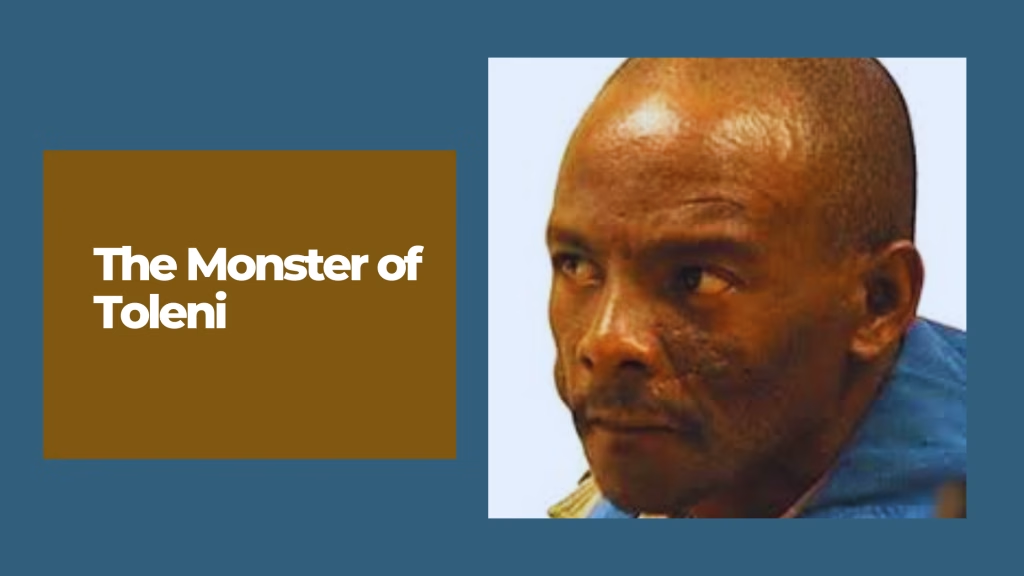
Twenty-three people died before police finally caught the killer. His name was Bulelani Mabhayi, and the village knew him well. He’d worked on many of their homes, plastering walls and fixing roofs. He was quiet, polite, and helpful. Nobody suspected him.
How did the Monster of Toleni hide in plain sight for so long? And why did it take five years to stop him?
Growing Up Without a Home
Bulelani Mabhayi was born in 1974 in South Africa. His childhood began to fall apart when he was just twelve years old. His father died that year. One year later, his mother died too.
Losing both parents before becoming a teenager changes a person. Bulelani and his siblings went to live with their grandmother in Toleni. Later, he spent some time with another grandmother in Gcuwa township near Butterworth.
People who knew young Bulelani described him as a pleasant child. Nothing about him stood out as particularly troubling. But something was building inside him that nobody could see.
At some point during his time in Toleni, Bulelani got arrested for dealing dagga (marijuana). He spent three years in Pollsmoor Prison in Cape Town. When he got out, he returned to Toleni.
The Man Who Ate Alone
Back in the village, locals started calling Bulelani “Gwala Dwa,” which means “the man who eats alone.” He would sit by himself, smoking his pipe and having meals in isolation. He never attended family events, ceremonies, or even funerals.
His aunt later said he loved children and often spent time with her grandchildren. Most people described him as humble and respectful. But some felt uneasy when they looked at him. They couldn’t explain why, just that something felt off.
Bulelani lived with his brother, Siabonga, for a while, but things turned bad between them. Bulelani claimed his brother tormented him, though he never explained what that meant. According to family members, Siabonga had a short temper and wouldn’t hesitate to stab someone if they made him angry, even in front of witnesses.
Some sources say Siabonga later got sentenced to life in prison for murder, though this couldn’t be confirmed.
Bulelani’s family gave him corrugated metal sheets to build a shack on their property. He lived there and worked odd jobs, plastering houses around the village. Then he suddenly left, claiming his brother was tormenting him again.
Weeks later, people spotted him in nearby Butterworth, eating from garbage bins. The village tried multiple times to convince him to return. He was incredibly useful to have around. He could do cement work, plastering, and bricklaying, and his prices were excellent.
Eventually, Bulelani came back. In February 2012, he moved into a rondavel (traditional round hut) next to Nokwaka Castle’s family home.
Nobody knew they’d just welcomed a serial killer into their neighborhood.
Life in a Village Where Everyone Knows Everyone
To understand how Bulelani got away with murder for so long, you need to understand life in Toleni.
The village sits along the N2 freeway, about 15 kilometers from Butterworth, positioned between East London and Mthatha. Cattle, sheep, and goats graze on the vegetation. Houses dot the landscape between rolling plains and valleys.
Everyone knows everyone in villages like this. Strangers stick out immediately. Life moves differently here, shaped by deep cultural beliefs and traditions.
One of the main principles in Toleni is minding your own business. There had always been petty crime, but things got worse when more taverns and bars opened. Access to alcohol increased, and so did serious crimes like murder and sexual assault.
People noticed the rising violence, but they kept to themselves. You didn’t interfere in other people’s affairs. You stayed out of trouble by staying quiet.
This culture of silence created the perfect hunting ground for the Monster of Toleni.
The Killing Begins
Bulelani Mabhayi committed his first murder in May 2007. He broke into the home of 78-year-old Nofenishi Esleana Mayekiso. She wasn’t having it. When she saw an intruder in her house, she grabbed an axe and attacked him.
Bulelani ran off because he was unarmed. But he came back later with his own axe. He raped the elderly woman, then hacked her to death.
For the next several months, he stayed quiet. Then in 2008, the screams came from the tavern. Mrs. Mavumane was dead, hacked to pieces with an axe.
By the end of 2008, four more victims had been discovered: Madison, Zenplay, Lazola Mafika, and another woman whose name was never recorded in any reports.
Police didn’t connect these deaths. Different officers investigated each case separately, with different theories about motives. Nobody realized a serial killer was hunting in Toleni.
The Pattern Emerges
By 2009, ten people were dead: six women and four children. All of them had been killed the same way, hacked to death with extreme violence.
Two of the victims were 69-year-old Tombomzi and her granddaughter, Nunalua. Another two were Nochakri and her daughter, Sifumolo Nogaya. Many had been sexually assaulted before dying.
Bulelani watched his neighbors carefully. He paid special attention to houses where he’d done work. He only approached homes where no men lived, or where the men were away. He made sure only women and sometimes their grandchildren would be inside.
In South Africa, it’s common for young children to live with their grandparents in rural villages. Sometimes their parents have died. More often, the parents work in big cities and can’t afford to bring their children with them. Housing is scarce, income is tight, and time is limited. So grandparents raise the children while parents work far away.
Bulelani targeted these vulnerable households. He knew exactly who lived where and when they’d be alone.
A Grandmother Hears Nothing
In 2010, Bulelani struck the Mbeki household. Mrs. Nondwe Mbeki lived with her daughter, Senatso Pamela, and two grandchildren: two-year-old Gama and six-year-old Kazimla.
The toddler kept irregular hours, waking up throughout the night. So when Mrs. Mbeki heard footsteps around midnight, she didn’t think much of it. She assumed it was her daughter dealing with the little one. She went back to sleep.
The next morning, she went to the kitchen to boil water. She noticed the kitchen door was open. So was the door to the room where her grandchildren slept.
Mrs. Mbeki immediately entered the room. She found her daughter, Senatso’s body, sprawled across the doorway. Then she discovered both grandchildren, lifeless.
All three had been hacked to death. Mrs. Mbeki had heard nothing. Not one scream. Not one struggle. Nothing.
How was that possible?
The Investigation Finally Connects the Dots
Over three years, sixteen women and children had been murdered in the upper part of Toleni village. Media coverage was minimal. Since police treated each case separately, nobody realized the full scope of what was happening.
After the Mbeki family murders, the Organized Crime Unit from East London finally got assigned to the case. Captain Batandwa Aaron Hanise led the investigation. Toleni was his hometown, and he was determined to catch this killer.
The Investigative Psychology Unit from Pretoria sent Lieutenant Colonel Ian Delang to help. He created a matrix analyzing all sixteen cases, looking for connections between the different murders.
They quickly discovered patterns. The murders almost always happened on Sundays. The killer had to be local because strangers would be noticed immediately in such a small village. The killer always closed doors behind them, making homes look empty so neighbors wouldn’t get suspicious.
Every victim had injuries to the left side of the head. The murder weapon was always an axe or a large knife. Victims were brutally killed, and many were sexually assaulted, regardless of age.
The profile became clear: they were looking for a local male, a single person acting alone.
Police offered a reward of 250,000 rand (about $17,000) for information leading to the killer’s arrest. Nobody came forward. The money went unclaimed.
Women Take Protection Into Their Own Hands
With police making no progress and fear gripping the village, women armed themselves. They gathered machetes and other weapons to defend against this unknown attacker.
One woman, Nonfundiso, offered her home as a haven. She already had burglar bars installed, making it safer than most houses. Women too scared to sleep alone at night came to stay with her. Because of the intense fear surrounding men and the trauma so many women carried, they didn’t allow any men near this crisis center.
Community patrols increased. Police presence grew. Then 2011 passed quietly with no murders.
The community breathed a sigh of relief. Maybe it was finally over.
They were wrong. Bulelani simply hadn’t been in the area for most of 2011. When he returned just before 2012, the killing started again.
DNA Evidence Points to One Killer
Forensic testing was done on DNA samples from all the victims. Investigators found semen on several bodies. The youngest victim with DNA evidence was only eight years old. The oldest was 83-year-old Gogoshe Michelle Thompson.
Six samples matched each other. The same man had attacked at least six different victims.
The only way to catch him was to test DNA from every man in the area. On May 17, 2012, Operation Good Hope began. Police units surrounded and cordoned off Toleni. Every man and boy over sixteen years old had to give a DNA sample.
They collected 340 samples total. Bulelani Mabhayi was one of them.
He couldn’t give fingerprints that day because he didn’t have his ID book with him. Nobody thought much of it. The samples went to the lab for processing.
But DNA testing in South Africa has massive backlogs. Low-profile cases take even longer to process. Cases from a small rural Eastern Cape village? Those could take months or years.
While police waited for results, Bulelani kept killing.
The Baby Who Became His Youngest Victim
On May 28, 2012, Bulelani attacked the Mnyalua household. Grandmother Nomandla lived with four grandchildren between fifteen months and thirteen years old.
The fifteen-month-old baby became Bulelani’s youngest victim. Two children survived: a twelve-year-old boy left severely brain-damaged from his injuries, and a three-year-old girl who’d been sleeping in a pile of blankets next to the bed. Bulelani missed her completely.
Thirteen-year-old Lusano was found outside, sexually assaulted and dead.
The aunt lived in a home just meters away. She heard nothing during the night. No screams, no strange sounds, nothing.
Nolau, the mother of baby Liama, who’d left him with his grandmother for the night, returned the next day to pure horror. She later said about her mother, “She was everything to m,e and I was everything to her.”
How could one man control multiple victims in different rooms without anyone screaming? The community became convinced there had to be more than one killer. How else could you explain the silence?
The Boot Print That Ended Everything
In August 2012, 55-year-old Nomphome Florence Lubambo lived with her grandchild. Because of everything happening in the village, she’d asked her nephew to stay with them for extra protection.
One night, her granddaughter was playing at a neighbor’s house. She had such a good time that she ended up spending the night there instead of coming home.
The next morning, Lubambo’s nephew was heading to the bathroom when he noticed a broken window. He immediately knew something was wrong. He called a neighbor, and the men approached the house together.
Inside, they found Mrs. Lubambo’s body covered with a comforter.
When Captain Hanise arrived at the scene, he noticed something important. A light bulb had been removed from the room. On the coffee table below it was a large footprint.
The community thought they knew who’d done it: Siabonga Mabhayi, Bulelani’s brother. He lived just 100 meters from the crime scene and was known for violence.
Police went to Siabonga’s residence. He wasn’t there. But Bulelani was.
They found him sitting in his room. Leaning against his wardrobe was an axe with blood on it. In the dustbin were pairs of used disposable rubber gloves.
Police took one of Bulelani’s work boots back to the crime scene just meters away. It was a perfect match for the print on the coffee table.
They asked about the blood on the axe. Bulelani said calmly, “This is Mrs. Lubambo’s blood. It was me who killed her.”
On August 12, 2012, after a five-year killing spree, the Monster of Toleni was finally arrested.
The Confessions Keep Coming
Not one person in the community suspected Bulelani. When police arrested him, people thought they had the wrong man. He was so quiet, so helpful, so normal.
But the DNA didn’t lie. Bulelani was number 336 of the 339 males tested. His DNA matched samples from multiple crime scenes.
Once the match was confirmed, Bulelani started confessing. He told police about his habits, how he watched and chose his victims. He went beyond the nineteen cases police were investigating, admitting to more murders they didn’t even know about.
He took the police to the Halaso homestead just outside Toleni. He’d been working on their home, plastering walls. He’d deliberately left bricks missing in the structure. When he returned after dark, he simply removed the bricks and climbed inside.
He made his way to the bedroom where Mrs. Halaso and her grandchildren slept. He murdered all three of them. Then he set fire to the house using their paraffin stove, burning the bodies.
Police had only investigated that incident as arson. They never knew it was murder.
Bulelani told them about another woman he’d met while traveling. He said they’d had consensual sex. He told her he loved her. Then he killed her anyway and buried her body. He took the police to the burial site.
Altogether, Bulelani Mabhayi had murdered 23 innocent people.
When asked why, he never gave a real answer.
Standing Trial Without Remorse
At Butterworth Magistrates Court, the families of victims finally came face to face with the man who’d taken their loved ones.
During his arrest and trial, Bulelani’s aunt maintained she wouldn’t see him at first. She felt visiting him would disrespect the victims’ families and add to their suffering. But she eventually realized she couldn’t turn her back on someone she’d raised as her own child. She was stuck between loyalty to family and horror at what he’d done.
Bulelani, 39 years old at the time, pleaded guilty to all 36 charges: murdering fourteen women and nine children.
While listening to the charges read aloud, Bulelani frowned slightly while chewing his lip. He looked off into the distance, appearing disinterested and detached from the whole proceeding.
He received 25 life sentences to run concurrently. According to South African law, he’ll be eligible for parole in 25 years.
High Court Judge Nolutando Kondra said, “Between 2007 and 2012, the community of Toleni lived in fear because a predator was living among them. It mattered not how young the victim was. No one was spared. It’s not clear how you were able to escape capture for such a long time.”
When asked if he regretted what he did, Bulelani said yes. He went on to elaborate: “Even to the people of Toleni and the citizens of South Africa, I would like to apologize, and I am very sorry for what I did.”
His words lacked any real remorse or sincerity. Right after that “heartfelt” apology, he added that if police hadn’t caught him, he would still be killing.
His family, especially his aunt, continues to feel the impact of his crimes. But Bulelani showed no real understanding of the pain he’d caused.
Was He Really Alone?
Even though Bulelani sits behind bars, his actions are still burned into the fabric of Toleni society. The community refuses to believe he acted alone.
Many think someone else helped him. How else could one man control multiple victims in different rooms without anyone screaming? How did he move through homes so silently that people sleeping meters away heard nothing?
When Bulelani testified in court, he always used the word “we” when answering questions. People wondered: Who is this “we” he’s referring to?
Many suspected his brother Siabonga played a role, given his violent history. But police ruled out his involvement. Siabonga died later in 2012.
Here’s something even more disturbing: since 2014, four teenage girls have gone missing from villages near Butterworth. Three were found dead. The fourth, 18-year-old Lutando Macabane, has been missing since June 1, 2018.
Is it truly over? Or is someone else still out there?
Understanding the Mind of a Monster
After his arrest, police sent Bulelani to Fort England Psychiatric Hospital in Grahamstown for evaluation. Doctors declared him fit to stand trial.
But looking at his behavior and actions, Bulelani clearly showed many traits of antisocial personality disorder, previously known as psychopathy. Not everyone with this disorder becomes violent, but Bulelani’s case was severe.
He showed a complete lack of empathy and regard for human life. Yet in court, he claimed he had value to society because “I have learned from this experience and what I was doing was not right and unacceptable.” In the next breath, he confirmed he had no respect for human life.
His actions were carefully planned and thought out. He was excellent at hiding his true self. Nobody suspected him in his small community. They valued his skills and liked him as a person.
But people also described him as a loner who never socialized. This was odd for someone in his thirties. In his community, people expected him to have his own family by that age. Maybe he tried and failed. That failure and loneliness could have triggered the murders. Or maybe he never wanted a family to begin with.
The only mention of a relationship was the woman he claimed to have loved before killing her. Whether he told the truth about loving her is questionable.
What’s clear is that Bulelani’s goal, like many serial killers before him, was to regain power and control. Sexual assault and murder of vulnerable people always involve power dynamics. His victims were either much older or much younger than him, and always female.
No matter how many lives he took, he couldn’t satisfy his desire for power and control.
The court noted that “Bulelani does not appear to appreciate the enormity of his actions. He appears to lack insight into the seriousness of his actions. In fact, the accused, by his own admission, stated that had he not been caught, he would have continued killing. It becomes doubtful, therefore, if there is any chance of rehabilitation.”
The only reason he offered for why so many had to die was that his victims would be able to identify him. But what about the fifteen-month-old baby? When asked about killing an infant, he said, “I killed the child because I was driven by an evil spirit.”
The Cultural Perspective
Two traditional healers from the Eastern Cape believed Bulelani suffered from what’s called “ukuthwasa,” a spiritual illness.
In Western psychology, mental illness is seen as a biological disease of the brain. In African traditional practice, some disorders are believed to have spiritual roots.
Read more: THE BEAST OF BIRKENSHAW: Peter Manuel
The traditionalists believed Bulelani continued his killing spree because he was never cleansed through a traditional ceremony after his first murder. They say a person who isn’t cleansed will kill again in the same month of different years. They pointed to the fact that murders happened in January and May of different years as proof.
We can’t know Bulelani’s true motives. But we can discuss with certainty how this case was handled by the police and media.
Or rather, how it wasn’t handled.
The Silence That Let Him Kill
Finding information about this case was incredibly difficult. There was barely any news coverage. This was one of South Africa’s top five most prolific serial killers, yet the media stayed mostly silent.
Why?
The answer isn’t pleasant, but it must be faced. There seems to be little value placed on poor Black lives, not just by media outlets but by South African government organizations.
Crime happens constantly in these areas, and it’s not taken seriously. It took five years and pure luck (a boot print) to catch Bulelani. Even after police collected DNA samples, it took months of delays. More innocent people died, including a baby, before the killer was caught.
The system failed these victims over and over again.
Human life should be valued equally regardless of color, culture, or economic status. Every crime victim has someone in the world who loves them. Their lives matter.
Finding the names of all the victims was nearly impossible. Many sources didn’t even record them. No innocent person deserves to lose their life this way and simply be forgotten, reduced to just another number, just another statistic.
No child deserves that pain and suffering.
The only comfort that can be taken from this whole situation is that the Monster of Toleni sits behind bars and cannot harm anyone else.
But the question remains: was he really the only one involved?
Remembering the Victims
In March 2018, just months before Lutando Macabane went missing, the government unveiled a large tombstone in Toleni. It features the names of all Bulelani’s victims.
But is that enough? In a small village like so many others in South Africa, residents feel forgotten by the government, by the media, by the world.
The victims of Bulelani Mabhayi deserve to be remembered. They were mothers and grandmothers, children with whole lives ahead of them, people who mattered to their families and communities.
Their names should be known:
- Nofenishi Esleana Mayekiso, 78
- Mrs. Mavumane
- Madison
- Zenplay
- Lazola Mafika
- Tombomzi, 69, and granddaughter Nunalua
- Nochakri and daughter Sifumolo Nogaya
- Nondwe Mbeki
- Senatso Pamela Mbeki
- Gama Mbeki, 2
- Kazimla Mbeki, 6
- Nomandla Mnyalua
- Baby Liama Mnyalua, 15 months
- Lusano Mnyalua, 13
- Nomphome Florence Lubambo, 55
- Mrs. Halaso and her two grandchildren
- An unnamed woman he met while traveling
- Four additional victims whose names were never recorded
These weren’t just statistics. They were real people whose lives were stolen by the Monster of Toleni.
Although Bulelani Mabhayi is behind bars, the effects of his actions are felt daily by the families he destroyed. Even his own family lives with the shame and pain of what he did.
In a province so beautiful, such evil occurred. We cannot change what happened, but we can use this story as a reminder that every life is precious.
Every life matters.
What aspect of this case do you find most disturbing? Do you think Bulelani acted alone, or was someone helping him? Share your thoughts in the comments below.