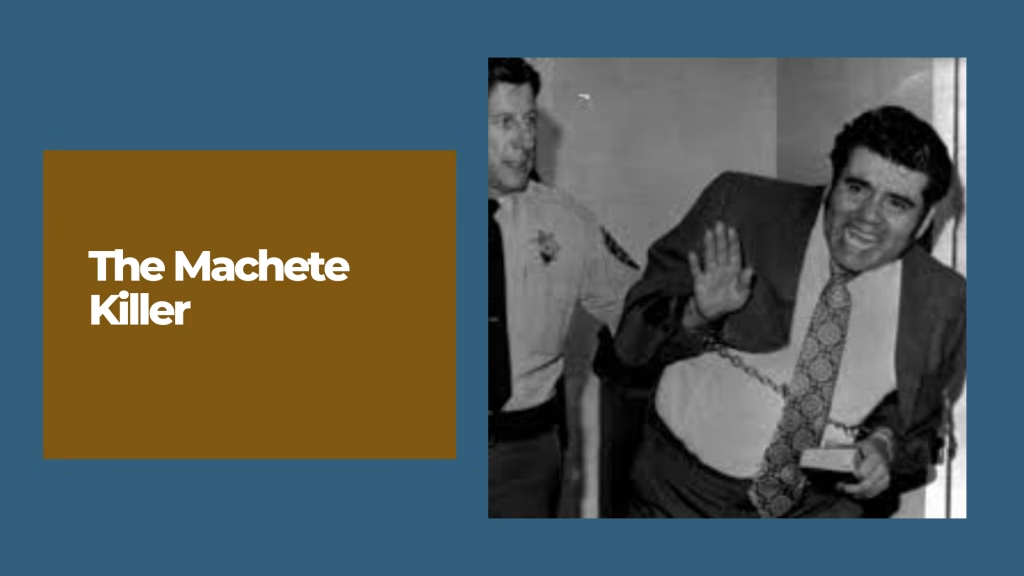
On May 19, 1971, Japanese farmer Goro Kagehiro discovered a freshly dug hole in the middle of his peach orchard at the Johnson Ranch in Sutter County, California, about five kilometers north of Yuba City.
There was nothing inside, but the discovery left him puzzled. He asked a crew of workers who were harvesting fruit nearby. None of them knew who had dug the hole.
That same night, Kagehiro decided to examine the area again. He discovered that someone had covered the hole with dirt.
In rural areas, some people have a habit of burying trash on other people’s property. But Kagehiro had a bad feeling about this. He called the police.
A pair of officers arrived in the early morning hours. After digging into what they thought was an illegal trash dump, they found the body of a man. He would later be identified as 40-year-old Kenneth Whitacre.
The body showed large wounds to the head, face, and chest, apparently produced by a machete. Among his clothes, officers found a homosexual erotic magazine, which made police suspect he’d been the victim of a homophobic attack.
At the scene, they found tire tracks but nothing else that could help the investigation.
The autopsy confirmed the victim died from his injuries. What caught attention was the enormous number of lacerations, two of which formed a kind of cross on the back of his neck.
Five days later, on May 24, police received another call. This time, from Jose Ramirez, a foreman at the Sullivan Ranch, regarding a hole covered with dirt that his employees had found while operating a tractor.
Ramirez and the rest of the workers were aware of the discovery on May 19 and didn’t hesitate to notify authorities. The Sullivan Ranch was just minutes from where officers had found Kenneth Whitacre’s body four days earlier at the Johnson Ranch.
When they dug into the earth, they found the body of a second victim: 67-year-old Charles Fleming, who also appeared to have been brutally murdered with machete blows.
This time, authorities decided to carefully review the scene. Near the location, they discovered several holes covered with dirt. The possibility that all of them contained more bodies was terrifying.
They didn’t take long to find a third body, destroyed. Next to it, they found a pair of receipts signed on May 21 by Juan Vallejo Corona, a 37-year-old Mexican immigrant who worked as a contractor and administrator for day laborers working at both ranches.
They decided to keep digging until they found six more bodies, plus another pair of receipts in Juan Corona’s name.
Finally, the sheriff gave the order to arrest the suspect.
Corona would be arrested by police on May 26 while human remains continued to be recovered from the Sullivan and Johnson ranches and surrounding orchards.
By June 4, when the excavations concluded, the total body count was 25.
This became one of the most abominable criminal cases in United States history.
Who Was Juan Corona?
Juan Vallejo Corona was born on February 7, 1934, in Autlán, Jalisco, Mexico. There’s no information about his childhood or family life beyond the fact that in 1950, at age 16, he emigrated to the United States in search of the traditional American Dream, as his half-brother Natividad Corona had done six years earlier.
Natividad was 11 years older than Juan.
Juan worked as a farm laborer for several years in California until he moved to Marysville in Yuba City with his half-brother. At age 19, he met a girl and got married, but the relationship lasted little more than three months before they divorced.
Read more: The Motorcycle Killer: Tiago Gomes da Rocha
The Flood That Changed Everything
Between December 23 and 24, 1955, a natural disaster marked the history of Yuba City. After two weeks of heavy rain, massive flooding occurred when the Feather River overflowed and destroyed about 300 houses, leaving 38 dead.
Thousands of people had to be evacuated, including Juan Corona. After the tragedy, he suffered a severe nervous breakdown.
He read the Bible compulsively and claimed that the ghosts of those who died in the flood spoke to him and pursued him. This began to worry his half-brother, who, in January 1956, managed to get him admitted to DeWitt State Hospital in Auburn, California.
There, at age 22, Juan was diagnosed with paranoid schizophrenia.
He underwent electroshock therapy for 23 sessions without any type of anesthesia. Three months later, he was deported to Mexico.
Although he stopped having hallucinations, during casual conversations with acquaintances, he would sometimes claim to be “sick in the head” or thinking “strange things.”
In 1960, at age 26, he married again, this time to a woman named Gloria Moreno. They would eventually have four daughters. In 1962, he returned to the United States seeking a better future for his family.
Corona was a punctual and orderly man, so he got a job as a labor contractor. He could provide groups of workers to the Johnson and Sullivan ranches between 1966 and 1969.
The Attack at the Guadalajara Café
However, on February 25, 1970, a horrible event occurred at the Guadalajara Café, a bar owned by Juan’s half-brother, Natividad Corona.
Around one in the morning, a customer entered one of the bathrooms and found a man lying on the floor in a huge pool of blood. His name was Jose Romero Raya, and he’d apparently been attacked with a machete.
His lips were torn from his mouth. Half his scalp was missing. His skull was fractured in three places.
Natividad Corona called the police. The man survived despite being completely disfigured and suffering brain damage.
According to his testimony, he couldn’t see his attacker. But his lawyers initiated a lawsuit against the bar owner. Natividad was forced to sell his business and flee.
That night, both Natividad Corona and his half-brother, Juan, were at the tavern.
Natividad Corona was described as a violent man who was openly homosexual. There was no proof, but many suspected that perhaps he’d tried to seduce Romero and, when met with a refusal, attacked him out of spite.
One month later, Juan Corona was admitted for a brief period to a psychiatric hospital due to another crisis. It was after this discharge that he supposedly began murdering his victims.
The Discovery of 25 Bodies
The bodies discovered in May 1971 painted a horrifying picture. Most victims were men between 40 and 67 years old, homeless people without close family members who were looking for sporadic jobs.
It was precisely Corona who hired them, recruiting them from the town’s taverns. Since they weren’t permanent employees, nobody questioned if they missed work or disappeared.
The autopsies revealed that all were murdered with a machete. The wounds concentrated on the face, head, and chest. Among all of them stood out a deep cut in the shape of a cross on the back of the neck and a stab wound to the sternum that the killer made to finish them off.
They also had defensive wounds on their hands, some of which had been amputated during the attack. In only one case could it be proven that the victim had received a gunshot to the head.
The bodies were found in shallow graves with arms extended over the head, shirt lifted over the face, pants below the knees, and genitals exposed. This led experts to suspect these were crimes of a sexual nature and that the victims had been abused.
Several witnesses claimed to have seen the victims for the last time talking with Corona or inside his truck. Officers found several blood stains in the vehicle.
Despite all this, Corona claimed he was completely innocent.
The Evidence Against Him
Officers who searched Corona’s house and office found a machete, a club, a shovel, a double-edged axe, a pair of knives, and a pistol with ammunition.
They also discovered an accounting book that included several dates and a list of 34 worker names. Seven of these names belonged to men found in the graves.
The autopsies proved that the victims died consecutively over a period of six weeks, averaging one murder every seven days.
Some police officers declared to the media that they’d already arrested the person responsible. But these were serious accusations that only complicated the case, especially because the suspect hadn’t confessed to the crimes and the evidence was circumstantial.
Even the person in charge of directing the investigation, Sheriff Roy Whiteaker, called a press conference and blamed Corona before a trial was held. This would bring several criticisms to his management.
At the same time, many people who knew Corona, while considering him a bit quiet and bad-tempered, never described him as a violent person. He was hardworking, married, had four daughters, and attended church every Sunday.
There was also no history of his being homosexual, which complicated the prosecution’s intention to accuse him of crimes of a sexual nature.
Although everything indicated Corona was responsible, doubt gradually began to settle around his guilt.
The Trial
The trial began on September 11, 1972, in Solano County, just months after the death penalty was abolished in the state of California. Juan Corona was accused of a total of 25 first-degree murders.
Several journalists of the era described the trial as long, tedious, and poorly planned by both the prosecution and the defense.
The prosecution not only presented circumstantial evidence but also incomplete information.
For example, on May 24 and 25, while bodies were being recovered, Corona was hanging around the area, just like several of the workers. The prosecution, some witnesses, and police officers estimated that this attitude was suspicious.
Corona knew all the workers at the Johnson and Sullivan ranches because he dealt with them daily. It wasn’t strange for them to accompany him in his truck from one place to another.
That vehicle seemed to be a key piece of the investigation, but its tires didn’t match the marks found in the mud near the first grave discovered.
The blood stains police found inside turned out to be from a worker injured while doing agricultural work, whom Corona himself had transported to a hospital.
At the accused’s house, they found a machete about 45 centimeters long that, in theory, would be the murder weapon. However, it didn’t have a single trace of blood.
While all the bodies showed large wounds made with a machete, one of the victims appeared to have died from a gunshot to the head. When the bullet was compared with Corona’s pistol, there were no matches.
Perhaps the most suspicious thing was that on several of the bodies, receipts signed by Corona were found, and many of these people were last seen with him. Still, this wasn’t enough to accuse him of murder.
On the other hand, the defense attorney didn’t bring Corona to the stand, didn’t request witnesses, and didn’t use psychiatric history or specialist advice to plead insanity. He simply limited himself to denying the accused’s participation in the events.
At the same time, dozens of people held peaceful protests outside the Fairfield courthouse in Solano, requesting Juan Corona’s release. Many of them were part of California’s Latino community, especially Mexicans, who accused the authorities of racism.
The Verdict and Aftermath
On January 18, 1973, Juan Corona was found guilty of all 25 murders and sentenced to life in prison. Meanwhile, his lawyer Richard Hawk profited by publishing a book about the case.
During the process, Corona suffered at least two heart attacks. He was first sent to the Vacaville Medical Center in California.
That same year, he was attacked with razors by four inmates who stabbed him 32 times in the face and tore out one eye. He was on the verge of death but managed to survive. He was transferred to the Correctional Training Center in Soledad, California.
In May 1978, authorities accepted an appeal in Juan Corona’s case due to the negligence and incompetence shown by his lawyer.
The new defense suggested that the real killer had been Natividad Corona and that he’d tried to frame his half-brother by planting false clues. However, the thesis was dismissed by the jury.
Natividad had settled in Mexico for a long period, and according to the prosecution, he couldn’t be in California during the period when the murders were committed.
Juan Corona was again found guilty of all charges and sentenced to 25 consecutive life sentences on September 23, 1982.
In 1992, he was transferred to Corcoran State Prison. He made a total of eight appeals, all of which were rejected.
According to available information, in the appeal made in 2011, Corona admitted to being the author of the murders. He confessed to a psychiatrist that he’d killed them because they were “demented subjects who had illegally entered the lands.”
By then, Corona’s health had deteriorated, and he suffered from senile dementia.
He died at age 85 on March 4, 2019, from natural causes.
The Unanswered Questions
Some specialists believe Juan Corona committed at least 34 murders, while others think the real person responsible could have been his half-brother, Natividad Corona.
The truth may never be fully known.
What we do know is that 25 men lost their lives in the peach orchards of Sutter County in 1971. Most were migrant workers, homeless men looking for day labor, people society had forgotten about.
They were:
- Kenneth Whitacre, 40
- Charles Fleming, 67
- And 23 others whose names deserve to be remembered
These weren’t just statistics. They were human beings with lives, hopes, and dreams. They came to California looking for work, for a chance at a better life. Instead, they found a brutal death and shallow graves in peach orchards.
A Dark Chapter in California History
In 1973, while Juan Corona’s trial was underway, a 33-year-old man named Dean Corll was found dead inside his property in Pasadena, Texas. After a long police investigation, it was discovered he was responsible for at least 27 murders, surpassing Corona’s count.
Five years later, John Wayne Gacy broke the macabre record again, being accused of 33 murders.
By then, the phenomenon of serial killers was already being studied and documented by a group of FBI agents led by Robert Ressler and John Douglas. Their contributions would prove invaluable for identification, profiling, and strategies to capture these killers.
The case of Juan Corona represents a dark chapter in California’s history. Whether he acted alone or whether his half-brother was involved remains a subject of debate.
What’s undeniable is that 25 vulnerable men were brutally murdered, their bodies buried in shallow graves across farmland, and for weeks, nobody noticed they were missing because they were exactly the kind of people society tends to overlook.
The Machete Killer case reminds us that the most vulnerable among us deserve protection and that their lives matter just as much as anyone else’s.