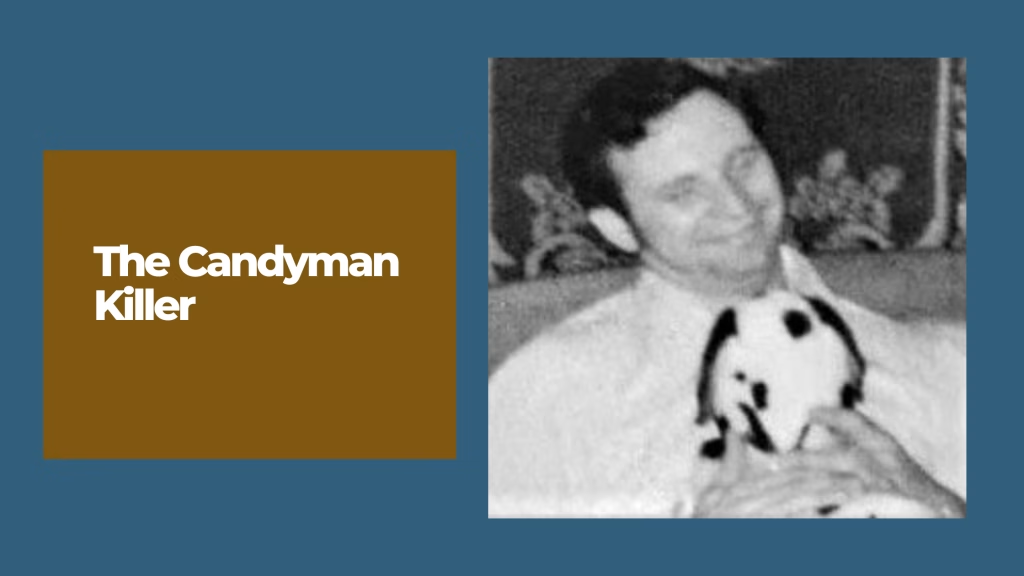
On August 8, 1973, police arrived at 2020 Lamar Drive in Pasadena, Texas, responding to a shooting. What they discovered inside that house would expose one of the most horrific serial murder cases in American history and reveal catastrophic failures in how missing children were treated by law enforcement.
The victim was 33-year-old Dean Corll, shot six times by 17-year-old Wayne Henley. But Corll wasn’t an innocent victim. He was a serial killer who had murdered at least 28 young people over three years, possibly many more.
What makes this case particularly disturbing isn’t just the number of victims. It’s that parents had been reporting their children missing for years. Police had been given leads, names, and evidence. Yet nothing was done until it was far too late.
This is the story of the Houston Mass Murders and the systemic failures that allowed them to continue.
The Man Behind the Candy Factory
Dean Arnold Corll was born on December 24, 1939, in Fort Wayne, Indiana, to Mary Emma and Arnold Edwin Corll. His childhood appeared relatively normal by the standards of the time, though his parents divorced when he was six years old.
What shaped Dean Corll’s path to becoming a killer remains unclear. Unlike many serial killers, there’s no documented history of severe childhood abuse or trauma. His mother, Mary, later insisted his upbringing was happy and normal, though psychologists question whether she missed warning signs or chose not to see them.
In the 1950s, the Corll family moved to Vidor, Texas, where Mary started a small candy-making business with her new husband, Jake West. They harvested pecans and made pralines, eventually expanding to other confections. The business grew successful enough that by 1958, they’d moved to Houston and opened a shop and factory under the name Pecan Prince.
Dean worked at the candy factory, and that’s where he earned his nickname: the Candyman.
Building Trust in the Community
In Houston Heights, Dean Corll became known as a friendly, generous man who gave free candy to local children. He’d hand out samples near schools and invite neighbourhood kids to use the pool table at the back of his factory.
To parents in the early 1960s, this seemed innocent. Corll worked at a candy factory. Of course, he’d give candy to kids. He seemed like a nice, quiet man who enjoyed helping young people.
Nobody suspected anything sinister. This was before “stranger danger” became part of the cultural conversation. The idea that a friendly local businessman might be a predator simply wasn’t on people’s radar.
Only Corll’s stepfather, Jake West, expressed concern, observing how Corll behaved around teenage boys. He told Mary he thought Dean might be gay. Mary dismissed the suggestion entirely, insisting her son was “a loyal, obedient, loving, and good normal boy.”
The one adult who noticed something wrong was ignored.
The Victims: Young Lives Cut Short
Between 1970 and 1973, at least 28 young people were murdered by Dean Corll. The actual number is likely much higher, possibly exceeding 40 or even more.
Most victims were teenage boys between 13 and 20 years old. Many came from working-class families. Some had gotten into minor trouble with the law. Others were excellent students with promising futures.
What they all had in common was that they trusted Dean Corll, or they trusted the teenage boys who lured them to him.
Read more: Alexander Pichushkin: The Chessboard Killer
The First Known Victim
Jeffrey Konen, 18, was a University of Texas student hitchhiking home to Houston on September 25, 1970. A friendly stranger offered him a ride. Jeffrey was never seen alive again.
His body was found three days later at High Island Beach, wrapped in plastic sheeting, covered with lime, with a boulder pushed on top of the shallow grave. He’d been bound, assaulted, and strangled.
This was the first victim police would later connect to Dean Corll, though he’d likely been killing for years before this.
James Glass and Danny Yates
On December 13, 1970, 14-year-olds James Glass and Danny Yates attended a religious rally at a church in Houston Heights. During the service, they simply vanished.
James’s father reported him missing immediately. Police told him James was probably a runaway because he’d once argued with his father about the length of his hair.
Danny’s father drove all the way to Monterrey, Mexico, following a dubious tip that Danny had been seen there.
Both boys had been murdered on the night they disappeared. Their bodies wouldn’t be found for nearly three years.
The Waldrop Brothers
On January 30, 1971, brothers Donald (15) and Jerry Waldrop (13) were walking to a bowling alley when they encountered someone they knew. They were taken to Corll’s apartment, where both were murdered.
Their father reported them missing. Police told him they were probably runaways.
When their father continued pushing for an investigation, trying for eight months to get police to take the disappearances seriously, he was told to “stop wasting police time.”
Imagine that. Your two sons have vanished, and the police tell you to stop bothering them about it.
David Hilligeist and Gregory Winkle
On May 29, 1971, 13-year-old David Hilligeist left home with his younger brothers to go swimming. He decided he was too embarrassed to go to the pool with little kids, so he went to get his friend, 16-year-old Gregory Winkle.
Both boys knew Dean Corll well. Gregory had worked at the Corll candy factory with his mother. David had hung out there regularly, playing pool.
When Corll invited them to his apartment, they had no reason to be afraid.
That night, Gregory’s mother, Selma, received a strange phone call. Gregory said he was in Freeport and would be swimming there. But Selma knew Gregory was familiar with Freeport. Why would he need to ask someone where he was?
She didn’t understand at the time that Corll was forcing Gregory to make the call, likely holding a weapon on him.
Both boys were murdered that night. David’s parents, Fred and Dorothy Hilligeist, searched desperately for their son. They hired a private investigator, spent their savings, went into debt, and papered Houston with missing persons flyers.
Dorothy even visited supposed psychics out of desperation, getting conflicting information that sent the family on wild goose chases to Dallas and New Orleans.
She did discover one real lead: Gregory had an older friend who owned a white van with the license plate TMF 724. She gave this information to the police.
Police did nothing with it.
If they had investigated, they would have discovered the van belonged to Dean Corll, a man who knew both missing boys. But the police weren’t investigating. As far as they were concerned, David and Gregory were just two more runaways.
The Victims Keep Coming
The murders continued month after month, year after year.
- Ruben Watson Haney, 17, disappeared after going to see a movie in August 1971
- Billy Baulch, 17, and Johnny Delome, 16, vanished in May 1972
- Steven Sickman, 17, went missing in July 1972
- Richard Hembree, 13, and Wally Simoneaux, 14, disappeared in October 1972
- Billy Lawrence, 15, told his father he was going on a fishing trip in June 1973
- Homer Garcia, 15, was last seen on July 7, 1973
- James Dreymala, 13, disappeared on August 3, 1973, while riding his yellow bicycle
Each name represents a young person with a family, with friends, with dreams and potential. Each disappearance devastated parents, siblings, and communities.
And in nearly every case, police classified them as runaways and refused to investigate.
The Accomplices: A Complicated Question
Dean Corll didn’t work alone. He had two teenage accomplices: David Brooks and Wayne Henley.
This is where the case becomes ethically complex.
David Brooks
David Brooks was 12 years old when he first met Dean Corll in 1967. Corll began giving him money and gifts. Their relationship became sexual when Brooks was 14, with Corll paying Brooks for sexual acts.
In September 1970, Brooks walked into Corll’s apartment and discovered him assaulting two teenage boys who were chained to a torture board. Instead of going to the police, Brooks accepted Corll’s offer: $200 for every teenage boy Brooks could bring to the apartment.
Brooks began luring victims. He was 15 years old.
Wayne Henley
Wayne Henley was 15 when he met Dean Corll in late 1971 through David Brooks. Henley came from a struggling family. His father was an alcoholic, his parents had divorced, and Henley was working odd jobs to help support his mother and siblings.
Corll presented the same offer to Henley: $200 per victim. Henley initially refused, but months later, when his family’s financial situation became desperate, he agreed.
Henley’s first victim was an unidentified boy he picked up in early 1972. From there, Henley became increasingly involved in the murders, eventually participating in torture and killing victims himself.
The Grooming Question
Both Brooks and Henley were children when they met Corll. Both were groomed over extended periods. Both were paid or given gifts. Both witnessed horrific violence.
But both also actively participated in luring victims who trusted them. Both participated in torture. Henley personally killed several victims.
The question that haunts this case: Were Brooks and Henley victims who were manipulated into becoming perpetrators, or were they willing participants who found something in themselves that aligned with Corll’s darkness?
Psychologists have debated this for decades. Both young men showed psychopathic traits when examined. Both claimed they were afraid of Corll and felt they had no choice. Yet both continued participating even when they had opportunities to escape or report him.
The truth is likely somewhere in the complicated middle. They were exploited and groomed as children. They were also responsible for the torture and deaths of other children.
The Catastrophic Police Failures
The most infuriating aspect of this case isn’t just that Dean Corll was a monster. It’s that he operated openly for years while police actively refused to investigate missing children.
“He’s Probably a Runaway”
This phrase appears again and again in this case. Parents would report their children missing, sometimes within hours of their disappearance. Police would immediately classify them as runaways and close the case.
The criteria for this classification were absurdly thin:
- James Glass had once argued with his father and stayed at a friend’s house overnight. Therefore, he must be a runaway.
- Danny Yates hung out at a house known to be frequented by troubled teens. Therefore, he must be a runaway.
- Billy Baulch and Johnny Delome received letters claiming they’d found jobs on a shipping route. Therefore, they must be runaways (even though one father knew no such shipping route existed).
Parents begged police to investigate. They were told to stop wasting police time.
Evidence Ignored
Dorothy Hilligeist gave police the license plate number of a suspicious white van connected to her missing son. Police never followed up.
When Ruben Haney disappeared, his mother told police he’d been arguing with a teenager named David Brooks over stolen stereo equipment. Police never questioned Brooks.
When Charles Cobble called his father, saying he was in serious trouble and needed $1,000 for ransom, the police told the father that no crime had been committed and refused to help.
When Maria Viricheva and Mikhail Lobov both survived attacks and reported them to police, giving detailed descriptions of their attacker, police dismissed both reports entirely.
The Class and Status Problem
Most of Corll’s victims came from working-class families. Many had long hair and dressed like hippies. Some had minor juvenile records for things like truancy or petty theft.
Police treated these missing children as disposable. The implicit message was clear: These kids don’t matter. They’re probably runaways. They’re troublemakers. Why should we waste resources looking for them?
Even when Billy Lawrence’s father reported his son missing and mentioned the suspicious phone call, police assumed Billy was telling the truth about going to Austin for work. The case was closed.
Only when Willard Branch Jr. disappeared and his father, a Houston police officer, tried to investigate did the department take any missing person case seriously. Even then, the officer died of a heart attack three weeks later from the stress, and the investigation stopped.
The Numbers Tell the Story
Between 1970 and 1973, dozens of teenage boys went missing in the Houston area, fitting the same victim profile. All from similar neighbourhoods. All within a relatively small geographic area. All young males between 13 and 20.
Any competent police force should have noticed the pattern. They should have connected the cases. They should have launched a task force.
Houston police did nothing.
When the murders finally came to light in August 1973, police discovered they’d been sitting on missing persons reports for 28 victims. They’d had leads, evidence, and witness statements. They’d ignored all of it.
August 8, 1973: The End Comes
By early August 1973, Dean Corll was planning to leave Houston. He’d told his mother he was moving to Colorado. Wayne Henley was talking about moving to Australia. David Brooks had a wife and a baby on the way.
The killing spree was winding down, not because police were close to catching them, but because the perpetrators were ready to move on with their lives.
On the evening of August 7, Wayne Henley brought 19-year-old Timothy Curley to Corll’s house for a party. They drank beer and huffed paint fumes. Around midnight, Curley said he was hungry and wanted to get food.
Corll and Henley preferred to wait until victims were more intoxicated before restraining them, so Henley and Curley left. They went to Henley’s house to grab food.
While there, they heard noise coming from down the street. They found 15-year-old Rhonda Williams, who’d been arguing with her father and was upset. Henley, high on beer and paint fumes, invited Rhonda to come party at Corll’s house.
When they arrived back at 2020 Lamar Drive around 3:00 AM with both Curley and Rhonda, Corll became angry. He muttered to Henley that bringing a girl “ruined everything.”
But then Corll’s mood seemed to change. He offered everyone beer and marijuana. He sat there watching as Henley, Curley, and Rhonda got more intoxicated. Corll didn’t partake. He just waited.
By 5:00 AM, all three teenagers had passed out.
The Final Confrontation
Corll stripped Timothy Curley and bound his hands and feet. He bound Wayne Henley and Rhonda Williams without removing their clothes. He gagged all three and wrapped tape around their mouths.
Then he waited for them to wake up.
Wayne Henley regained consciousness first. Corll removed his gag and said, “Man, you blew it bringing that girl. But I’m going to fix you now. I’m going to kill you all. But first I’m going to have my fun.”
Corll kicked Rhonda repeatedly in the chest and stomach, yelling at her to wake up. Then he shoved his gun in Henley’s face and dragged him to the kitchen.
For 30 minutes, Henley begged for his life. He reminded Corll of their friendship. He offered to help torture and kill Timothy and Rhonda if Corll would let him live.
Corll agreed.
He freed Henley and gave him a knife. He told Henley to cut away Rhonda’s clothes while he assaulted Timothy. Corll placed his gun on a bedside table and began attacking Timothy.
Henley deliberately took his time cutting Rhonda’s clothes. He cut away the tape around her mouth and removed her gag. Half-conscious, Rhonda asked, “Is this for real?”
“Yes,” Henley replied.
Rhonda asked the question that would save her life: “Are you going to do something about it?”
Years later, Henley said that moment hit him with massive remorse. Rhonda’s boyfriend, Frank Aguirre, had been one of Corll’s victims. Now Corll was trying to kill her, and she was looking to Henley, whom she trusted, to save her.
Henley grabbed the gun from the bedside table, pointed it at Corll, and shouted, “This has gone far enough, Dean! I can’t let you kill all of my friends!”
Corll looked at the gun and began walking toward Henley. “Kill me, Wayne,” he said simply.
Henley backed away. Corll kept coming. “You won’t do it,” Corll sneered.
Henley pulled the trigger.
The first shot hit Corll in the forehead but didn’t penetrate his skull. Corll kept coming. Henley fired twice more, hitting him in the shoulder and chest. Corll staggered but didn’t stop.
Henley fired three more times, hitting Corll in the shoulder and lower back. Finally, Corll slumped to the floor, turned his face to the wall, and died.
The Aftermath and Investigation
At 8:24 AM on August 8, 1973, Wayne Henley called the police: “You better come here right now. I just killed a man.”
When police arrived, Henley told them the body was inside. Officers found Dean Corll dead in a pool of blood. In the bedroom, they discovered a torture board, plastic sheeting, weapons, cords, handcuffs, and other instruments.
Henley was arrested and taken to the station for questioning. After describing that morning’s events, he began telling a much darker story.
He said Dean Corll had been torturing and murdering teenage boys for years. He said bodies were buried at a boat storage facility, at High Island Beach, and at Lake Sam Rayburn.
Officers were sceptical until they ran the names Henley provided. Every single one was a missing person.
That evening, police went to Southwest Boat Storage and began excavating. They found 17 bodies buried in the dirt floor of shed number 11.
Over the next several days, police excavated more sites based on information from Henley and Brooks. They found four more bodies at Lake Sam Rayburn and four at High Island Beach.
The final confirmed count was 27 bodies, though one more would be discovered years later, bringing the total to 28.
At the time, this was the highest death toll from serial killings in recorded American history.
The Families Finally Get Answers
For parents who’d been told their children were runaways, the discovery was devastating but also brought a horrible sense of closure.
Dorothy Hilligeist finally learned what happened to her son, David. The license plate she’d given police years earlier had been the right lead all along.
Selma Winkle learned why her son Gregory had made that strange phone call about Freeport.
The Waldrop family discovered that when police told them to “stop wasting our time,” both of their sons were already dead, buried in Corll’s boat shed.
Some families never got closure. Several bodies remain unidentified to this day. Billy Baulch’s body was never found, despite Henley claiming he was buried at High Island Beach.
The Trials and Aftermath
Wayne Henley went to trial in July 1974. He was convicted of six counts of murder and sentenced to 594 years in prison (99 years for each count).
David Brooks was tried in 1975 for the murder of Billy Lawrence. He was convicted and sentenced to 99 years.
Both claimed they’d been coerced by Corll and had no choice. The brutality of their actions, as described in their own confessions, undermined this defence.
Henley appealed, claiming the jury had been prejudiced by media coverage. He was granted a second trial in 1979. The verdict was upheld.
David Brooks died from COVID-19 in prison on May 28, 2020, at age 65.
Wayne Henley, now 68, remains imprisoned at the Mark Stiles Unit in Jefferson County, Texas. He is eligible for parole in October 2025.
Dean Corll’s Mother Never Accepted the Truth
Mary Corll maintained until her death that her son was innocent. She believed Henley and Brooks had committed all the murders and killed Dean when he discovered what they were doing.
She said, “He was not a sex maniac or sadist. The people who knew Dean, who worked with him, who raised him, will never believe these terrible accusations.”
This denial was likely the only way she could cope with the reality that her son was one of America’s worst serial killers.
What Changed After the Houston Mass Murders
The Houston Mass Murders exposed catastrophic failures in how law enforcement treated missing children, particularly those from working-class families or with any history of behavioural issues.
Policy Changes
The case led to significant changes in how missing persons cases are handled:
- The Runaway Classification – Police departments across the country were forced to reconsider their practice of immediately classifying missing children as runaways without investigation.
- Missing Children Databases – The case highlighted the need for better information sharing between jurisdictions. This eventually contributed to the creation of national missing children databases.
- Mandatory Investigation Protocols – Many departments implemented policies requiring initial investigation of all missing children reports, regardless of the child’s background or circumstances.
- Parent Advocacy – The case empowered parents to demand action when their children went missing, rather than accepting police dismissals.
Cultural Impact
The Houston Mass Murders shattered the innocence of an era. The friendly candy man giving out treats to neighbourhood kids became a symbol of hidden danger.
The case contributed to the rise of “stranger danger” education and increased parental supervision of children. Whether this was an overreaction is debatable, but the case certainly changed how American parents thought about their children’s safety.
The Unanswered Questions
Despite the arrests, trials, and convictions, many questions remain about the Houston Mass Murders.
How Many Victims Were There Really?
The official count is 28 confirmed victims. But several factors suggest the actual number is much higher:
- Henley insisted there were more bodies, but police stopped excavating after finding 27 at the primary sites
- Corll operated without accomplices for years before recruiting Brooks and Henley
- Witnesses reported seeing the trio burying bodies at Galveston Beach, but this site was never excavated
- The parking lot where Corll buried “defective candy” behind his factory has never been excavated
- The crawl space of a house where Corll lived in Indiana yielded a human femur in 2015
Some investigators believe the true victim count could exceed 40, possibly reaching as high as 100 if Corll was active from his late teens.
Were There Other Accomplices?
Evidence suggests Brooks and Henley may not have been Corll’s only accomplices:
- Multiple witnesses reported seeing Corll with different teenage boys at burial sites
- Billy Ridinger was allegedly involved in at least one incident, but was never charged
- The circumstances around certain murders suggest additional participants
The Trafficking Connection
Dean Corll told Wayne Henley he worked for a Dallas-based child trafficking ring. Henley thought this was a lie.
But in August 1973, around the time Corll’s murders came to light, investigators uncovered a Dallas-based trafficking network called the Odyssey Foundation. This operation involved thousands of victims and allegedly included wealthy clients, celebrities, and politicians.
A 1975 police raid in Houston connected to this network found pornographic photographs that included 11 of Corll’s victims.
John Wayne Gacy, another serial killer who murdered 33 young men, also had alleged connections to John David Norman, who ran the Odyssey Foundation.
Was Corll part of something larger? The evidence is circumstantial, but it raises disturbing questions about whether he was an isolated predator or connected to an organised network.
Lessons We Still Haven’t Learned
More than 50 years after the Houston Mass Murders, many of the systemic issues that allowed Dean Corll to operate remain problems today.
Missing children from marginalised communities still receive less attention and fewer resources than children from wealthy families. Runaways and homeless youth remain vulnerable to predators. Law enforcement agencies still struggle with information sharing and pattern recognition across jurisdictions.
The Houston Mass Murders should have been a watershed moment that fundamentally changed how we protect children. In some ways, it was. But in many ways, the same failures continue.
Remembering the Victims
It’s easy to get lost in the horror of this case, in the gruesome details and the staggering body count. But we must remember that these weren’t just statistics. They were real people with families who loved them.
They were boys who liked swimming and bowling, and going to the movies. They were students and workers. They had girlfriends and best friends. They had dreams about their futures.
Dean Corll took all of that away from them.
And for years, while their parents begged for help, police did nothing.
The victims of the Houston Mass Murders deserve to be remembered not just for how they died, but for the fact that they lived. They mattered. They still matter.
Their names should be remembered:
Jeffrey Konen, James Glass, Danny Yates, Donald Waldrop, Jerry Waldrop, David Hilligeist, Gregory Winkle, Randall Harvey, Ruben Watson Haney, Frank Aguirre, Steven Sickman, Roy Bunton, Billy Baulch, Johnny Delome, Wally Simoneaux, Richard Hembree, Willard Branch Jr., Richard Kepner, Joseph Lyles, Billy Lawrence, Homer Garcia, Charles Cobble, Marty Jones, James Dreymala, and three young men who remain unidentified to this day.
Twenty-eight confirmed lives lost. Possibly many more. Each one was a tragedy that could have been prevented if someone in authority had simply listened when parents said, “My child is missing. Please help me find them.”
Note: This case involves disturbing content related to violence against children. If you or someone you know needs support, resources are available through the National Centre for Missing & Exploited Children (1-800-843-5678) and RAINN (1-800-656-4673).
Pingback: The Beast of Ukraine: Sergey Tkach