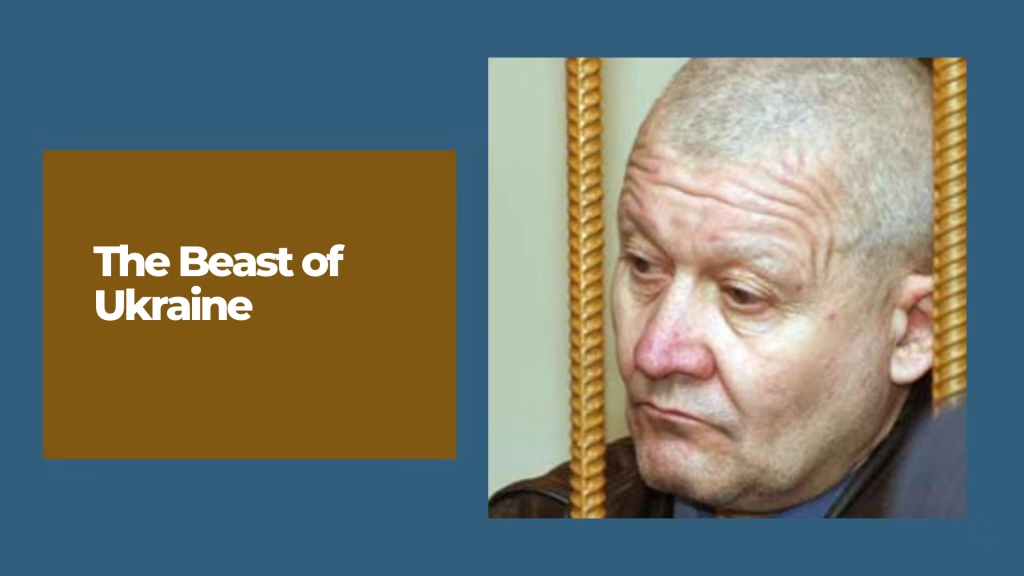
In 2005, a fisherman in the Ukrainian city of Pavlograd told police he recognized a man who’d been talking to a missing 9-year-old girl at the river. The man’s name was Sergey Tkach, a 52-year-old alcoholic who worked at the local factory.
When police arrived at Tkach’s semi-abandoned house on the outskirts of town, he opened the door reeking of alcohol. He behaved calmly as officers told him they were taking him to the station for questioning.
At the police station, the first thing Tkach said was: “I’ve been waiting for you for 25 years.”
Then he began confessing to dozens of murders.
But here’s what makes this case particularly horrifying: During those 25 years, while Tkach was killing, police had arrested more than 10 innocent men for his crimes. Some spent years in prison. One was just 14 years old. Another was sentenced to death and took his own life in custody.
The real killer had been detained by police several times during his murder spree. Each time, he talked his way out or bribed the officers. Once, he even committed a murder right at the site where police were having lunch during a stakeout.
This is the story of Sergey Tkach, one of the most prolific serial killers in history, and the catastrophic police failures that allowed him to operate for a quarter century.
The Attacks Begin in Pavlograd
Pavlograd was a typical quiet provincial town in Ukraine with a population of about 100,000 people. Most residents knew each other in some way and felt safe in their community.
That sense of safety was shattered in 2003.
Ira Badova was an ordinary schoolgirl walking home past a ravine in a wooded area. A man on a bicycle passed by her. When they were near each other, he attacked without warning.
He began strangling Ira, then sexually assaulted her, then strangled her again before fleeing the scene. Ira survived only because her attacker thought she was dead. She couldn’t describe him because she’d barely seen his face.
A few weeks later, another victim wasn’t as fortunate. The body of ninth-grader Vassa was found between a transformer booth and a garage near the city center. That evening, she’d visited a computer club. On her way home, she was attacked. After being sexually assaulted, Vassa was strangled to death.
More bodies were discovered in ravines, parks, and construction sites. People were outraged that police couldn’t find the criminal. Under pressure from authorities and the public, police made a decision that would haunt them for years.
They simply decided to find someone to blame.
The First Innocent Victim: Vitaly Kira
Twenty-three-year-old Vitaly Kira walked to work along the same road every day. This road wasn’t far from where the body of a sixth-grader had been found.
Vitaly had passed by the victim one day when she was walking with friends. He knew her and said hello. During police interviews, the victim’s friends remembered this encounter and mentioned Vitaly.
Police immediately arrested him and took him for questioning.
They interrogated Vitaly harshly and persistently for days, demanding a confession to murder. Vitaly refused. He hadn’t done anything wrong. He wouldn’t confess to a crime he didn’t commit.
So the police took him to a separate room and began beating him brutally.
Vitaly endured the beatings without confessing. The police needed to find someone guilty at any cost, so they tried a different approach.
They hinted to Vitaly that if he didn’t sign a confession, some people might accidentally break into his home. Something bad might happen to his wife and daughter.
Vitaly could have endured the beatings for much longer. But he couldn’t allow his family to be threatened. He signed a confession to a murder he didn’t commit.
He hoped he could retract his statements in court. But it was all in vain. Police fabricated evidence. Vitaly was found guilty and sentenced to 15 years in a maximum security prison.
A few years later, while Vitaly was serving his sentence, his wife informed him she wanted a divorce. She was planning to marry another man.
Vitaly continued serving time for someone else’s crime while the real killer had no intention of stopping.
More Attacks, More Innocent Men Imprisoned
In 2005, 19-year-old Olga Tapala was working in her garden when a man approached her fence. He started offering her zucchinis, claiming they were from his garden.
The zucchinis were stolen. The man was not the kind villager he pretended to be.
After a short conversation, the man looked around and suddenly attacked Olga, strangling her. Olga doesn’t remember what happened next. She woke up in tall grass near a forested area. She realized she’d been assaulted. Her attacker apparently thought she was dead and left.
Olga was too embarrassed to tell anyone at first. But when she saw her mother, she broke down in tears and told her everything.
They went to the police. Olga gave a detailed description of her attacker: a man in his 50s, average height, physically strong, wearing a blue t-shirt and dark pants. She described his face, and a composite sketch was made. His most distinctive feature was his mustache.
The next day, police began detaining all men with mustaches they could find in the city and the surrounding areas. They showed these men to Olga. After she’d seen about 15 men with mustaches, none of whom were her attacker, the police gave up on this approach.
The attacks continued. On July 21, the body of eighth-grader Ana Nosa was found in an abandoned house. On August 2, the victim was 14-year-old Masha Mova.
People were terrified. Under pressure to find the killer, investigators continued their pattern of arresting random people and sentencing them for crimes they didn’t commit.
In the Soviet Union and post-Soviet countries, this was common practice. When police detectives weren’t professional enough to catch the real criminal, and when pressure from society and superiors became too high, they’d randomly arrest people they thought were suspicious. Sometimes they’d grab people who’d been arrested for similar crimes before. These innocent people would be sent to prison for 10 or 15 years.
Nikolai Dymuk was one of these victims. He was having a picnic with friends near where one victim’s body was found. He was detained and, unable to withstand torture, confessed to a crime he didn’t commit. He was sentenced to 10 years in prison.
The Most Horrific Case: A 14-Year-Old Boy
Among all the falsely accused, one case stands out as particularly horrendous.
Fourteen-year-old Yakov Paschuk was convicted of murdering his 8-year-old cousin, Yana.
Detectives came for Yakov during his lesson at school. They took him away in handcuffs directly from the classroom. At the police station, detectives beat him. When they threatened to kill his parents, Yakov agreed to confess.
A 14-year-old child couldn’t resist such pressure from adult men.
Read more: The Candyman Killer: Dean Corll
Detectives didn’t care that Yakov had an alibi at the time of the murder. They didn’t care that it wasn’t physically possible for a quiet 14-year-old to have done something that horrific. The body had been found in an abandoned building, horribly mutilated.
Yakov was convicted and sent to prison at age 14.
The murders continued because catching random people cannot stop a killer who’s still free.
The Break in the Case
On August 3, 2005, 9-year-old Lena Zakorko went missing. She’d gone swimming with friends at the Samara River. The search for Lena yielded no results.
When police questioned everyone who’d been at the beach that day, several of Lena’s friends remembered that an adult man had approached her. Some claimed they were talking, and he was teaching her how to swim properly.
The killer was now so confident he wouldn’t be caught that he was approaching victims in broad daylight.
Police questioned locals who’d been at the beach. Finally, they got their first real clue. A local fisherman who was on a boat also saw the man who approached Lena. He recognized him because they worked together at the same factory.
The man’s name was Sergey Tkach.
Sergey was a 52-year-old quiet alcoholic who’d never been arrested. He was generally an unremarkable person. But when police followed up the lead and found him at his semi-abandoned house, something unexpected happened.
During his first interrogation, Tkach said, “I’ve been waiting for you for 25 years.”
Then he began giving his testimony.
The Confession That Shocked Ukraine
Tkach started by describing what happened to 9-year-old Lena Zakorko, his last victim, who went missing by the riverbank. He waited until people left the beach, then attacked Lena. After assaulting her, Tkach drowned her in the river.
Detectives thought Tkach was responsible for about 10 murders in Pavlograd. But after his arrest, Tkach surprised them by revealing he’d been killing for 25 years and had dozens of victims.
How was it possible that a middle-aged alcoholic wasn’t caught while killing for 25 years?
Police wanted to know more about Tkach’s personality. They delved deeper into the story of his life.
The Making of a Killer
Sergey Tkach was born on September 15, 1952, in Kirovsk in the eastern part of Soviet Russia. He was the fourth child in a large family. His father worked in the mines.
Sergey’s parents were preoccupied with work, leaving little time for their children. Severe punishment was normal for childhood misdeeds in the family. Because of this upbringing, Sergey grew up sickly and unsociable, with a slim build that made him vulnerable among his peers.
According to some sources, Tkach was under psychiatric observation as a child.
To build physical strength, he took up weightlifting and achieved some success, becoming a junior champion in his hometown. His sports career developed rapidly. He won medals at district competitions and became physically very strong.
His hopes for a bright future were dashed by an unsuccessful training session where he injured the tendon in his left arm. He was forced to leave competitive sports. The injury also ended his plans to get higher sports education.
After school, Tkach joined the Army. He served in the Navy in the Far East of the USSR. Tkach was so enamored with the sea that he decided to enroll in the Sevastopol Naval Academy without waiting for his discharge. He successfully passed all entrance exams.
Then he faced disappointment again. During the medical examination, doctors found he had heart problems. He was expelled from the academy and sent back to complete his military service.
The shock of this failure was so intense that he attempted to take his own life. He was saved but discharged from service. With such a record, he had no future in the military.
Tkach decided not to return home. He looked for work in the city where he’d served. During this period, his sadistic tendencies fully manifested.
The Dog Catcher
Tkach got a job with a dog-catching service. While his colleagues shot dogs using service weapons, Sergey used a piece of rebar to kill stray animals with his own hands. The process of skinning them brought him the greatest pleasure. He later sold those pelts to local craftsmen.
Surprisingly, despite his attitude toward animals, Sergey later got a dog of his own after he became a serial killer. The dog became his best friend, the one he poured out his soul to after committing crimes.
After saving some money, Tkach returned to his native Kirovsk. Back home, he got a job in the police force, initially as a criminal investigator and later as a forensic expert.
This gave him an excellent understanding of how Soviet investigators worked. He knew how they searched for criminals and collected evidence.
Tkach was later dismissed from the police force for document forgery. But the knowledge he gained there made him a very prepared criminal who was difficult to catch.
By this time, Tkach had started a family. His relationship with his wife was complicated. They argued often. Tkach got a job at a railway station and began drinking heavily. He even set a personal record he was proud of: downing a bottle of vodka in just 13 seconds.
As arguments in the family got worse, he took one of his sons and left for Crimea, where his parents lived. His wife came after him and, with police help, got her son back and obtained custody.
During this conflict, Sergey was arrested by the police. His wife took their son and went back to their hometown.
That’s when Tkach committed his first murder.
The First Murder: 1980
It was 1980, 25 years before Tkach would finally be arrested.
One night, Tkach drank two bottles of wine and went for a walk. While walking, he spotted a young woman. He attacked her from behind, strangling her. When she showed no signs of life, Tkach sexually assaulted his victim.
Realizing what he’d done, Tkach decided to confess. He called the police and reported his actions. But he didn’t wait for them to arrive. He fled.
At the police station, officers weren’t in a hurry. They didn’t believe him, thinking it was a joke from a drunk person.
Tkach decided to move to Pavlograd, an average town northeast of Crimea. There, he remarried and became a father again. In 1983, his wife gave birth to a daughter.
Despite having a seemingly settled family life, the urge to kill didn’t leave Tkach.
The Killing Continues
His first young victim was a 10-year-old schoolgirl. On October 21, 1984, as she was on her way to music school, Tkach ambushed and attacked her. He dragged his victim to an abandoned oil factory.
After the murder, he took her music notebook and wristwatch. From then on, he often took personal items from his victims: lipstick, umbrellas, shoes, and dolls.
Detectives tried in vain to find any clues on the body. But the knowledge Tkach obtained while working in the police helped him avoid investigators.
Tkach admitted he’d once had access to highly classified materials, including murder cases. He read these and knew how he would be hunted.
He always used protection when assaulting victims so he wouldn’t leave DNA evidence. He took all victim’s items that might have retained fingerprints. Tkach traveled by bicycle or left crime scenes via railway tracks because they were treated with chemicals that prevented dogs from picking up his scent.
He committed murders near highways and railroads, hoping suspicion would fall on travelers or truck drivers.
On February 23, 1985, Sergey Tkach committed another murder. He attacked a second-grader named Olya Shalaya. Despite heightened awareness after the previous murder at the oil factory, parents were still bringing their children to and from school. But on that day, Olya was returning home alone. Her mother was delayed at the clinic where she worked and didn’t make it in time.
Tkach intercepted the schoolgirl right near her house.
After these murders, the best detectives from all over the Soviet Union were sent to Pavlograd. Their combined efforts to catch the criminal led nowhere.
According to Tkach’s confessions after his arrest, from 1985 onward, he was detained several times by police on suspicion of murder. Each time he got away, sometimes by just talking to officers and convincing them he was innocent. Most often, he bribed them.
Growing Bolder
Tkach became so brazen from impunity that he wasn’t afraid to attack almost right in front of police patrols.
Once, knowing there was an ambush waiting for him in a forest, he calmly waited until the police went for lunch. Then, right at the site of their duty post, he committed another murder.
During his time in Pavlograd, Tkach committed 30 attacks. Most ended with his victims’ deaths.
In 2000, his wife was promoted. She got a job as deputy director at an oil processing plant in the city of Pavlograd, where the family eventually moved.
After moving, Tkach held back for three years. Then he started killing again.
If he hadn’t resumed killing, the murders he committed in Pavlograd might never have been solved, as many men had already been arrested and sentenced for these crimes. But Tkach simply couldn’t stop.
More Innocent Men Pay the Price
While Tkach was committing murders, police officers were arresting and punishing innocent people.
In July 1989, Tkach killed a 9-year-old girl in a small village near Pavlograd. After this crime, the father of the deceased, Vladimir Shishy, was arrested.
Investigators had no substantial evidence, so they manipulated the victim’s mother, Vladimir’s wife. They convinced her that her husband had killed not only their daughter but also other schoolgirls whose bodies had been found in Pavlograd.
Vladimir’s wife believed the investigators, possibly because they presented fabricated evidence. She gave testimony against Vladimir. He was detained and forced to confess to 22 murders and assaults he didn’t commit.
No matter how much Vladimir tried to prove his innocence, the case went to trial. Eventually, Vladimir gave up. He took his own life in pre-trial detention.
Village residents directed their anger toward Vladimir’s wife because they thought she was covering up the murders. Her house was set on fire several times. She was fired from the school where she worked and brought to the brink of starvation because she couldn’t find another job.
The Innocent Finally Released
Ten years after his conviction, Vitaly Kira was released after five years in prison. He was freed without any compensation for his unjust sentence.
Nikolai Dymuk also spent five years in prison before being released.
Yakov Paschuk, convicted at 14 years old, served eight years for the murder of his niece, which was actually committed by Tkach. The years he spent in prison were so horrible that he tries not to remember them today. You can imagine the treatment in prison for those convicted of such crimes.
When Yakov was released, he was 22 years old but looked at least 10 years older.
What makes it even worse: Yakov was only released in 2010, when Tkach was sentenced. He served five extra years from the moment Tkach was arrested because the judge didn’t want to release him before Tkach’s sentence was finalized.
Yakov’s entire life and physical health were shattered. He received less than $20,000 in compensation.
During the years Sergey Tkach committed his crimes, more than 10 innocent men ended up behind bars. Not a single police officer involved in their cases was convicted. They all got away with dismissals.
How He Avoided Capture
While others served time for their crimes, Tkach continued to kill. Neither his wife, friends, nor colleagues suspected him of anything. He knew that other men were sentenced to prison for his crimes, but he didn’t care.
However, some strange things were noticed about Tkach. After a work shift, he would wipe his hands not with a towel but with children’s underwear. People noted that Tkach frequently repainted his bicycle and constantly changed his appearance. He would grow and shave his hair and mustache several times.
Neighbors remarked that Tkach looked like the composite sketch police were showing to residents. He would just joke about it.
By the time of his last attack in 2005, Tkach was being hunted by groups of up to 600 detectives. He was so confident in his elusiveness that he even attended the funeral of one of his victims because he was acquainted with the victim’s family. Tkach even carried funeral flowers during the procession.
Tkach told investigators he never planned the murders. He committed them either in a state of alcohol intoxication, having drunk vodka mixed with medical drugs, or during moments of what he called “insanity.”
Tkach didn’t hide that one goal of his murders was to show his former police colleagues that he was better and smarter than them. Additionally, Tkach dreamed of surpassing the notorious serial killer Andrei Chikatilo.
The Investigation and Trial
The investigation into Tkach’s case lasted three long years. He confessed to more than 100 crimes. Only 10 girls managed to survive his attacks. All of them recalled that during his crimes, Tkach never looked his victims in the eyes.
Out of the 100 crimes he confessed to, the investigation managed to prove only 37. These murders were committed all over Ukraine.
Sergey Tkach’s criminal case comprised 105 volumes. In 2010, Tkach was sentenced to life imprisonment.
Psychiatrist Vladimir Gluzman, who examined Tkach, commented: “He killed to be the coolest among killers.”
Tkach felt no remorse for his murders of schoolgirls. But when asked what he would do if his children were threatened the same way, he would fly into rage, saying he would murder and mutilate that person.
During investigative experiments, when Tkach was taken to crime scenes, he remembered everything in the slightest detail. He was only afraid of revenge from the relatives of his victims.
In one experiment in Pavlograd, an enraged crowd nearly overturned the police van containing Tkach. From then on, he demanded a bulletproof vest and enhanced security during outings.
Once, Tkach was taken to a cemetery where one of his murders had been committed. When they arrived, a funeral procession was passing by. Tkach was so afraid that he refused to get out of the car. He thought someone in the procession might be a hitman sent to kill him.
Prison and an Unlikely Marriage
Even in prison, Tkach continued to dream of fame. He wanted to write a book about himself and was sure a film would be made about his life. He even chose a director: Steven Spielberg.
When Tkach was already in prison, it turned out he was receiving letters from a 25-year-old woman named Alona. She lived in Russia and first saw Tkach in the news when she was 16. She fell in love with him and started writing him letters.
After a couple of years, Alona visited Tkach in prison several times. The couple got married and had a daughter.
Alona loved Tkach dearly and planned to have three children with him. In Russia, Alona enjoyed fame. Everyone was shocked by her behavior. She was invited to various TV shows and featured in reports.
Fortunately, her parents categorically forbade her from taking her and Tkach’s daughter to prison to see him. He never saw his daughter in person.
The couple hoped Sergey would be released from prison and they would buy a house near a lake and live happily. These plans were not meant to be.
In 2018, Sergey Tkach died of a heart attack. Despite prison staff informing his family and wife about his death, no one came to claim his body. He was buried in an unmarked grave near the prison.
The Unanswered Questions
To this day, we don’t know how many murders Tkach actually committed.
Police were able to prove 37 of them. Tkach claimed he committed 110 murders. Even the detectives who worked on his case think the real number is somewhere between these figures, likely no fewer than 70 murders.
The case of Sergey Tkach represents not just the story of a prolific serial killer, but a catastrophic failure of law enforcement that allowed an alcoholic factory worker to murder for 25 years while innocent men rotted in prison for his crimes.
It’s a story about what happens when police are more interested in closing cases than solving them. When pressure for results leads to torture and fabricated evidence. When the system values confessions over truth.
Sergey Tkach was a monster. But the system that allowed him to operate freely for a quarter century while destroying innocent lives was monstrous, too.
The victims deserve to be remembered. The innocent men who served time for crimes they didn’t commit deserve justice and compensation far beyond what they received. And the failures that allowed this to happen deserve to be studied so they’re never repeated.
But in many parts of the world, these same failures continue today.