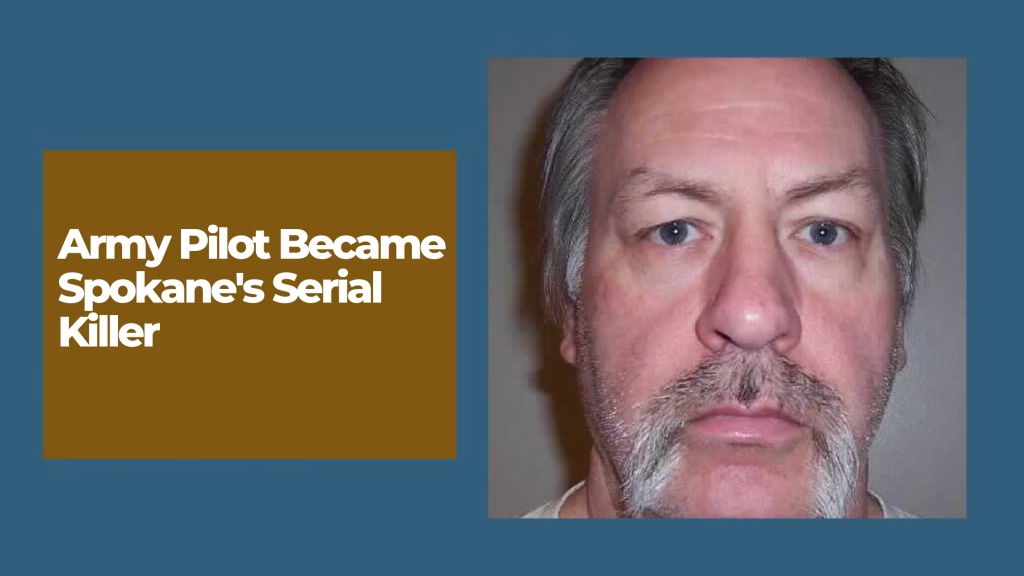
The white Corvette caught the attention of Spokane police officers more than once in 1998. Behind the wheel sat a well-dressed, middle-aged man who looked like he belonged in the upscale neighborhood where he lived, not cruising the gritty streets of East Sprague, Spokane’s red-light district.
But there he was, again and again, in an area known for prostitution and drugs. Officers took note but never suspected they were looking at one of the most prolific serial killers in Pacific Northwest history.
Robert Lee Yates Jr. seemed like the last person who would murder 13 women. He was a decorated Army helicopter pilot with 18 years of distinguished military service. He had a wife of 26 years and had five children. He attended church regularly. Neighbors described him as friendly and helpful, the kind of dad who played catch with his kids in the front yard.
But for two terrifying years between 1996 and 1998, Yates stalked the streets of Spokane, picking up prostitutes, sexually assaulting them, shooting them in the head, and dumping their bodies like trash along rural roads and in vacant lots. When police finally connected the dots, they discovered something even more disturbing: Yates had been killing for 25 years, with victims dating back to 1975.
The case would expose how a serial killer can hide in plain sight, protected by respectability, military service, and the terrible truth that society doesn’t look too hard when prostitutes start disappearing.
Spokane: A Quiet City Shattered by Murder
Spokane, Washington, sits near the Idaho border in the eastern part of the state. With a population of nearly 200,000 in the late 1990s, it was a quiet community where computer professionals, healthcare workers, and Air Force personnel from nearby Fairchild Air Force Base made their homes.
The average murder rate was about five per year. Spokane was the kind of place where violent crime made headlines because it was so rare.
That all changed in the summer of 1997.
On August 26, 1997, two bodies were discovered on the same day. Sixteen-year-old Jennifer Joseph and 20-year-old Heather Hernandez were both found dead in rural areas outside Spokane. Both had been shot in the head. Both were known to work as prostitutes on East Sprague.
For Sergeant Cal Walker of the Spokane County Sheriff’s Office, the discovery of two murdered prostitutes on the same day raised an immediate red flag. “You have to wonder right then and there, in a community our size, if something isn’t connecting those two,” he later said.
The two murders prompted police to take a second look at other unsolved cases. In June 1996, the body of Shannon Zielinski was discovered. In May 1997, Melody Murfin had been reported missing. Were these deaths connected?
As more bodies turned up, the terrible answer became clear: yes.
The Bodies Keep Coming
The murders accelerated through late 1997 and into 1998. Each discovery brought fresh horror and growing panic to the Spokane community.
November 1997: Darla Scott, 29, was found dead
December 1997: Laurel Wason and Shawn McClenahan discovered on the same day
February 1998: Sunny Oster becomes another victim
By early 1998, it was undeniable. Spokane had a serial killer specifically targeting prostitutes who worked the three-block stretch of East Sprague known as “the strip.”
The victims shared disturbing similarities. They were all women, most in their 20s and 30s, though some were younger. All worked as prostitutes to support drug addictions. All had been sexually assaulted. All had been shot in the head with the same caliber weapon. And in most cases, a plastic bag had been tied around the victim’s head after death.
“We were having a flurry of victims,” one detective later recalled. “The pressure on the detectives was pretty immense. You’d get woken up knowing that phone call meant another life had been taken.”
For the women who worked on East Sprague, terror became part of daily life. These women knew each other. They were friends, sometimes like family, looking out for one another in a dangerous world. Now they were disappearing one by one.
“It was always on women’s minds,” one survivor later said. “We all had children, families. We were all individuals, all different, yet we were all the same. We were like a family.”
One woman carried a large knife, saying if the killer picked her up, she’d leave her mark. Another woman, Linda Maybin, talked openly about the murders. “It was almost like she knew she was going to be a victim,” someone remembered.
By the time authorities formed a task force in 1998, at least 12 women had been murdered in just two years.
The Task Force: Racing Against Time
Spokane wasn’t Los Angeles or New York. This was a mid-sized city with limited resources. While major metropolitan areas might throw hundreds of detectives at a serial killer case, Spokane was lucky to put together eight.
But those eight detectives were determined. “We will solve this,” they told the sheriff from the very beginning. “We’re going to solve this.”
The task force faced unique challenges. Most serial killer investigations involve victims from various backgrounds, making it easier to identify patterns. But all of Yates’s victims came from the same small area: a three-block stretch of East Sprague where prostitutes solicited customers.
This narrow focus actually helped investigators. “With the number of times that our offender would have had to go into that area,” one detective noted, “it was highly probable that he had some type of police contact.”
In other words, someone on the force had probably encountered the killer during routine patrols, traffic stops, or solicitation arrests. His name was likely already in police files somewhere.
The challenge was finding it among thousands of records.
Building the Database
Detectives did something cutting-edge in 1998: they built a comprehensive computer database. They entered every name associated with East Sprague: men arrested for solicitation, drivers stopped in traffic checks, names from bar tabs, vehicle registrations, everything.
The goal was to find names that appeared multiple times across different categories. The more times a name appeared, the higher the priority for investigation.
Meanwhile, two officers went out to East Sprague every night to talk with the prostitutes still working the street. This required building trust. Usually, police and prostitutes are on opposite sides of the law. Now they had to work together to catch a killer.
Many of the women were terrified but had no choice. They needed money for drugs or to survive. Even knowing a serial killer was hunting them, they continued getting into cars with strangers.
“It’s a split-second decision,” one woman explained. “You just either jump in the car, or you don’t. It has a lot to do with how they speak to you, how they look.”
The fact that women kept getting killed despite being on high alert told investigators something crucial: “This isn’t a monster. This guy is probably very normal-looking, just very average-looking.”
The FBI Profile: Predicting the Killer
The task force brought in FBI Behavioral Analyst Mark Safarik to create a profile of the unknown killer. What Safarik came up with would prove eerily accurate.
The killer was likely:
- A white male in his late 20s to early 30s (Yates was actually in his mid-40s, but looked younger)
- Someone who worked menial jobs
- Had a rough exterior, but could appear normal
- Harbored deep hatred for his attraction to women, particularly prostitutes
- Projected a masculine image
- Hung out at bars and blended into the community
- A night owl with rage issues
- Most intriguingly, might have a middle-aged, middle-class accomplice who helped with early kills
The profile also noted the killer’s signature: plastic bags tied around victims’ heads. This wasn’t about psychological gratification. It was utilitarian. “You’re shooting someone in the head, then you can keep blood from getting in different locations by using bags,” Safarik explained.
The killer also didn’t hide bodies particularly well. Many were found close to roads, almost as if he didn’t care about discovery. This suggested he didn’t believe he could be linked to the victims.
In other words, he was someone who wouldn’t normally be associated with prostitutes. Someone respectable. Someone above suspicion.
Physical Evidence: DNA and Ballistics
While detectives built their database and interviewed witnesses, forensic scientists studied physical evidence from the crime scenes.
This was before DNA technology became routine in investigations, but the Spokane lab was able to extract DNA from several victims. The same DNA profile appeared again and again, confirming what detectives already suspected: one man was responsible for multiple murders.
Ballistic evidence also linked the killings. The same .25 caliber handgun had been used in numerous murders. All the investigators needed was to match that gun and the DNA to a suspect.
Hair and fiber evidence were meticulously collected from each victim. These tiny traces of evidence would later prove crucial in building a case against Yates.
Read more: Billy Chemirmir: The Man Who Murdered 18 Elderly Victims for Their Jewelry
“That individual left part of himself with most every one of those victims,” one investigator noted. “The big tool in this case was DNA.”
The White Corvette: The Clue That Broke the Case
The break came from 16-year-old Jennifer Joseph, one of the earliest confirmed victims found in August 1997.
A witness had seen Jennifer leaving East Sprague with a man driving a white Corvette. This was the last time anyone saw her alive.
A white Corvette wasn’t exactly common in Spokane. Detectives compiled a list of every Corvette registered in Spokane County, Eastern Washington, and northern Idaho. They cross-referenced those names with their database of men who’d had contact with East Sprague.
Several names emerged that appeared on multiple lists. One of them was Robert Lee Yates Jr.
Detectives interviewed Yates and asked him to submit to a DNA test. He declined, which was his legal right. But refusing the test elevated him to prime suspect status.
Investigators shifted their focus to Yates’s Corvette, which he’d recently sold to another person. They tracked down the new owner and asked to examine the vehicle.
When they pulled fiber samples from the car’s interior, those fibers matched fibers found on Jennifer Joseph’s body. This was significant but not definitive. They needed more.
A search warrant was issued for a thorough forensic examination of the Corvette. What they found was damning: bloodstains that had survived despite what appeared to be meticulous cleaning. And underneath the floorboards, investigators found a button that matched buttons on Jennifer’s clothing.
“It’s almost like she might have had a hand in somehow getting that button underneath the floorboard where it couldn’t be found,” one detective later said. “This person was meticulous about cleaning that vehicle and never found it all this time.”
When lab results came back confirming the blood was Jennifer Joseph’s, investigators had what they needed: definitive proof linking Yates to a murder victim.
“Once we had that definitive link to show that Jennifer Joseph’s blood was found in Mr. Yates’s Corvette,” a detective explained, “that gave us what we needed to pursue a warrant for DNA on Mr. Yates.”
The Arrest: April 18, 2000
On April 18, 2000, Robert Lee Yates Jr. was arrested at his home and charged with the murder of Jennifer Joseph.
The arrest stunned everyone who knew him. Yates was a 47-year-old married father of five. He’d served 18 years in the Army as a decorated helicopter pilot and instructor. He worked at Kaiser Aluminum. He attended church regularly. He was the kind of neighbor who waved hello and played catch with his son in the yard.
“I can’t even believe it,” one neighbor said. “He always struck me as a good neighbor.”
A woman who had once dated Yates years earlier was sitting in a bar when his picture came on the news. “I almost fell off my barstool,” she recalled.
But to the women of East Sprague, particularly those who had survived encounters with him, the news brought a different emotion: recognition mixed with horror.
One woman who’d dated Yates multiple times and even had his phone number said, “He was beyond normal. Maybe that should have been my first clue. A nice guy, very intelligent, attractive, and he paid well.”
She remembered discussing the serial killer case with Yates during their encounters. He suggested the killer might be someone in the police force. She thought it might be a cab driver. “I never would have guessed in a million years it was him,” she said.
The revelation shattered her sense of judgment. “I used to be able to trust my own judgment, and I can’t do that anymore,” she said, describing acute survivor’s guilt.
The Double Life of Robert Lee Yates Jr.
As details of Yates’s arrest spread, everyone asked the same question: How could a man who seemed so normal be a serial killer?
Robert Lee Yates Jr. was born in 1952 and grew up on Whidbey Island, about 30 miles from Seattle, in the small town of Oak Harbor. His father described a happy childhood.
“Bobby grew up a happy little kid,” Robert Yates Sr. said. “As he grew up, we got into sports more heavily. I coached him two or three different times. He did better than average in school.”
The family was Seventh-day Adventists and active in their church. When the church burned down, 16-year-old Robert Jr. helped rebuild it alongside his parents. A childhood friend, Al Gatti, described the Yates family as living their religious values.
“I never heard him cuss, never even heard him raise his voice,” Gatti said. “There wasn’t any alcohol in the family, no smoking. They were a clean-living family.”
In high school, Yates was a star baseball player, sang in the choir, and acted in school plays. In 1974, he married Linda Brewer. The marriage would last 26 years.
Early on, Yates struggled to find his place. He worked as a prison guard at Washington State Penitentiary in Walla Walla, but didn’t last long. Several other jobs followed before he finally found his calling in 1976: the United States Army.
Military Career: An Unlikely Killer’s Resume
In the Army, Yates excelled. He became a helicopter pilot and was so skilled that he became an instructor teaching other pilots how to teach flying. Throughout his 18-year military career, Yates’s record was distinguished.
He was stationed at multiple bases:
- Fort Rucker, Alabama
- Fort Drum, New York
- Germany (where his family joined him for three years)
- Haiti
- Somalia
“If you talked to the Army about his records in the service, he’s an outstanding person,” his father said. “The military couldn’t believe what he did. They said he was one of their top instructors.”
But behind the impressive military resume, darker patterns were emerging. In 1998, while living in Spokane after retiring from the Army in 1996, Yates was stopped by police for having a known prostitute in his car. He claimed she was his daughter’s friend and he was driving her home.
Two days later, his 19-year-old daughter came to the county jail to report her father for hitting her. He was charged with misdemeanor assault.
Police interviews with family members after his arrest revealed a very different picture of Yates at home: domineering, emotionally and physically abusive, running the household “with an iron hand,” emotionally distant from his wife and children.
“He was very much of a disciplinarian,” his father admitted. “I thought he was a little bit too tough on his children at times.”
One potential explanation for Yates’s psychological development emerged: when he was six years old, he’d been molested by an older boy. His wife Linda had mentioned it to his father, but Yates Sr. had never known about it.
“I asked Bobby about it,” his father recalled. “He said it happened, but told me he didn’t know why that would make a difference in his life. But it certainly could have, I guess.”
The Investigation Expands: More Victims, More Evidence
While Yates was in custody for Jennifer Joseph’s murder, investigators continued building their case. They believed he was responsible for many more killings.
Detectives obtained a search warrant for Yates’s home and spent a month painstakingly searching for evidence. They went through every piece of clothing belonging to Yates, his wife Linda, and all five children, looking for fibers that might have transferred to victims.
“You’re talking about going through every person’s clothes looking for fibers,” one detective explained. “The transfer of those fibers, how could it have occurred? Could Mr. Yates have had a hug with one of his daughters, picked up a fiber, and then transferred that fiber to his victim? So we couldn’t just look at his clothes. We had to look at Mrs. Yates’s clothes and five kids’ clothing items packed into that house.”
Forensic botanists made a bizarre discovery: plants growing in Yates’s yard matched vegetation found on or near several victims. The investigation revealed that Yates had actually transported these plants from his yard with the bodies.
“Mr. Yates, with one particular victim, had gone over and raked up a certain area of the yard, gathered that up, transported a victim and the vegetation, and dumped that,” an investigator explained. “The next victim would have another series of plants from different areas in the backyard.”
Why Yates transported plants from his yard to disposal sites remains a mystery. Was it an attempt to throw off investigators? Did it have some psychological significance? We may never know.
Boot prints from Yates’s shoes matched plaster casts taken from multiple crime scenes. Tire tracks from his Ford pickup matched tracks near the bodies. The evidence was mounting.
A Survivor Comes Forward
One month after Yates’s arrest, investigators got an unexpected call. A woman named Christine Smith had seen Yates’s picture in the newspaper and recognized him as the man who’d tried to kill her.
Smith had been picked up by Yates in his van months earlier. He’d driven her to a remote location, pulled out a gun, and shot her in the head. Miraculously, she survived by playing dead. When Yates left, believing she was dead, Smith was able to crawl to safety.
Her testimony would prove crucial. For the first time, investigators had a living witness who could describe exactly how Yates operated, what he said to victims, and how he tried to kill them.
The Plea Bargain: Trading Death for Answers
By May 31, 2000, prosecutors had linked Yates to eight murders and one attempted murder. He was arraigned and entered a plea of not guilty.
The prosecution initially planned to seek the death penalty and try Yates for all murders at once under a “common scheme” argument, meaning he had a specific plan to target one group (prostitutes).
But legal research revealed problems with the common scheme approach. For it to apply, Yates would have had to kill all the prostitutes he’d been with, and he clearly hadn’t. Some women he’d paid for sex and let go unharmed.
Fearing they might not get the death penalty, Yates’s defense attorneys made an offer: in exchange for a life sentence without parole, Yates would confess to not just the eight murders he was charged with but to six additional killings, some dating back more than 20 years.
Prosecutors insisted Yates take a polygraph test, confessing to all the murders. The results indicated he was telling the truth, though this later became controversial when other polygraph experts reviewed the test and called the results “inconclusive.”
Prosecutors met individually with victims’ families to get their input on whether to accept the plea deal. The tally was 19 families for life in prison, 12 for the death penalty.
The deciding factor was pragmatic: the plea agreement would solve six cold cases and bring closure to more families. One case, the murder of Shawn McClenahan, was deliberately left out of the agreement. It had the strongest evidence (fingerprints, DNA, and ballistics) and could be brought back for a death penalty trial if the plea fell through.
This decision infuriated McClenahan’s family. “For me, I’m very angry because it’s saying she was never worth anything, there was nothing worthwhile to her life,” one family member said.
The Shocking Confessions: 25 Years of Murder
As part of the plea agreement, Yates confessed to six additional murders that shocked investigators.
Patrick Oliver and Susan Savage – Murdered in 1975 in Walla Walla, Washington. These murders went back 25 years, revealing Yates had been killing since his early 20s, long before anyone suspected.
Stacy Hawn – Murdered in 1988 in Skagit County, Washington.
Shannon Zielinski – Murdered in 1996 in Spokane. Her case had been one of the first that raised red flags.
Heather Hernandez – Murdered in 1997 in Spokane.
And then came the most shocking revelation: Melody Murfin, who’d been missing since 1997. Yates drew police a map for the police of her body, and investigators were stunned by what it revealed.
The Body in the Front Yard
“We were prepared for an outdoor-type setting somewhere in the woods, as we had been so many times with this investigation,” one detective recalled. “It was a huge surprise for us to be led right back to the Yates home.”
Melody Murfin was buried in Yates’s own front yard, underneath a flower bed.
Police had spent weeks searching the Yates property after his arrest, believing they’d covered every square inch. They’d used ground-penetrating radar. But they’d missed her.
“We have all this money and all this time put into this task force, and they didn’t find her when they scanned the yard the first time, nor the second time,” Melody’s daughter said. “I went a long time without my mother, and then to have him say she’s in my yard, four feet under… it was very disturbing.”
One of the most chilling details: Melody was buried directly outside the headboard of Yates’s bedroom. He and his wife, Linda, slept just feet above the decomposing body of one of his victims.
When investigators asked Yates how he could sleep there, knowing a body was buried beneath his window, he was dismissive. “It was nothing like that,” he said. “It was back in the corner, and it was three feet deep, and apparently it was wrapped in plastic.”
His casual tone revealed a complete disconnect from the horror of what he’d done.
The Sentencing: Facing the Families
On October 26, 2000, Robert Lee Yates Jr. stood in a packed courtroom and pleaded guilty to 13 murders and one attempted murder.
For the first and only time, he addressed his victims’ families directly.
“Nothing I can say will erase the sorrow, the pain, and the anguish that you feel and that I’ve caused in your lives,” Yates began. “I’ve caused much sorrow, much pain. You can’t know how much pain I know I’ve caused for all of you and my family. I’ve taken away the love, the compassion, and the tenderness.”
He went down the list of victims, apologizing to each family by name. “To the family and friends of Shannon Zielinski, I am sorry. To the family and friends of Heather Hernandez, I am sorry. To the family and friends of Jennifer Joseph, I am sorry.”
Yates also claimed he’d found God. “In my struggle to overcome my guilt and shame, I have turned to God,” he said.
The apology rang hollow to the families in the courtroom.
Victim Impact: The Families Speak
Then it was the families’ turn. One by one, they stood and addressed Yates directly.
“I want him to sit in prison the rest of his life in a little tiny room with all the pictures of these dead girls so he can look at them and remember what he did,” one family member said.
Jennifer Joseph’s father spoke through tears: “Your honor, I still cannot believe that a brutal murderer like the Spokane killer can plea bargain to save his life. Who was there to plea bargain for my daughter Jennifer and all the other daughters?”
Another family member looked directly at Yates: “I know the remorse and sorrow you feel is for yourself and not the countless women you so cruelly murdered. The main question is, why did she have to die? He had no right to take her life. I hope you rot in hell.”
One woman addressed the elephant in the room: “I’m still in shock. It just makes me mad that this happened to so many people. They didn’t deserve this. No one deserves to be killed like that. How they must feel about us, how much they probably hate us.”
This was Yates’s own daughter, Sasha, speaking alongside her grandfather. The shame and pain of being related to a serial killer was palpable.
Even Yates’s father struggled to comprehend what his son had become. “I felt so bad for them,” Robert Yates Sr. said of the victims’ families. “You’re a sick monster, and you will be judged. God will not forgive you, Mr. Yates.”
The Sentence: 408 Years
Judge Richard Schroeder sentenced Robert Lee Yates Jr. to a total of 408 years in prison without the possibility of parole. In reality, this meant life imprisonment. Yates would die in prison.
“You will live with the thoughts of all of these deaths for the rest of your life,” the judge told Yates.
But the case wasn’t entirely closed. Pierce County prosecutors had rejected the plea agreement and still planned to charge Yates with two more murders: Connie LaFontaine Ellis and Melanie Mercer, whose bodies were discovered near Fort Lewis in Tacoma, where Yates had done National Guard duty.
Pierce County prosecutors announced they would seek the death penalty for those murders. Yates pleaded not guilty.
Meanwhile, investigators believed there might be even more victims. Blood stains found in Yates’s vehicles didn’t match any known victims. Detectives suspected the real body count was higher than 13.
Authorities across the country with unsolved murders began looking at cases that might be linked to Yates. One such case was the 1995 murder of a transgender prostitute near Fort Rucker in Alabama, where Yates had been stationed. Another was near Fort Drum in Watertown, New York, another place Yates had been stationed.
The Unanswered Question: Why?
Even with Yates behind bars, the biggest question remained unanswered: Why?
How does a man go from being a well-respected military pilot to a serial killer? What happened to transform a churchgoing father of five into someone capable of murdering 13 women?
Yates himself never provided a satisfactory answer. As part of the plea agreement, he wasn’t required to explain his motives or methods.
“How is it that you can go out, sexually assault and brutalize a victim and kill her, and 20 minutes later walk into your house like nothing’s happened?” one investigator wondered.
The childhood molestation Yates experienced at age six may have played a role in his psychological development. His domineering, abusive behavior at home suggested deep-seated anger and control issues. His choice of victims—prostitutes he simultaneously desired and despised—pointed to profound internal conflict about sexuality.
But none of this fully explains how someone crosses the line into serial murder, then continues killing for 25 years while maintaining a double life as a respectable family man.
“I think he is the person who can answer those questions,” one detective said. “And I think that’s the same questions the families have. How did he get from being a well-respected career military guy, helicopter pilot, to where he is now, thought of in a whole different light—a serial killer?”
Justice Incomplete: More Victims?
Investigators firmly believe Yates killed more than the 13 women he confessed to. The blood evidence, the decades-long timeline, and the locations of his various military postings all suggest additional victims may exist.
“We’ve got some bloodstains that right now are unaccounted for,” one detective noted. “So we’ve got a lot of work to do.”
For the families of known victims, the plea bargain brought mixed feelings. Yes, they had answers, and Yates would never walk free. But many felt cheated that he escaped the death penalty.
“Why did we have to give that sick man a plea bargain to find my mother?” Melody Murfin’s daughter asked. “They searched many times, and they didn’t find her. Now, because they didn’t find her, he gets to live. How can you kill so many women and still be able to live?”
It’s a question without a satisfying answer.
The Women Who Survived
While 13 women lost their lives, at least one woman who dated Yates multiple times survived. Her reflections provide chilling insight into how Yates operated.
“He was beyond normal,” she recalled. “Maybe that should have been my first clue. A nice guy, very intelligent, attractive, and he paid well.”
She described feeling intense survivor’s guilt. “I’m suffering from an acute case of survivor’s guilt because I was one of the lucky ones. He picked me up on the street for a date. We dated, and he gave me his phone number at work at Kaiser. I called him several times. I had more of a relationship with him than most of the other girls.”
The two even discussed who they thought the Spokane serial killer might be. “He thought it was somebody on the police force,” she said. “I, on the other hand, thought it might be a cab driver.”
The revelation that her “regular customer” was actually the killer devastated her. “It makes it a lot harder for me because I was starting to have some feelings for the man. I used to be able to trust my own judgment, and I can’t do that anymore.”
Remembering the Victims
The women Robert Yates killed were more than “just prostitutes,” as society often dismisses them. They were daughters, sisters, mothers. They had families who loved them, dreams they hoped to achieve, and struggles they were trying to overcome.
Jennifer Joseph, 16 – Just a teenager, still had her whole life ahead of her. Her father said writing her obituary at 16 was the hardest thing he’d ever done. “Jennifer was a person who liked to laugh. She was happy, she liked her music, and she was a pretty good girl, really. The apple of her father’s eye.”
Sunny Oster – Her family wrote a poem: “Today I went walking as I often do, and I started thinking of you. My steps grew faster and faster, you see, I felt you were looking right at me.”
Shawn McClenahan, 39 – She’d just been accepted into a methadone program and felt her life was finally turning around. She called family to update them and let them know she was alive and doing well. Three weeks later, she was dead.
Shannon Zielinski, Heather Hernandez, Darla Scott, Laurel Wason, Melody Murfin, Linda Maybin, Shawn Johnson – Each had a story. Each deserved better than to be murdered and discarded.
“No matter what their lifestyle was, they made some bad choices; there’s no denying that,” one family member said. “Nobody deserves to be treated like garbage, that somebody just decides your life’s not worth anything and they’re just going to take it and discard you somewhere.”
The Impact on Yates’s Family
One group of victims that’s often forgotten in serial killer cases: the killer’s own family.
Linda Yates had been married to Robert for 26 years. She had five children with him. She believed she knew her husband. When police arrested him, they whisked Linda and the children to an undisclosed location where friends, family, and victim services advocates cared for them.
“I’m convinced Mrs. Yates did not have a clue what her husband was doing,” the sheriff said. “There was nothing that would have led her to believe her husband was involved in something like that. She’s as much a victim in this as our other ladies.”
Sasha Yates, Robert’s daughter, spoke at his sentencing. Her pain was evident. “I feel immensely terrible that this happened. It feels like a dream. I’m still in shock. It just makes me mad that this happened to so many people. They didn’t deserve this. No one deserves to be killed like that. How they feel about us, how much they probably hate us.”
She stood shaking in the courtroom, unable to comprehend how her father could have done these things.
Robert Yates Sr., who’d raised his son in a loving Christian home, was devastated. “I cry about it every day,” he said. “I think it’s the worst thing that could ever happen to any family.”
Where Is Robert Yates Now?
Robert Lee Yates Jr. is serving his 408-year sentence at Washington State Penitentiary. He’s housed in protective custody, isolated from the general prison population for his own safety.
The Pierce County charges for two additional murders were never prosecuted. Given that Yates was already serving multiple life sentences with no possibility of parole, prosecutors decided not to pursue the death penalty case.
Yates will die in prison. He’ll never again see freedom, never again walk the streets of Spokane, never again hunt vulnerable women.
But for the families of his victims, justice feels incomplete. Thirteen women are dead. More may have been murdered that we’ll never know about. And the man responsible took his full story to the grave, refusing to explain why he destroyed so many lives.
What do you think drives someone like Robert Yates to live a double life as both a family man and serial killer? Share your thoughts in the comments below.