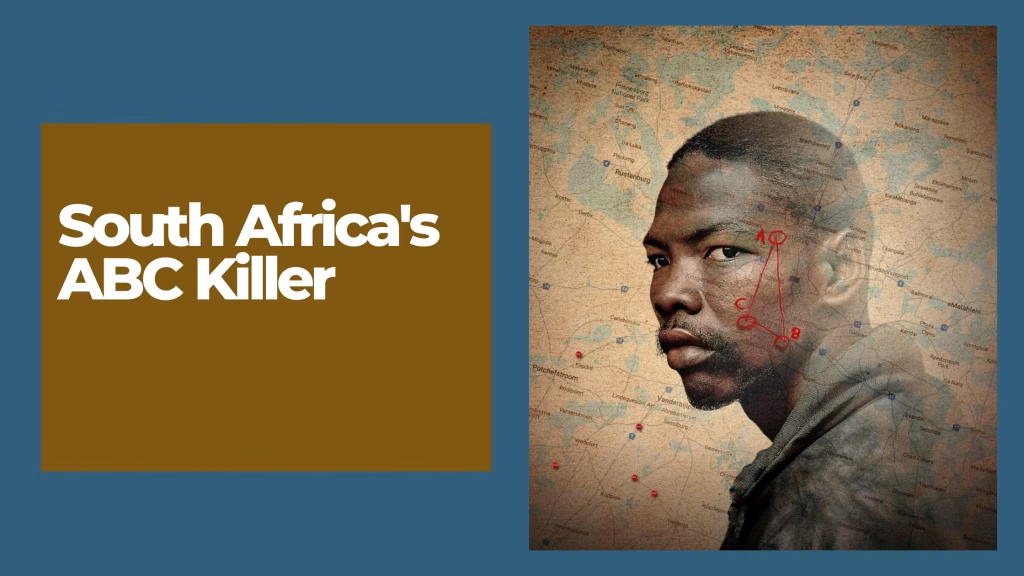
Moses Sithole murdered 38 women in just over a year. He lured them with fake job offers. Then he strangled them in remote fields across South Africa. But here’s what makes this case even more disturbing. The killer ran a fake charity that claimed to protect abused women and children. The irony is almost too sick to process.
Between 1994 and 1995, bodies started appearing in fields around Johannesburg. Young women, all unemployed, all desperate for work. Meanwhile, Sithole walked around townships handing out official-looking forms. He presented himself as a successful businessman who wanted to help. Communities trusted him. Families thanked him for offering their daughters opportunities. And one by one, he led them to their deaths.
This isn’t just another serial killer story. This is about how one man weaponised poverty and exploited desperation. Nelson Mandela himself had to address the country on national television. The president begged communities to help catch the killer who hunted their daughters. By the time police captured Moses Sithole in October 1995, South Africa had a new title they never wanted. Home to one of the world’s most prolific serial killers.
So how did a convicted rapist fool an entire country? Let’s break it down.
Moses Sithole’s Childhood: Abandoned at Five, Abused in Orphanages
Moses Sithole came into the world in 1964 in Vosloorus, Boksburg. This happened in apartheid South Africa. His father died when Moses was young. The death left his mother to care for five children alone.
The Abandonment That Shaped a Killer
Instead of trying to make it work, she made a choice that would shape everything. When Moses turned five, she took him and his siblings to a police station. She told officers to never reveal who their mother was. Just dropped them off. Like unwanted packages.
Moses spent three years bouncing between orphanages. Staff physically abused him regularly. Eventually, he couldn’t take it anymore and ran away. He hoped his mother would take him back. She didn’t. She sent him right back to the orphanage.
Think about that rejection for a second. Your own mother chose twice to get rid of you.
From Orphan to Youth Counsellor
Eventually, Moses went to live with his older brother Patrick. When he reached working age, he started working in the Boksburg gold mines. He also took odd jobs around Johannesburg. By his twenties, something interesting happened. Moses started acting as an unofficial youth counsellor. He found runaway kids on the streets and returned them to their families.
On the surface, it looked noble. But looking back, you have to wonder. Was he genuinely helping? Or was he obsessed with the idea of parents actually wanting their children back? Something he never experienced.
His friends knew him as charming and sexually active from a young age. He had a long line of girlfriends. What they didn’t know was the violence happening behind closed doors.
The First Conviction: Six Years for Rape, Then Freedom
Moses Sithole’s first suspected rape happened in September 1987. The victim was a Johannesburg woman who would later testify against him. Though not for that specific crime.
A Pattern of Violence Against Women
In 1988, he started dating a 17-year-old girl named Sabonga Nkosi. He abused her throughout their relationship. Then he raped her 15-year-old sister. The younger sister reported being strangled to unconsciousness during the assault. Moses carried out another attack on a Cleveland woman later that year.
Then, in February 1989, he raped Buyiswa Doris Swakamiswa. He threatened her with a panga, a South African machete. He said he’d kill her if she told anyone.
The Arrest That Should Have Stopped Him
A few months later, Swakamiswa started a new job. She looked out the window one day. Her attacker stood outside her workplace. She called the police immediately. Officers arrested Moses, but then made an absolutely baffling decision. They had the rapist and his victim share the back seat of the police car.
Why were they both going? What did she do? This wasn’t smart policing. It was lazy and dangerous.
Moses didn’t exercise his right to remain silent. Instead, he spent the entire ride shouting at Swakamiswa. He told her he should have killed her when he had the chance. Literally threatening murder while sitting in a police car with officers in the front seat.
During the trial, he changed his tune completely. He maintained his innocence. It didn’t work.
Police convicted Moses Sithole of rape in 1989. The court sentenced him to six years in prison. He served the time at a prison where, according to his later claims, inmates beat and sexually assaulted him repeatedly. Whether that’s true or just part of his victim narrative remains unclear. What is clear? Moses walked out of prison in November 1993 with a burning hatred for women and a twisted need for revenge.
Moses Sithole Falls in Love – While Plotting Murder
Here’s where it gets even stranger. While Moses served his prison sentence for rape, a woman named Martha Ntalovo came to visit her nephew. The nephew was a fellow inmate. Moses started writing her letters.
The Woman Who Loved a Rapist
At first, Martha ignored them. But eventually, she agreed to start a relationship with this convicted rapist she’d met in prison. Yeah, you read that right.
Martha later testified during his murder trial. She said, “He began to write me letters. Initially, I didn’t respond, but after a while, I agreed to a relationship. So I started to visit him regularly until he was released on parole in November of 1993.”
When Moses got out, they moved in together in Pretoria. Martha soon became pregnant with their daughter, Brigitte. The couple got married.
Building a Fake Charity Empire
Around this same time, Moses decided to found a charity organisation. He called it “Youth Against Human Abuse.” A typist at his car washing job helped him draft official-looking forms. The forms claimed to report abuse against women and children. He handed them out at schools and community centres.
On the surface, Moses Sithole looked like a reformed man. A family guy who campaigned for the rights of mistreated women and children. He organised meetings at local schools and offered to help organisations combating domestic violence. He continued helping runaway kids find their way home.
Communities saw him as a leader. Someone who genuinely cared. But during this same period, Moses was becoming one of the worst predators South Africa had ever known.
The Fake Charity That Lured Women to Their Deaths
Moses used his charity work as the perfect cover for murder. He created official-looking membership forms and letters. He presented himself as a successful businessman and charity advocate. Then he’d approach women in townships plagued by massive unemployment. He offered them rewarding work opportunities.
The Perfect Predator’s Pitch
Using one of his six known aliases, he’d introduce himself with easy charm. His silver tongue made the lie believable. His pitch was simple. Come work for his charity helping abused women and children. Good pay, meaningful work, a chance to escape poverty. Who wouldn’t be interested?
Moses would invite women to his charity headquarters for an interview. Sometimes that same day, sometimes after phone calls and letters. Then he’d suggest taking a shortcut. The path went through a barren, remote piece of wasteland. Once they were out of sight of any witnesses, he would strike.
The First Murder: His Wife Was Pregnant
According to Moses, his first victim asked him for directions. He saw in her a surrogate for the young woman who had sent him to prison years earlier. Except that’s twisted logic. He went to prison for being a rapist. The woman who reported him simply told the truth. But in Moses’s mind, all women deserved punishment for what happened to him.
His own wife was five months pregnant when he committed his first murder. Moses later said on camera, “I killed her and left her there. I went straight home and had a shower.” Just like that. No remorse, no hesitation.
The Bodies Start Piling Up: Cleveland, Atteridgeville, Boksburg
The first body appeared on July 17, 1994. Police found her in a field near the Johannesburg suburb of Cleveland. Someone had beaten, raped, and strangled the woman to death. The killer had draped a piece of clothing over her face. Rocks weighed it down. Three messages were scrawled on her body:
“She’s a bitch”
“I am not fighting with you, please”
“We must stay here for as long as you don’t understand”
Cleveland: Where the Horror Began
Investigators later identified the victim as Maria Monene. Over the next six months, more bodies appeared around Cleveland. Some sources say as many as 15. All displayed the same pattern. Young, Black, unemployed women lured to remote areas, raped, and strangled.
The killer usually used the victim’s own underwear as the murder weapon. In some cases, families received phone calls from the killer afterwards. He taunted them with sick pleasure.
Atteridgeville: The Killings Spread North
Meanwhile, about 40 miles north in Atteridgeville, Pretoria, more bodies started appearing. They showed identical methodology. Police realised they were dealing with something unprecedented. An organised, methodical serial killer operating across multiple regions. Then came the discovery that shocked the nation.
The Boksburg Mass Grave: Ten Bodies, One Monster
On September 16, 1995, an off-duty police officer hunted rabbits with his dog. They were in scrubland around Boksburg. Suddenly, the dog caught a scent and ran off the trail. It wasn’t a rabbit the dog found.
The Discovery That Changed Everything
The officer discovered a woman’s body. Someone had brutally beaten and abandoned her near the entrance to a mine shaft. When forensic investigators arrived, they made a horrifying discovery. They weren’t standing over one victim. They stood on top of a mass grave.
Investigators exhumed ten bodies at the site over two days. Some were severely decomposed. Detectives believe the killer might have taunted newer victims by showing them the bodies first. Think about the psychological torture of that. Seeing exactly what’s about to happen to you.
Nelson Mandela Gets Involved
Police quickly established links between the Boksburg victims and those found in Atteridgeville and Cleveland. They were potentially dealing with the worst serial killer in South African history. The event brought media attention to a fever pitch. Nelson Mandela himself visited the scene of the crime. Then he gave a televised speech to the nation.
Mandela addressed residents of South Africa’s poor Black communities. He acknowledged their historical distrust of the police due to apartheid. He urged them to aid authorities in capturing the killer. “They are not the enemy anymore,” he said. “They need our support.”
The Profiler Who Predicted Everything
With intense pressure from the media and the public, police scrambled. They needed to produce a psychological profile of the killer. South Africa’s very first criminal profiler, Micki Pistorius, took the lead.
A Profile That Proved Eerily Accurate
She drafted an image of the suspect. Black man in his late 20s or early 30s. Somewhat handsome and charming. Able to win the trust of victims despite obviously hating women. Probably divorced or separated from his spouse. Enjoyed visiting bars.
Likely had past convictions for theft or fraud. Collected mementoes from victims. Had “a high sex drive and reads pornography.” His fantasies were aggressive, and he believed women were merely objects to be abused. Enjoyed charming and controlling women in a calculating way. He was conscious that he would eventually kill each victim. And he “saves the thought while he softens her up.”
If that sounds incredibly specific, get ready. She was almost entirely correct about everything.
The FBI Gets Involved
Pistorius called in help from retired FBI veteran Robert Ressler. He had coined the term “serial killer.” He also inspired a character in the TV show Mindhunter. Ressler flew to South Africa for a week-long consultation in September 1995. He gave his seal of approval to Pistorius’s work. He agreed that all the cases were related.
Together, they predicted the killer would eventually contact the media. This was based on his previous attempts to communicate with the police through graffiti left on bodies. They also suspected he might have an accomplice. Potentially connected to another suspect whom police had recently killed.
Turns out, they were right about the media contact, too.
“I Force a Woman to Go Where I Want, Then I Kill Them”
On October 3, 1995, something predicted happened. Just hours after police found the latest body, a Cape Town newspaper called The Star received a phone call. The victim was 20-year-old Agnes Mantsali. Journalist Hasman de Beer answered.
The Killer Calls the Press
The caller identified himself as Joseph Makina. The man the police were desperately hunting. During the interview that followed, the caller explained he’d once been falsely imprisoned. The killings were his way of getting revenge.
He told de Beer, “I force a woman to go where I want. And when I go there, I tell them, ‘Do you know what, I was hurt, so I’m doing it now.’ Then I kill them.”
When asked how many victims, he claimed 76. Meaning there were plenty of bodies still unfound. Before hanging up, he provided directions to one of them. The directions were completely accurate. This proved the caller wasn’t a prankster.
The Near Miss at the Payphone
The mysterious recruiter gladly gave de Beer a phone number. Police could reach him there in the future. Detectives traced it to a payphone in Pretoria. But by the time they rushed there, the killer was long gone.
It was a devastating near-miss. Especially since investigators were already pretty certain they’d cracked his real identity.
The Brother-in-Law’s Phone Number That Broke the Case
In the days leading up to that call, investigators had been gathering details. They focused on the fake charity organisation used to lure victims. They looked through phone records. Eventually, they found one number that several victims had contacted. They asked the phone company who owned it.
The Sister Who Named Her Brother
The number belonged to a woman in Pretoria. When questioned about the “Child Protection Community Organisation,” she pointed the police toward her brother. Moses Sithole. A community campaigner for a similar organization. A day labourer known for returning runaway children to their parents.
On the surface, he sounded lovely. Then the police looked into his past.
The Connection to an Earlier Victim
Moses Sithole had a direct connection to one of the Cleveland victims. Amanda Thethe. She and Moses had actually been romantically involved when someone killed her. An affair while his wife sat at home pregnant with their first child.
If you remember, it was Thethe’s credit card that led police to their first break in the case months earlier. The arrest and death of David Selepe. Pretty convincing connection between the two suspects.
On top of that, 31-year-old Moses was already a convicted rapist. He’d served six years in prison for assault in 1989. His biography matched perfectly with the details given by the mysterious caller. The stars were aligning.
There was just one problem. Moses Sithole was nowhere to be found. His wife had kicked him out back in December 1994. He’d been sleeping on the streets ever since.
The Manhunt: Moses Sithole’s Face Goes Public
With no idea where to find him, police released Moses Sithole’s image to the press. This happened in early October 1995. His face appeared on front pages across South Africa. Police Commissioner George Fivaz issued a warning. He discouraged mob justice. He urged anyone who spotted Sithole to follow standard legal procedure. Hand him over to the police.
The Fear of Necklacing
The unspoken part? South Africa practised a particularly brutal form of lynching called “necklacing.” The method involved filling a rubber tyre with petrol. Then forcing it over a victim’s arms and chest. Then I lit it on fire. Moses had every reason to fear being recognised on the street.
Even with his face everywhere, Moses managed to avoid being spotted. He remained free long enough to claim three more victims in Boksburg. This happened the week after police released his photo. Agnes Mantsali, Beauty Ndabeni, and an unidentified Jane Doe.
Even with his face everywhere, Moses managed to avoid being spotted. He remained free long enough to claim three more victims in Boksburg. This happened the week after police released his photo. Agnes Mantsali, Beauty Ndabeni, and an unidentified Jane Doe.
The Desperate Call for a Gun
Eventually, the pressure got to him. In mid-October, Moses contacted his brother-in-law. He asked if he could get hold of a gun for protection. The brother-in-law agreed. He arranged a meeting at the factory where he worked in Benoni. Just north of Boksburg.
But the brother-in-law had already disowned Moses by this point. He went straight to the police. Together, they organised a sting operation.
The Dramatic Capture: Axe vs. Gun in a Rainy Alleyway
On October 18, 1995, police sent Inspector Francis Mulavhedzi to the factory undercover. He posed as a new security guard. When Moses Sithole arrived at the arranged time, the inspector invited him inside to wait. It was raining outside.
The Chase Through the Rain
Moses refused. He sensed something wasn’t right. When Inspector Mulavhedzi stepped inside, he said he was going to fetch the brother-in-law. Moses made a break for it.
The detective pursued. He fired two warning shots into the air as Moses ran. Eventually, he cornered Sithole in an alleyway. That’s when Moses charged at him with an axe. No idea where he got it from. But he came at the officer swinging.
Inspector Mulavhedzi shot Moses in the right leg. Moses kept coming. He tumbled over the officer, and a struggle ensued. Moses managed to bite the detective’s thumb. Then Mulavhedzi fired two close-range shots straight through Moses’s stomach. The fight ended.
Surviving Two Bullets to the Stomach
Moses spent two days in intensive care. Then, doctors transferred him to a military hospital. He made a full recovery. Surviving two bullets to the stomach is pretty remarkable, honestly.
The Confession: A Female Officer and Disturbing Behaviour
So far, much of the profilers’ work had proven correct. Moses was a ladies’ man in his early 30s. Separated from his wife. With obvious hatred for women. He had contacted the media. But the accuracy didn’t stop there.
The Twisted Mind Revealed
According to one uncorroborated source, Moses refused to give a statement at first. Not until police brought in a female officer. Then he confessed to over ten murders. He described several in detail. That’s when the female officer noticed something disturbing. Moses had started playing with himself during the confession.
Just as predicted, Moses Sithole was a total creep in every possible way.
Here’s what that unfortunate detective learned during his confession. Moses claimed his killing spree began when his first victim asked him for directions. He saw in her a substitute for the young woman who had sent him to prison. Even though, again, he went to prison for being a rapist. That woman simply told the truth.
No Remorse, Only Control
Moses said he killed her and left her there. Then went straight home and had a shower. His wife was five months pregnant at the time. Over the following year, he would do the same to many more women.
Investigators found some with their hands bound behind their backs. Others had blindfolds tied around their heads. Some had clothing draped over their faces after death. As if Moses couldn’t stand looking into the eyes of the humans he’d just murdered.
The Argument That Ended His Marriage
Despite his propensity for violence, just a silly argument eventually caused his marriage to fall apart. This happened in spring 1995. He’d taken a set of keys to work. The keys belonged to an elementary school where he held charity meetings. The school asked Martha to return them. When Moses came home, they argued. The couple broke up.
Moses continued his killing spree while sleeping rough in train stations. He moved between Pretoria and Johannesburg. This was when bodies started appearing at an alarming rate.
The Trial: 2,410 Years Behind Bars
It would be almost an entire year before Moses stood trial. Authorities moved him to Pretoria Central Prison. There, doctors confirmed he was HIV positive. This meant his wife and child were also infected. Just another layer of tragedy caused by this man.
The Blood-Soaked Arrival
Police scheduled the trial for November 14, 1996. But Moses showed up to court that day in blood-soaked trousers. He had a knee injury. According to guards, he’d suffered a bad fall that morning. More likely, someone decided to teach Moses a very good lesson of his own. Authorities rescheduled the trial for February 1997.
Overwhelming Evidence
The evidence was overwhelming. There was the confession he recorded in prison the year before. Moses now denied it. An American voice expert testified. The individual who called the newspaper was almost definitely Moses.
Moses remained calm through the whole affair. Even as victims’ families shouted abuse from the stands. He showed little emotion when his own wife took the stand. She rejected his request to hold their infant daughter while giving testimony. She told the court she no longer loved her husband. Not after discovering who he really was.
More importantly, she confirmed something crucial. Several pieces of jewellery entered into evidence belonged to Moses. Family members of the victims had identified that same jewellery. It had belonged to their murdered daughters.
The Ridiculous Defence
The defence team tried to paint Moses as a mistreated victim. They claimed manipulative police railroaded him. They even claimed Moses had just been casually walking down the street. He accidentally bumped shoulders with Inspector Mulavhedzi. And the cop just started shooting for basically no reason.
Nobody bought it.
On December 5, 1997, the verdict came down. After an exhausting trial, the courts convicted Moses Sithole on all counts. During the three-hour verdict reading, he sat emotionless. He scribbled notes on a pad. At the end, he gathered up his documents. Then he left the courthouse with a smile on his face.
The next day, he returned for sentencing. Justice David Carstairs told Moses something important. Had South Africa not abolished the death penalty in 1995, he wouldn’t have hesitated to impose it. Since that wasn’t possible, he instead slapped Moses with the maximum sentence. For every crime. To be served consecutively. The total? 2,410 years behind bars. Moses Sithole will be eligible for parole after a measly 930 years.
When the judge announced the sentence, spectators in the gallery cheered. Some still cried out for the return of the death penalty. Tabloids echoed that sentiment soon after.
Where Is Moses Sithole Today?
Moses Sithole is currently serving his sentence in C-Max. The maximum security block of Pretoria Central Prison. He’ll remain there for the rest of his life.
His wife, Martha and daughter Brigitte both tragically passed away. HIV-related complications killed them. They never had access to proper healthcare. Meanwhile, Moses receives medical treatment in prison. That treatment far surpasses what many poor South Africans can access on the outside.
One question still haunts investigators. Was Moses really working alone? Another rapist and murderer, David Selepe, was found in possession of something important. Amanda Thethe’s credit card. She was one of Moses’s murdered mistresses. Their methods were strikingly similar.
After police captured Moses, they posthumously exonerated Selepe of four out of six murder charges. Those charges were transferred to Moses. But Moses denied these claims. Even during his candid confession. So perhaps those really were Selepe’s crimes. Maybe he coached Moses on methodology. Or simply inspired him without the two ever meeting. Or maybe Moses looted the card from Amanda’s body and sold it.
The Third Killer Theory
There’s also speculation about a third killer. Either a second accomplice or a copycat. Police pursued this theory for some time. But authorities never made further arrests to this day.
If you’ve been keeping count, quite a few bodies remain unaccounted for. Moses previously claimed a total of 76 victims while boasting in prison. It’s possible he was much more prolific than anyone ever knew.
And if you want to be really technical? You could add two more victims to his count. Martha and Brigitte, who died from the HIV Moses gave them.
What Makes the ABC Killer Case So Disturbing
Here’s what gets me about Moses Sithole’s case. It wasn’t just the murders. It was the weaponisation of hope. He specifically targeted women in communities devastated by unemployment. Women are desperate for any chance to escape poverty. Women are trying to provide for their families. He created an entire fake charity specifically designed to exploit that desperation.
Here’s what gets me about Moses Sithole’s case. It wasn’t just the murders. It was the weaponisation of hope. He specifically targeted women in communities devastated by unemployment. Women are desperate for any chance to escape poverty. Women are trying to provide for their families. He created an entire fake charity specifically designed to exploit that desperation.
Here’s what gets me about Moses Sithole’s case. It wasn’t just the murders. It was the weaponisation of hope. He specifically targeted women in communities devastated by unemployment. Women are desperate for any chance to escape poverty. Women are trying to provide for their families. He created an entire fake charity specifically designed to exploit that desperation.
The Manipulation of Trust
Think about the psychological manipulation involved. These women trusted him because he presented himself as someone who cared. Someone is protecting abused women and children. He handed out official-looking forms at schools and organised community meetings. He returned lost children to their parents.
Everyone saw him as a hero. And then he used that same trust to lead women to their deaths. One after another. For over a year.
A Mirror to Society’s Failures
The ABC Killer case forced South Africa to confront uncomfortable truths. How poverty creates vulnerability. How predators exploit systemic inequality, communities struggling to survive often can’t protect their most vulnerable members. Moses Sithole saw all of that and weaponised it for his twisted revenge fantasy.
Today, South Africa has the third-highest number of serial killers in the world. At 117 identified cases. Criminologists explain that during apartheid, killers could easily fly under the radar. As long as they kept their crimes restricted to predominantly Black townships. After apartheid ended, police began tracking cases properly. They started linking murders together. This resulted in a wave of identifications.
Moses Sithole’s story isn’t just about one monster. It’s about the systems that create them. And the communities that suffer most when they strike.
Related Cases:
Anatoly Onoprienko: The Terminator – Ukraine’s Deadliest Serial Killer
Zhang Jun: China’s Deadly Gang Leader