Black smoke poured from the chimney at 21 Rue Lesueur in Paris. For days, it didn’t stop. The thick, foul smoke filled the air around the elegant three-story house with its private stable and courtyard.
Neighbors grew suspicious. This was once the home of a lesser French princess. Now it sat empty, supposedly, with a note tacked to the door: “Away for one month.”
But if the house was empty, why was smoke pouring from the chimney day and night?
On March 11, 1944, police finally arrived. When they entered the basement, firefighters emerged vomiting. One of them told the officers: “You have some work ahead of you.”
Inside, a stove burned at full blast. A human arm dangled from its open door. Nearby, coal was mixed with human bones and fragments of dismembered bodies. It was impossible to count how many victims lay in this basement of horrors.
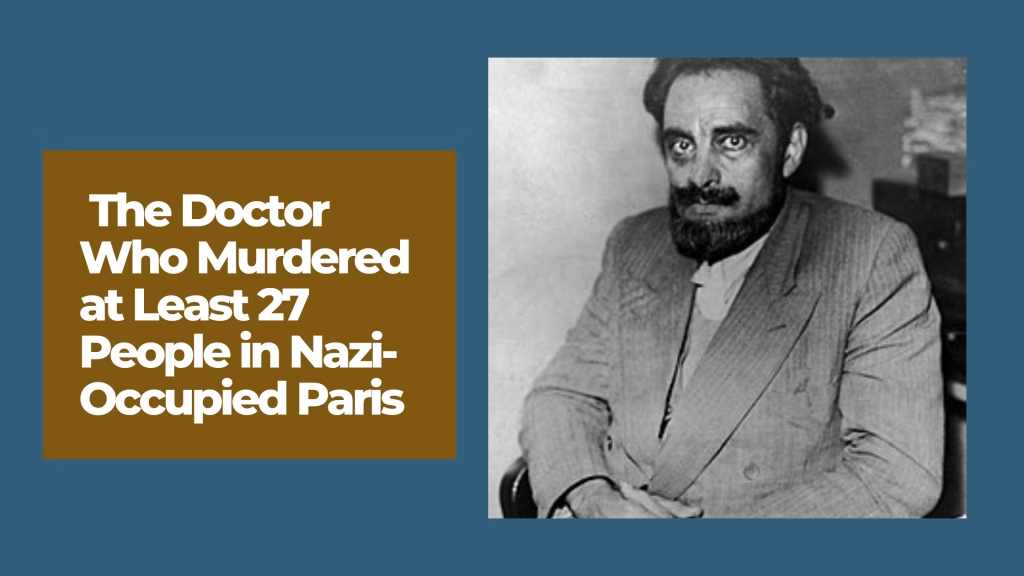
The house belonged to Dr. Marcel Petiot. And by the time police discovered his killing chamber, he had already vanished into the streets of occupied Paris.
The Mad Doctor’s Background
Marcel Andre Henri Felix Petiot was born on January 17, 1897, in Auxerre, about 100 miles south of Paris. From childhood, something was clearly wrong with him.
Neighbors later claimed he enjoyed torturing small animals to death. Teachers found him intelligent but also a loner with a short attention span. At age 11, he stole his father’s revolver and fired it during history class. He staged a circus act at school, standing a friend against the door and throwing knives at him.
Between 1907 and 1909, his parents told doctors that Marcel suffered from convulsions, sleepwalking, and habitually wet himself. After his mother died in 1912, his behavior worsened.
At age 17, he robbed a postbox and was charged with mail theft. A psychiatrist evaluated him and declared him “an abnormal youth suffering from personal and hereditary problems which limit to a large degree his responsibility for his acts.”
It was enough to get the charges dropped. The pattern was forming: no matter what Petiot did, his supposed mental illness got him off the hook.
World War I and Medical School
In January 1916, Petiot was drafted into the French infantry during World War I. He was gassed and wounded by grenade fragments in 1917. The wounds healed, but Petiot displayed mental illness symptoms that sent him to psychiatric clinics.
When he was caught stealing Army blankets, doctors diagnosed him with “mental disequilibrium, neurasthenia, mental depression, melancholia, obsessions, and phobias.” Once again, they ruled him not guilty by reason of insanity.
In June 1918, Petiot shot himself in the foot. He displayed convulsions at a railway depot, lying unconscious for most of a day. The diagnosis now includes amnesia, sleepwalking, depression, and suicidal tendencies.
He was finally discharged in July 1919 with a 40% disability pension. That rating was increased to 100% in September 1920, with one doctor suggesting Petiot be committed to an asylum.
Instead, Petiot entered a mental hospital as a student.
Through an accelerated education program for war veterans, he completed medical school in just eight months and served a two-year psychiatric internship. He received his medical degree on December 15, 1921.
A man diagnosed as criminally insane was now a licensed physician.
Mayor of Villeneuve
In 1922, Petiot moved to Villeneuve-sur-Yonne, a village 25 miles from Auxerre. He immediately began promoting himself with flyers that read: “Dr. Petiot is young, and only a young doctor can keep up to date on the latest methods.”
Behind the charming facade, Petiot was a thief and a fraud. He enrolled patients for state medical assistance without telling them, ensuring he got paid twice: once by the patient and once by the government. He prescribed dangerously high doses of addictive narcotics. When a pharmacist complained about a near-fatal dose prescribed for a child, Petiot replied: “What difference does it make to you? Isn’t it better to do away with this kid who’s not doing anything but pestering its mother?”
In March 1922, Petiot began an affair with Louise Delaveau, a young woman whose elderly mother was his patient. Soon after the affair began, the mother’s home was burglarized and set on fire.
In May 1926, Louise disappeared. Neighbors recalled seeing Petiot load a large trunk into his car. Weeks later, a similar trunk was fished from the river, filled with the dismembered remains of a young woman who was never identified.
Police briefly searched for Louise, then dismissed her as a runaway. She may have been Petiot’s first murder victim.
That same year, Petiot ran for mayor of Villeneuve. He won by a landslide after hiring an accomplice to disrupt a debate with his opponent by cutting power to the entire village and starting several fires.
Villeneuve now had a certified madman in charge.
A String of Suspicious Deaths
As mayor, Petiot’s kleptomania became an open secret. He was suspected of stealing money from the town treasury, a bass drum from the local band, even a large stone cross he’d once called an eyesore.
In March 1930, a fire destroyed the home of dairy unionist Armand Debauve. His wife Henriette, was found inside, beaten to death. Police suspected murder during a robbery, as 20,000 francs were missing.
Rumors spread that Henriette was Petiot’s mistress and that he’d been seen near her home the night of the crime. A witness named Fiscot planned to testify but made a fateful visit to Dr. Petiot’s office instead. He sought treatment for rheumatism, received an injection, and died three hours later. Petiot signed the death certificate, blaming an aneurysm.
By 1931, prosecutors were investigating numerous complaints against Mayor Petiot. He was suspended twice and eventually resigned. But five weeks later, he won the election as a general councilor.
In January 1933, Petiot moved his family to Paris for a fresh start.
Building a Practice in Paris
Petiot promoted himself aggressively in Paris, advertising a wide variety of treatments and claiming both real and imaginary credentials. He erected a brass plaque outside his office so packed with false endorsements that another physician complained, and he was forced to remove it.
Despite the bogus credentials, Petiot attracted thousands of patients. Years later, in 1944, police would interview 2,000 of them without hearing a single word of criticism.
But rumors persisted that Petiot performed illegal abortions and supplied addicts with drugs under the guise of treatment.
In 1934, a young woman named Raymonde Hanss visited Petiot for treatment of an abscess. She never regained consciousness after surgery and died several hours later. An autopsy revealed significant morphine levels, but authorities closed the case without charges.
Petiot was caught shoplifting a book in April 1936. He assaulted a policeman and escaped on foot. When he surrendered two days later, he tearfully pleaded for mercy, citing his military records as proof he wasn’t responsible for his behavior. Police dropped the assault charge. He was acquitted of theft on grounds of insanity.
The Nazi Occupation Changes Everything
In June 1940, German troops seized Paris. A collaborationist French government was organized while resistance fighters armed themselves for guerrilla war.
For Dr. Petiot, the Nazi occupation opened up a world of deadly opportunity.
Read more: Cedric Maake: The Serial Killer Who Terrorized Johannesburg for Over a Year
He began providing false medical certificates to Frenchmen drafted for slave labor. He treated sick workers who returned from Germany. He may have genuinely helped some resistance efforts.
But mainly, Petiot saw a chance to exploit desperate people willing to pay anything for escape.
The Escape Network
After 1940, Petiot’s chief operation involved disclosing escape routes to potential fugitives. He welcomed Jews, resistance fighters, and petty criminals. Anyone who could meet his price of 25,000 francs per person.
For that amount, Petiot promised safe passage to South America, complete with all necessary travel papers.
In 1941, he bought the house at 21 Rue Lesueur as a “way station” for his underground railroad.
Among his early customers were two Parisian pimps, Joseph Reoreco and Adrien Estebeteguy, who were wanted by French and German police for armed robbery. In September 1942, Reoreco traveled with his mistress and another couple. They paid the fee and vanished.
Estebeteguy and his girlfriend followed in March 1943. They also vanished without a trace.
Petiot would later boast of killing all three pimps and their women, branding them as Nazi collaborators.
By April 1943, Gestapo officers reported hearing talk of an organization offering clandestine crossings into Spain using falsified Argentinian passports. The Nazis claimed voyagers traveled on neutral ships leaving from Portugal.
In fact, none of them ever left Paris alive.
The Victims
The list of people who disappeared after visiting Dr. Petiot grew longer:
Nelly Denise Hotin, a pregnant newlywed seeking an abortion in July 1941. Never seen again.
Dr. Paul Braunberger, an elderly Jewish doctor who disappeared from a Paris subway station in June 1942.
The Kneller family, three German Jews whose dismembered remains were fished from the Seine in August 1942.
The Wolf family, who disappeared along with six friends.
Joseph Piereschi, another pimp, vanished with his mistress, Josephine Grippay.
Police dragged numerous dismembered bodies from the Seine throughout 1942 and 1943. The remains included nine heads, four thighs, and various other mutilated pieces. French police were baffled.
The Gestapo, for their part, cared less about dead Frenchmen than about Jews and resistance fighters escaping to freedom.
Petiot’s Arrest and Release
In May 1943, an informer named Charles Beretta infiltrated Petiot’s network. The Gestapo arrested several accomplices, who eventually identified “Dr. Eugene” as Marcel Petiot.
Petiot spent eight months in prison, where he was tortured repeatedly. But he staunchly refused to betray resistance members. Based on tales he later told, his silence may have come from simple ignorance. He had no names to offer because he played no significant role in the real resistance.
Any confession of his escape operation would have been tantamount to suicide.
Frustrated, the Nazis released Petiot in January 1944.
Ironically, the months of torture and confinement gave Petiot his best cover yet. Here was a man who’d been imprisoned and tortured by the Gestapo. Surely he was a hero?
The Discovery
When police entered 21 Rue Lesueur on March 11, 1944, they found a house of horrors.
In the basement, a stove burned at full blast with a human arm hanging from its door. Coal was mixed with human bones and body fragments. A large heap of quicklime contained more human remains, including a recognizable scalp and jawbone.
In the stable, a pit had been dug and filled with quicklime and corpses in various stages of decomposition.
On the staircase, police found a canvas sack containing half of a headless corpse.
The basement had sinks large enough for draining the corpses of blood. There was a soundproof octagonal chamber with wall-mounted shackles and a peephole in the door.
When Dr. Petiot finally arrived on his bicycle, he told police: “This is serious. My head could be at stake.” After questioning each officer to make sure they were French, he identified the bodies as “Germans and traitors to our country.”
He claimed to be the head of a resistance group and said he had 300 files at home that must be destroyed before the enemy found them.
The French policemen, embittered by years of Nazi occupation, let him leave.
Seven months would pass before they saw him again.
Life as a Fugitive
Loyal patients and friends helped Petiot survive as a fugitive. They shuttled him from address to address in Paris while he grew a beard and adopted multiple false names.
In August 1944, Petiot joined the French Forces of the Interior under the name Henri Valeri. He was commissioned as a captain in charge of counter-espionage.
His cover began unraveling in September when two soldiers from his unit robbed and murdered an elderly mayor. When three witnesses reported the crime, Captain Valeri tossed them in jail and ordered another officer to stop investigating.
Soon after, the newspaper Resistance published an article about fugitive Petiot. He sent a letter to his former lawyer condemning the article as lies, which confirmed he was still in Paris.
On October 31, 1944, Petiot was recognized and arrested at a Paris Metro station. He carried a pistol, 31,700 francs in cash, and 50 documents in six different names.
His long run was over.
The Trial
Petiot’s defense was simple: complete innocence. He admitted killing certain “enemies of France” as a resistance member but denied any murders for profit.
He claimed he first discovered corpses at 21 Rue Lesueur in February 1944, after his release from Nazi custody. He assumed they were collaborators killed by members of his network.
Prosecutors investigated and found no support for his claims. No recognized resistance groups would vouch for him. Groups he described in detail proved to be non-existent. No record survived of his alleged assassinations or secret weapons.
Petiot was charged with murdering 27 victims for an estimated 200 million francs in cash, gold, and jewels that were never recovered.
His trial began on March 18, 1946. Petiot took an active role in his defense, bantering with judges, brilling witnesses, and exchanging insults with lawyers.
He denounced one attorney as “a double agent and a defender of Jews.” He noted that victim Joseph Reoreco “had a head like a pimp, you know, like a police inspector.”
When asked about missing victim Joachim Guschinov, Petiot smirked: “South America is a big place.”
He dismissed the Wolf family as Germans, not Dutch Jews fleeing persecution. Victim Ivan Dreyfus was “a traitor four times over.”
Petiot maintained his hero’s posture to the end. He admitted to killing 19 of the 27 victims found on Rue Lesueur. They were all Germans and collaborators, of course, among the 63 enemies of France he claimed to have killed between 1940 and 1945.
The Verdict
After deliberating for three hours, the court convicted Petiot on all but nine counts. He was found guilty of 26 premeditated murders.
His death sentence was a foregone conclusion.
Attorney Floriot appealed, citing that a mistrial should have been granted after the judge and two jurors publicly declared their belief in Petiot’s guilt before deliberations. The appeal was rejected.
The day before judgment was rendered, guards found a vial concealed in Petiot’s uniform. They suspected poison, but it proved to be a sedative he’d smuggled in months earlier.
The prisoner seemed calm, smiling as he asked guards: “When are they going to assassinate me?”
The Execution
At 3:30 a.m. on May 25, 1946, a portable guillotine was delivered to Santé Prison.
Summoned from his cell, Petiot refused the traditional glass of rum but accepted a cigarette. He agreed to meet with a chaplain for his wife’s sake, telling the minister: “I am not a religious man, and my conscience is clean.”
He signed the register, had his hands bound, his neck shaved, and the collar cut from his shirt. He approached the guillotine calmly.
Dr. Albert Paul, who’d examined Petiot’s victims, noted that he “moved with ease, as though he were walking into his office for a routine appointment.”
Before being strapped to the sliding table, Petiot warned the witnesses: “Gentlemen, I ask you not to look. This will not be very pretty.”
The blade dropped at 5:05 a.m.
According to witnesses, Petiot was smiling as his head tumbled into the basket.
The Mystery That Remains
Marcel Petiot was convicted of 27 murders, but the true number was almost certainly higher. Chief coroner Albert Paul said the remains found at 21 Rue Lesueur represented far more than 10 victims.
They collected 33 pounds of charred bones, 24 pounds of unburned fragments, 11 pounds of human hair, including more than 10 whole scalps, and three garbage cans full of pieces too small to identify.
Petiot himself claimed 63 wartime killings. Modern estimates suggest the real number may have been between 60 and 100 victims.
The 200 million francs in cash, gold, and jewels stolen from his victims were never recovered. Petiot took those secrets to his grave.
Was He Really a Resistance Hero?
This question haunted the trial and continues to fascinate historians. The evidence suggests Petiot did participate in minor resistance activities. He provided false medical certificates. He may have treated wounded fighters. He definitely helped some people genuinely escape.
But the overwhelming evidence points to a serial killer who used the chaos of war to prey on desperate people. He promised salvation and delivered death. He robbed his victims of their valuables and their lives.
Petiot was no hero. He was a psychopath who found the perfect hunting ground in Nazi-occupied Paris, where desperate people would pay anything for hope, and where bodies in the Seine attracted little attention.
Doctor Satan, as he came to be known, was exactly what the name suggested: evil incarnate wearing a physician’s white coat.