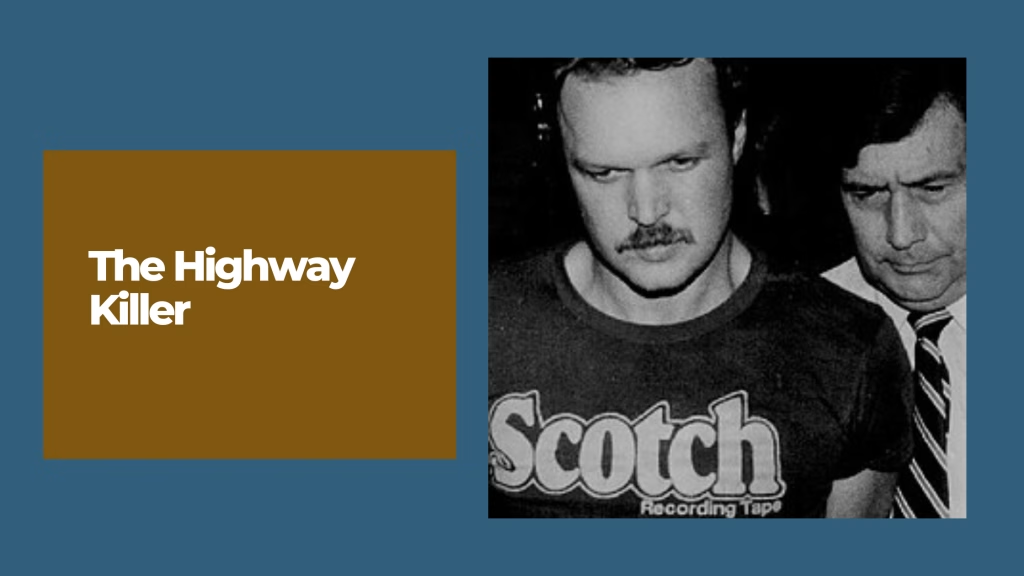
The mushroom hunters in Kenosha County, Wisconsin, thought they’d found someone’s discarded trash. It was October 4, 1983, and a plastic bag sat abandoned in the woods near the highway. But when they got closer, the horrifying truth became clear.
Inside the bag was a human torso. No head. No arms. No legs. Just a drained, sawed-apart piece of what was once a living, breathing person.
This gruesome discovery was just one piece in a terrifying puzzle that had been building across the Midwest for over a year. Young men were disappearing from highways, gay bars, and street corners. Their bodies would turn up days or weeks later, always near interstates, always brutally stabbed, often with their pants pulled down to their ankles.
Police were hunting a killer who seemed to strike at will across multiple states, leaving a trail of mutilated bodies that grew longer with each passing month. The man behind these horrors was Larry Eyler, a house painter by day who transformed into a sadistic predator by night.
By the time authorities finally stopped him, at least 21 young men were dead. But many investigators believe the real number could be as high as 70.
A Childhood Built on Neglect and Violence
Larry Eyler was born on December 22, 1952, in Crawfordsville, Indiana, the youngest of four children. From the moment he entered the world, his father, George, made it clear that Larry was unwanted. The family already had three kids, and Larry pushed his father over the edge.
George Eyler was a violent alcoholic who used his fists more often than his words. He beat every member of the family regularly, but reserved special brutality for his wife, Shirley, and his youngest son, Larry. They became his personal punching bags whenever the alcohol took hold.
Shirley did her best, working as a waitress and in factory jobs to keep the family afloat while George drank away any money he earned. By 1955, the marriage imploded completely. Shirley couldn’t take George’s abuse anymore.
What followed was a nightmare of instability for young Larry. He and his siblings were bounced between babysitters, foster homes, and relatives. Sometimes they were simply left in the care of their older siblings, who were barely more than children themselves.
Shirley desperately wanted to be loved, to find someone who would care for her. So she kept getting married. In 1957, she married another man who turned out to be an abusive alcoholic. They divorced a year later. She married again in 1960. Same result. Then again in 1972. Four weddings, four abusive alcoholic stepfathers, four divorces.
Every stepfather who entered Larry’s life brought the same toxic combination: heavy drinking and violent discipline. One particularly sadistic stepfather would punish Larry by holding his head under scalding hot water. This wasn’t discipline. It was torture masquerading as parenting.
By the time Larry reached grade school, he was fluent in neglect, trauma, and rejection. He attended St. Joseph High School in Lebanon, Indiana, where his troubles only multiplied. Tall, socially awkward, and broke, wearing shabby clothes and worn shoes, Larry became an easy target for bullies.
His sister Theresa often had to step in to protect him because Larry couldn’t defend himself. While Theresa meant well, this only humiliated Larry further. Why could his sister ward off bullies when he couldn’t? It made him feel weak and powerless.
Teachers described him as quiet and polite at first, but eventually, the constant bullying took its toll. When Larry finally started acting out and standing up for himself, Shirley immediately shipped him off to a school for unruly boys. God forbid he defend himself against his tormentors.
In 1963, Larry begged and pleaded to come home from school. His crying worked, but not before psychologists evaluated him. Their assessment: average intelligence, severely insecure, with an extreme fear of abandonment. Given his childhood, who could blame him?
The psychologists recommended he attend a Catholic boys’ home in Fort Wayne. Larry spent six months there before returning home again, unable to stick anything out.
The Shame of Being Different
Then puberty hit, one of the most confusing times in any child’s life. For Larry, it brought a realization that would haunt him forever: he was gay.
In the 1960s, in Indiana, being gay wasn’t something you celebrated. It was something you hid, something you were ashamed of. Larry came out to some close family members, hoping for support and understanding. He got very little.
Although he tried to carry himself with confidence and pride, Larry was drowning in self-hatred. He tried dating girls in high school, but none of those relationships worked because he simply wasn’t attracted to women. And that was okay, or at least it should have been.
He confided in a few people about his religious guilt and sexual confusion, but this was a time when empathy for LGBTQ+ individuals was rare. People would get awkward and shut down the conversation before Larry could fully open up.
Academically, Larry struggled. He flunked high school but managed to earn his GED, which he wore like a badge of honor. He drifted through odd jobs: first as a security guard at Marion General Hospital, where he was fired after six months for creeping out the people he was supposed to protect. Then he worked at a shoe store, which didn’t go much better.
Around this time, Larry started frequenting gay bars, hoping to find a place where he could be himself. He wanted to test the waters with casual hookups, maybe become more confident and secure in who he was.
It didn’t work. The more casual encounters he had, the more intense his shame became. Men who hooked up with Larry later said he couldn’t make eye contact during sex. He would turn his head away, refusing to look at them. And disturbingly, he would start shouting insults during intimate moments: “You’re a slut. You’re a bitch. You’re a whore.”
The self-hatred was eating him alive.
The Leather Scene and Robert Little
By the mid-1970s, Larry was a well-known figure in the Midwest gay community, particularly in the leather crowd. Picture him strutting into clubs wearing tight leather shirts, pumping iron at the gym, acting like he was God’s gift to the Midwest just because he had some muscle.
Some people saw him as a good-looking bodybuilder, devoted to his mother and sisters. Others who got close to him saw something far darker. They described how quickly Mr. Chill could transform into Mr. Psycho, especially behind closed doors.
In the bedroom, Larry was a full-fledged sadist. He didn’t care what his partners were comfortable with or wanted. He would beat them, use knives and razors to slice their flesh. This wasn’t a rumor. This was a preview of the horror to come.
By day, Larry worked as a house painter. By night, he would dress up in camouflage and pretend to be a Marine, despite never serving a day in his life. Around this time, he moved into a condo in Terre Haute with a 38-year-old library science professor named Robert David Little.
The two had met at Indiana State University in 1974. Larry later claimed Robert was like a father figure to him, the father he never had. But this “father role” wasn’t as innocent as it sounds.
Larry and Robert started hitting gay bars together like a tag team. Robert was socially awkward and not conventionally attractive, so he struggled to meet men on his own. Larry, with his looks and confidence, would be the one to bring men home to their condo.
The condo became a base for their predatory nighttime lifestyle. It was here that Larry’s violent, sadistic fantasies were fed, reinforced, and given space to grow in private.
The First Attack: A Preview of Horror
On August 3, 1978, Larry crossed the line from creepy bar guy to attempted murderer. He picked up 19-year-old hitchhiker Craig Long, using the standard predator playbook: lure, proposition, intimidate.
When Craig sensed danger and tried to leave, Larry pressed a knife to his chest. Craig, terrified, told Larry he had no money, nothing of value. Larry responded chillingly: “It’s not your money I’m interested in.”
Larry drove Craig to a rural field and forced him to strip naked. He handcuffed him, bound his ankles, and threw him in the back of his truck. As Larry began undressing, Craig saw an opening. With Larry’s pants around his ankles, Craig bolted from the truck and ran.
But Larry caught up. Craig felt a sharp plunge in his chest. He’d been stabbed, and the blade punctured his lung. But Craig was smarter than Larry could ever be. He immediately played dead.
Convinced he’d killed Craig, Larry took off. The moment he was gone, Craig dragged himself to a nearby house and called the police.
Here’s the audacity of Larry Eyler: he actually went to that same house, acting like he was there to pick up a lost wallet. When police arrived, Larry claimed the stabbing was “simply an accident” and that they were “just playing around.”
Police searched Larry’s truck and found what could only be described as a serial killer starter kit: hunting knife, butcher’s knife, handcuffs, metal-tipped whip, tear gas, another set of handcuffs, rope, and yes, a sword. Because what house painter doesn’t keep a sword in their truck?
This should have been the end of Larry Eyler’s freedom. But it wasn’t.
Justice Denied
The legal aftermath was a farce. Larry was charged with aggravated battery and initially pleaded guilty. Friends and family raised his $10,000 bond, and he was released. Then Larry’s lawyer, funded by Robert Little, offered Craig Long $2,500 to drop the charges.
Craig was traumatized and terrified. He just wanted to move on with his life. So he took the deal.
Larry immediately switched his plea to not guilty. In November 1978, he walked out of court acquitted, paying only a $43 court fee.
Can we even call that a slap on the wrist for attempted murder?
But Larry learned something crucial from this experience. His lesson wasn’t that attempted murder is wrong. His lesson was that he could never leave a witness alive again. Next time he struck, every victim had to die.
John Dobrovolskis: A Toxic Triangle
In August 1981, Larry entered what appeared to be a real relationship, though it was as toxic as you’d expect. Twenty-year-old John Dobrovolskis was a married man living in Chicago with his wife, Sally, and five children (two biological, three foster kids).
John was outwardly heterosexual but secretly gay. Shockingly, Sally loved him enough to tolerate his desire for gay relationships while maintaining their marriage. She even allowed Larry to stay at their place on weekends like a live-in lover, with Larry paying a third of the rent.
It was a triangle, except Sally was never allowed in on the “good stuff.”
Larry and John were both into sadomasochistic sex, which isn’t a crime when it’s consensual. But over time, Larry pushed things to extreme levels of degradation. He would tie John to devices, beat him, lash him, all while hurling insults: “You’re a whore. You’re a bitch.”
Their fights were explosive too, with Larry constantly accusing John of infidelity. The hypocrisy was staggering. Larry was fine with John cheating on his wife, but couldn’t stand the thought of John being with anyone else. And Larry himself was sleeping with other men at the time.
Weirdly, when John would slap or beat Larry during arguments, Larry never fought back. No one knows why.
Meanwhile, Robert Little kept trying to sabotage Larry’s relationship with John. The “father figure” apparently wanted to be the lover figure.
By this point, Larry was living a double life. During the week, he played live-in lover with John’s family in Illinois. On Saturdays, he’d drive to Indiana, work as a liquor store clerk, and return to the condo with Robert Little in Terre Haute.
Two states. Two lives. Two men. And underneath it all, his violent urges were intensifying by the day.
The Highway Murders Begin
Between 1982 and 1984, Larry Eyler transformed from a predatory creep into a full-blown serial killer. He’s been tied to at least 21 murders of young men, though many investigators believe the real number exceeds 70.
His method was consistent: lure victims with promises of drugs, alcohol, or sex. Knock them out. Bind them. Release his sadomasochistic rage through torture and stabbing. Then dump their bodies near highways like trash.
Most victims were stabbed in the chest or abdomen. Many had their pants and underwear pulled down to their ankles. Shirts and wallets were usually missing. Some victims were disemboweled. At least four were dismembered.
Every single victim was discarded like garbage.
October 12, 1982, marked the first known attack of this killing spree. Larry lured 21-year-old Craig Townsend into his vehicle in Crown Point, Indiana. He drove Craig to a rural field, drugged him, beat him, slashed him, and left him for dead in the cold.
Miraculously, Craig survived. Larry’s “system” still wasn’t perfect.
Eleven days later, Larry tried again. He abducted 19-year-old Steven Crockett. This time, the young man didn’t get away. His body turned up 12 hours later in a cornfield, stabbed 32 times, including four stab wounds to his head.
Just one week later, 26-year-old Edgar Undercofler vanished from Rantoul, Illinois. His body wouldn’t surface until March 1983.
The following month brought another victim: 25-year-old John Johnson. His body was found a month later, killed in the same way.
Then, 19-year-old William Lewis was stabbed to death while hitchhiking.
Larry’s pace was escalating. He was killing weekly, sometimes monthly, striking whenever he saw opportunity.
The Bodies Pile Up
On December 19, 1982, 23-year-old Steven Agan was taken from Terre Haute. When investigators found his body nine days later, they discovered something straight out of a nightmare.
Steven’s body was found in an abandoned farm outbuilding near Indiana State Route 173. Chunks of human flesh clung to the plaster walls, suggesting the young man had been suspended and restrained while Larry slashed and stabbed him.
The coroner said there was “tremendous rage” in this killing. The wounds suggested there might have been more than one perpetrator.
The same day the autopsy was completed, another victim appeared: 21-year-old John Roach. His body was found near Interstate 70 with eerily similar injuries.
By December 30, Larry had snatched 22-year-old Yale graduate David Block from Highland Park. David’s case made headlines because he was a Yale graduate. But what about the young hitchhikers? Why weren’t they making headlines? Every victim was equally important, but society didn’t see it that way.
David’s body wouldn’t be found until May 1984.
January 24, 1983: 16-year-old Ervin Gibson was abducted in Lake County, Illinois. His body wasn’t found until April, dumped on top of a dead dog that Larry had also stabbed to death.
Between March and April 1983, Larry killed at least five more victims aged 17 to 29.
May 9 brought the discovery of 21-year-old Daniel McNeive. His body was found near Indiana State Road 39 with 11 knife wounds to his neck, five to his back, and 11 to his abdomen. His intestines were protruding from his body. Welt marks on his wrists and ankles showed he’d been bound and restrained.
Nine days later, 25-year-old Richard Wayne was murdered in Effingham, Illinois. His body was tossed off a bridge and left in a creek until December.
The Community Connects the Dots
By early 1983, the gay community was connecting dots before police did. It was clear to them that a predator was targeting gay men for murder and mutilation.
A gay newspaper called Works set up a hotline and offered a $1,500 reward for information. They speculated the killer was a self-hating man who couldn’t accept his sexuality and punished those who could.
Meanwhile, police were raiding bars and videotaping patrons, seemingly punishing the public rather than protecting them.
Finally, six days after McNeive’s body was found, Indiana State Police convened 35 detectives from four jurisdictions. They concluded one man was behind these murders and created the Central Indiana Multi-Agency Investigation Team (CIAIT).
The manhunt had officially begun.
The FBI Profile: A Perfect Match
CIAIT contacted the FBI’s National Crime Information Center, asking for help with cases involving young males who’d been abducted, stabbed, and mutilated. Calls came in immediately from Kentucky, Chicago, and other jurisdictions with similar murders.
The task force nicknamed their suspect “The Highway Murderer.”
On June 6, 1983, the first major break came. Thomas Henderson, one of Larry’s former lovers, called the confidential hotline. He gave police the serial killer rundown: violent temper, bondage kink, arrested in 1978 for stabbing a teenage hitchhiker.
Henderson also mentioned that in May 1982, Larry had abducted and drugged a 14-year-old boy, as what police believed was a “test run.”
When police ran Larry’s details through their database, everything matched. The 1978 arrest, the handcuffs, the bindings—it all aligned with the current crimes. And Larry bounced between Indianapolis and Illinois like a pinball machine.
But a match isn’t evidence. They didn’t have enough for a search warrant or full surveillance. So they quietly tracked him, hoping he’d slip up.
The FBI created a profile that could have been Larry Eyler’s dating bio: white male, late 20s to early 30s, works menial jobs, rough exterior, deep hatred for his attraction to men, projects a masculine image, hangs out at bars, pretends to hate gay men to mask his desires, night owl with rage issues.
The cherry on top? The profile predicted he might have a middle-aged, middle-class, smarter accomplice who assisted in early kills.
Hello, Robert Little.
The FBI also predicted that he covers victims with dirt to erase his crimes, is physically strong enough to overpower athletic young men, and binds victims (explaining the welts on wrists and ankles).
Larry was ticking every checkbox. The only thing missing was a neon sign saying “Serial Killer at Work.”
More Bodies, More Evidence
By summer 1983, the body count was snowballing. On July 2, farmers near Paxton, Illinois, found a partially naked young Hispanic male stabbed repeatedly in the abdomen.
Eight weeks later, a tree-trimming crew found 28-year-old Ralph Calise near Route 60 in Illinois. He’d been stabbed 17 times with a butcher knife so savagely that his intestines protruded from his body.
On September 8, investigators from multiple jurisdictions met to compare notes. When the smoke cleared, five more deaths were officially linked to the Highway Murderer. The body count had jumped to 17.
Then came one of the grisliest discoveries. On October 4, mushroom hunters in Kenosha County, Wisconsin, spotted a plastic bag containing a human torso. On October 11, the torso was identified as 18-year-old Eric Hansen, last seen alive on September 27 in Milwaukee.
Eric had been butchered. His head, arms, and legs had been sawed off with a hacksaw. His torso was completely drained of blood. His hands and head were never found.
From October 18 to 19, four bodies were unearthed near an abandoned farmhouse in Lake Village, Indiana. All partially buried, dead for months, pants bunched at their ankles. Three white victims were lined up three feet apart with heads facing north. The fourth was an African American young man. All had been stabbed at least a dozen times with a knife at least eight inches long.
The Arrest That Almost Got Away
On September 30, 1983, police pulled Larry over for a routine traffic stop on Interstate 65 near Lowell, Indiana. He had a young hitchhiker in the car with him.
When officers looked inside the vehicle, they found a serial killer kit: knives, rope, handcuffs, ankle binds, wrist straps, hammer, two baseball bats, mallet, and surgical tape.
Larry and the hitchhiker were taken in for questioning. Larry was initially charged with soliciting sex. By 1:30 p.m., CIAIT had him in an interrogation room, telling him straight up: “You’re a suspect in a string of murders.”
Larry acted cool and collected. When confronted with victims’ names, he barely flinched, saying he’d heard about them in the newspaper but didn’t know them.
He agreed to have his vehicle searched, fingerprints taken, and even agreed to a future polygraph.
Investigators tore through his vehicle and found a mobile torture kit. Boot impressions from Larry’s boots matched plaster casts taken from Ralph Calise’s murder scene, even down to wear marks. Tire tracks from his Ford pickup matched tracks at the scene.
Yet after all this evidence, he was let go.
But police knew they were close. They just didn’t want to strike too early.
The Search of Robert Little’s Condo
In the early hours of October 1, police secured a search warrant for Robert Little’s condo in Terre Haute. They found circumstantial gold: credit card receipts showing Larry had been in the right jurisdictions at the right times, phone bills showing calls made to Robert after murders, including one from a payphone near where Gustavo Herrera’s body was found.
Hospital records confirmed Larry had been treated for a deep cut on his hand the same day Gustavo was killed. Larry claimed he’d cut himself falling on glass. Receipts showed the next day he bought a new knife and new handcuffs.
One task force member stated: “If Larry Eyler is not the killer, then he’s following the real one around.”
On October 2, Larry was brought in for further questioning. This time, he admitted he liked dominant bondage play and that his relationship with John Dobrovolskis was violent. But he denied knowing Ralph Calise or visiting that murder scene.
There still wasn’t enough to formally charge him. He was released on October 4.
The minute he was released, he hired a lawyer and filed a civil suit for $250,000 against the Lake County Sheriff and Indiana State Police, claiming harassment and civil rights violations.
The Evidence Suppressed
On October 6, FBI labs confirmed Larry’s boot prints matched the casts perfectly. Four distinctive wear marks all matched. Tire tracks matched his vehicle. Blood found on the bottom of his boots was Type A—not his blood type (which was O positive), but matching his victim’s blood type.
Larry was charged with Ralph Calise’s murder on October 29. His bail was set at $1 million, and his trial was set for December 19.
But then came the bombshell.
On January 23, 1984, a hearing was held to decide whether to suppress evidence. One detective admitted Larry had been detained longer so the Indiana task force could arrive, not because of the murder charges. The only formal charge on record at that point was solicitation of sex.
Worse, Lake County and Chicago officers had entered John Dobrovolskis’ home without a search warrant.
On February 1, 1984, Judge William Block delivered a devastating ruling. While Larry had signed a Miranda waiver, investigators had held and questioned him for offenses unrelated to the solicitation charge. This tainted every piece of evidence stemming from that detention.
The judge ruled that possession of Larry’s boots and tire tread casts had been obtained without proper seizure, violating the exclusionary rule. He also criticized the affidavit used to get the warrant for Robert Little’s home.
The judge suppressed all evidence investigators had painstakingly gathered since the September 30 arrest.
Then came the final blow: Larry’s bond was cut from $1 million to $10,000.
On February 6, 1984, Larry Eyler walked out of custody. Robert Little paid the reduced bond.
Daniel Bridges: The Murder That Sealed His Fate
Within weeks, Larry moved to Rogers Park in Chicago. Robert Little paid for the new apartment and furniture.
On July 15, 1984, Larry finally got his truck back. Robert Little paid for new tires.
Investigator Dan Colin had warned Larry’s attorney after the suppression ruling: “We’ve traced Larry for a year. We’ve tied him to 21 murders. We can place him at nine scenes with receipts, calls, and gas purchases. His pattern is simple: he kills, then he calls. Now that you got him off, you’d better hope there aren’t any more long-distance calls to Terre Haute.”
Those words proved chillingly prophetic.
On August 19, 1984, around 10:30 p.m., Larry lured 16-year-old Daniel Bridges back to his Rogers Park apartment. Daniel was vulnerable, involved in male prostitution since age 12, not because he was gay but because he felt he had no other options. He was actually a close friend of Ervin Gibson, one of Larry’s earlier victims.
Inside the apartment, Larry bound Daniel to a chair, beat him, tortured him, and stabbed him to death. In his bathroom, Larry dismembered Daniel’s body into eight pieces, draining the blood from each part and stuffing the remains into plastic bags.
On August 21, the building’s janitor found the horror in a dumpster not meant for tenant use. One of the bags split open, and Daniel Bridges’ head rolled out.
The janitor had seen Larry using that dumpster the day before and immediately informed the police.
When Larry’s name came across the radio, Chicago police knew exactly who they had. Within minutes, they stormed Larry’s apartment and arrested him.
The Final Trial
A forensic sweep found massive amounts of blood across Larry’s bedroom, ceiling, chair, walls, and floors. More blood was found under the floorboards near the bathroom. Daniel’s jeans were still in the apartment, soaked with blood. They found a hacksaw with extra blades and trace amounts of blood, plus receipts proving Larry had bought the saw just days before.
Larry was immediately charged with Daniel Bridges’ murder. This time, there would be no technicalities to save him.
Larry claimed his fingerprints were on the trash bags because he was “simply trying to move them out of the way to dump his own trash.”
Dr. Robert Stein, a battle-hardened medical examiner who’d seen the worst, described the scene as “completely horrific.” Daniel had been beaten around the face and eyes, slashed with shallow cuts to make him bleed, stabbed 14 times with an awl or pickaxe focused on his sternum, and “gutted” with deep knife wounds so severe his intestines protruded. He’d also been stabbed three times in the back with enough force to puncture his heart and lung.
Dr. Stein’s conclusion: Daniel was the victim of prolonged, sadistic, deliberate torture.
The prosecution went for the death penalty, stacking charges: aggravated kidnapping, unlawful restraint, concealment of a body, and murder.
On July 1, 1986, Larry’s trial opened in Cook County. He pleaded not guilty.
The evidence was overwhelming. Blood, bags, the head rolling from the dumpster, the janitor witnessing Larry dump the bags. When Larry dumped those bags, he told the janitor: “Just dumping some shit from my apartment.”
That’s how little he thought of his victims.
The defense’s arguments were pathetically weak: maybe other men killed Daniel, maybe it was consensual, maybe Daniel walked in voluntarily because drugs and alcohol were in his system.
Even if Daniel entered voluntarily, he didn’t volunteer to be tortured and murdered.
On July 9, 1986, after three hours of deliberation, the jury returned: Guilty on all counts.
During sentencing, the prosecution brought in earlier assault victims Larry had bound, gagged, and stabbed. The defense brought in Larry’s family and a Catholic chaplain to humanize him, weeping about his abusive childhood.
Yes, his childhood was terrible. But many people survive horrific childhoods without becoming monsters. They grow up to be empathetic, kind people because they know how it feels to suffer and would never want anyone else to feel that way.
On October 3, 1986, the judge returned with his decision. He said the murder was “so barbaric it defied description.” Larry Eyler was sentenced to death by lethal injection.
The judge called him “an evil person” and stated, “You truly deserve to die for your acts.”
The Confession and Robert Little’s Trial
Larry was transferred to death row at Pontiac Correctional Center. But he wasn’t going to sit quietly.
Appeals followed. Larry tried to claim that Robert Little murdered Daniel Bridges and that he simply dismembered and disposed of the body. He also confessed to the murder of Steven Agan, carefully weaving Robert Little into the narrative as a willing participant.
By late 1990, facing a possible second death sentence for Steven Agan’s murder, Larry handed over a 17-page confession detailing the murder while implicating Robert. He tried to cut a deal for 60 years in prison rather than lethal injection.
In January 1991, Larry’s attorney made one final play: Larry would confess to 20 more murders if they revoked his death sentence. Otherwise, he’d take his secrets to the grave.
On April 11, 1991, Robert Little went on trial in Vermillion County for Steven Agan’s murder. He pleaded not guilty.
Larry testified that Robert had lured Agan with booze and drugs, performed bondage acts on him, then stabbed him to death while taking polaroids and masturbating. Larry claimed Robert ordered him to kill Steven.
Robert’s defense argued Larry had every reason to lie to save his own skin. They noted polaroids were never found.
The jury deliberated for seven hours. On April 17, 1991, Robert Little was acquitted of all charges. He walked out of court smiling, hugging his lawyer, and went right back to teaching at Indiana State University.
Steven Agan’s family was devastated.
Death Comes for the Highway Killer
On March 6, 1994, Larry Eyler died. But not from lethal injection.
He died from AIDS-related complications at age 41, apparently gravely ill for about 10 days.
While it’s satisfying that this monster is dead, it’s not the justice the families deserved.
Two days after Larry’s death, his attorney Kathleen Zellner publicly named the 17 murders Larry had privately confessed to. She still insisted that Larry claimed Robert Little was the only one who did any murdering and that he remained free.
Remembering the Victims
The crimes of Larry Eyler left a trail of devastation, but his name should never eclipse the lives he stole. Each victim had hopes, dreams, families who loved them, and futures violently taken away.
Steven Crockett, 19. Edgar Undercofler, 26. John Johnson, 25. William Lewis, 19. Steven Agan, 23. John Roach, 21. David Block, 22. Ervin Gibson, 16. Daniel McNeive, 21. Richard Wayne, 25. Ralph Calise, 28. Eric Hansen, 18. Daniel Bridges, 16.
And the unidentified victims whose names we’ll never know.
Every single one of them mattered. Every single one deserved better than to be discarded like trash along a highway.
What aspects of Larry Eyler’s case do you find most disturbing? The fact that he almost got away due to legal technicalities? The possible involvement of Robert Little? Share your thoughts in the comments below.
Related Articles You Might Find Interesting:


Pingback: Billy Chemirmir: The Man Who Murdered 18 Elderly Victims for Their Jewelry