A landlady was found dead in her bedroom in early 1953. The scene was horrifying.
She had suffered head trauma, but that’s not what killed her. Severe neck injuries caused her death. Bite marks covered her neck. Human bite marks.
Blood pooled on the bedroom floor where she’d slowly bled to death.
A month later, another woman named Camila Monreal was found dead. Same bite marks on her neck. Same internal bleeding. This time, investigators found a bloodied hammer and a broken broomstick at the scene. Her trachea had been severed.
The village of Monteros in Tucumán, Argentina, was gripped with terror. Whispers spread like wildfire: a vampire was stalking their town.
They weren’t entirely wrong. For seven years, a killer would claim 15 victims, always entering through open windows at night, always biting their necks and drinking their blood.
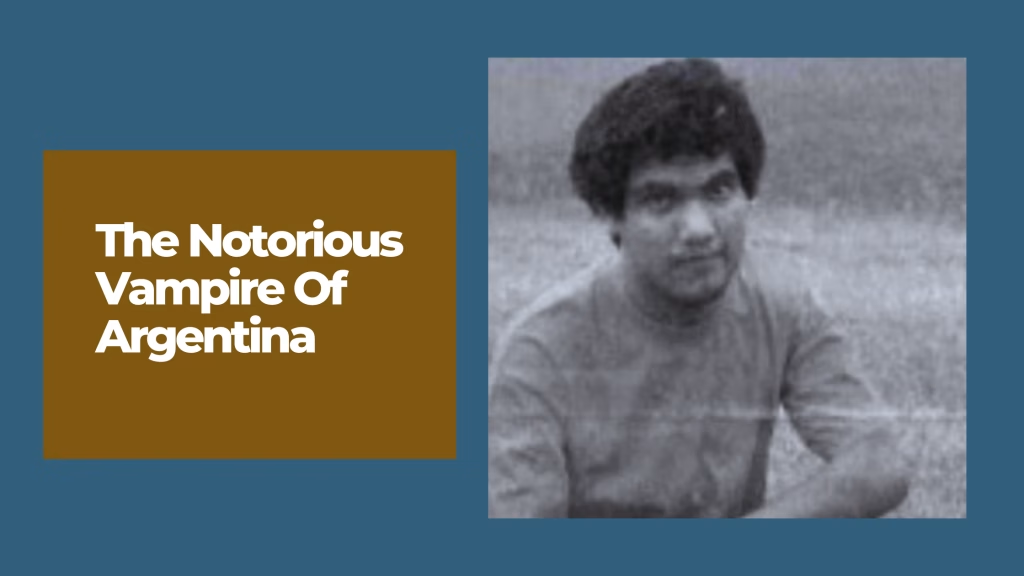
His name was Florencio Roque Fernandez. And he truly believed he was a vampire.
A Childhood of Abandonment
Florencio Roque Fernandez was born on July 15, 1935, in Monteros, Tucumán, Argentina. From birth, he faced severe health challenges.
His parents, Maria and Javier Fernandez, struggled themselves. They were unable to provide sufficient care for their son. Florencio’s turbulent upbringing would shape everything that came after.
As a child, Florencio displayed clear signs of mental illness. He likely suffered from schizophrenia, which caused delusions and vivid hallucinations.
These haunting visions convinced him of something terrifying: he was a vampire.
It wasn’t a game or a fantasy. Florencio firmly believed this identity. The delusion consumed him completely.
He also developed an unusual and disturbing attraction to blood. This obsession would only grow stronger as he aged.
Then came the worst blow of all. Florencio’s parents abandoned him when he was still very young.
Left to fend for himself, the child sought shelter in the unforgiving streets of San Miguel de Tucumán.
Life in the Cave
With no family to support him, Florencio lived in destitution. He had no warmth, no care, no guidance. Just survival on the streets.
As the years passed, his mental health deteriorated. His condition worsened without treatment or help.
Eventually, he found refuge in a secluded cave near Monteros. This dark, isolated space became his makeshift home.
The cave offered him something crucial: protection from light.
Florencio suffered from photophobia, an extreme sensitivity to light. Sunlight caused him physical pain. The cave’s darkness felt safe.
He retreated deeper and deeper into isolation, living like the vampire he believed himself to be. He slept during the day in a coma-like state. At night, he emerged.
And when he emerged at night, he hunted.
The Window Vampire
In the 1950s, Monteros was a charming village with a deadly vulnerability. The summers were scorching. Most residents kept their windows open at night to beat the heat.
This made them perfect targets.
Florencio developed a calculated method. He would carefully select his victims and stalk them for several nights. He waited patiently for the right moment when the women were alone at home.
Then, under the cover of darkness, he struck. He entered through open windows to catch them off guard.
He attacked with brutal force, biting their necks and drinking their blood. If the bite didn’t kill them, he would let them bleed to death.
After the first two murders in early 1953, panic spread throughout Argentina. Newspapers published articles about the “Window Vampire” terrorizing Monteros.
Over seven long years, he claimed the lives of 15 women.
A Town Paralyzed by Fear
The attacks were unpredictable. Sometimes he struck twice in two months. Other times, he went dormant for an entire year.
This unpredictability made him even more terrifying. No one knew when he would strike next.
Local police struggled to apprehend the killer. Every lead went nowhere. Every trap failed.
The murderer left no trace behind. This fueled townspeople’s belief that a supernatural force was at play. Maybe vampires were real after all.
In response to the mounting fear, residents took drastic measures to protect themselves. Large crucifixes appeared on homes, blessed by priests with holy water. Some people kept sharpened wooden stakes at the ready, prepared to defend themselves against a vampire attack.
Windows that had once been left open to catch the summer breeze were now locked tight, even in the oppressive heat.
Still, the vampire found ways inside.
The Capture
On February 14, 1960, the 15th victim was murdered. This tragedy finally prompted action from federal authorities.
Investigators from Buenos Aires arrived to assist with the case. They mapped out all the attacks and made a chilling discovery: every incident occurred close to an abandoned region on the outskirts of town.
Armed with this information, police embarked on a search operation. What they found shocked them.
A young man was living in a cave. He appeared to be in terrible physical condition, malnourished and weak.
When officers tried to bring him out into the sunlight, he retreated deeper into the darkness. The light caused him visible distress.
The man was 25-year-old Florencio Fernandez.
During the day, he remained in a coma-like sleep. At night, he rose wearing a black cloak, prowling the village like Dracula himself.
He was arrested on February 14, 1960. But his capture raised serious concerns about his mental state.
The Diagnosis
Following his arrest, doctors evaluated Florencio. The diagnosis was clear: schizophrenia.
The Mayo Clinic defines schizophrenia as a disorder involving delusions, hallucinations, disrupted thought processes, abnormal speech patterns, and other symptoms that severely affect functioning.
Florencio displayed all these symptoms. But he’d never received treatment or support for his illness until after he’d committed these terrible acts.
His delusions of being a vampire weren’t an act. They were symptoms of severe, untreated mental illness.
His photophobia was also real. Sunlight genuinely caused him pain and terror. This condition contributed to his secluded lifestyle in the cave, which only reinforced his vampire delusions.
Unfortunately, Florencio didn’t receive help until it was far too late.
No Trial
Because of his severe mental illness, Florencio was deemed unfit to stand trial for his murders.
Instead, he was committed to a psychiatric institution for the rest of his life. There, he would finally receive the treatment he’d needed since childhood.
Read more: Marcel Petiot: The Doctor Who Murdered at Least 27 People in Nazi-Occupied Paris
Years later, Florencio Roque Fernandez died from natural causes while still institutionalized.
The Tragic Reality
What makes Florencio’s story particularly disturbing is how young he was when the violence began. His first victim fell prey to him when he was just 17 years old.
From that point forward, violence and darkness tainted his entire existence.
Could these murders have been prevented? Almost certainly.
If Florencio had received proper mental health treatment as a child, if his parents hadn’t abandoned him, if society had supported him instead of leaving him to live in a cave, 15 women might still be alive.
This isn’t a story about a supernatural vampire. It’s a story about the deadly consequences of untreated mental illness.
Were There Really Vampires?
In the 1950s, belief in the supernatural was still strong in rural Argentina. When residents of Monteros heard about bite marks on necks and blood being consumed, their minds went to vampires.
The crucifixes, the holy water, the wooden stakes. These weren’t just superstitions. People genuinely believed they were under attack by the undead.
In a way, they were right to be terrified. A predator was hunting them at night. He did drink their blood. He retreated to a dark cave during the day.
But Florencio Roque Fernandez wasn’t a supernatural creature. He was a deeply troubled young man suffering from severe schizophrenia, abandoned by his family, left to spiral into delusion and violence.
The real horror isn’t that vampires exist. It’s that society failed this young man so completely that he became a monster.
The Victims We Remember
Fifteen women lost their lives to Florencio Fernandez between 1953 and 1960. Most of their names have been lost to history, but they deserve to be remembered.
We know a few:
- A kind landlady, the first victim in early 1953
- Camila Monreal, a Mexican citizen
These women were daughters, sisters, mothers, friends. They lived in a small, tight-knit community where everyone knew each other.
Their murders traumatized an entire village for years. Even after Florencio’s capture, many residents never felt truly safe again.
Lessons From a Tragedy
Florencio Fernandez’s case serves as a cautionary tale about the critical importance of mental health treatment.
Schizophrenia is a serious condition, but it’s treatable. With proper medication and support, people with schizophrenia can live stable, fulfilling lives without posing danger to themselves or others.
But when mental illness goes untreated, especially when combined with abandonment, poverty, and isolation, the results can be catastrophic.
Florencio’s parents couldn’t care for him. The community didn’t step in. He fell through every crack in the system. By the time he was finally caught, 15 women were dead.
How many other “monsters” are really just people with untreated mental illness who needed help?
The Shadow of the Vampire
Today, Monteros has moved past the terror of the 1950s. But the legend of the Window Vampire still lingers in local folklore.
Older residents remember the fear. They remember locking their windows even in the brutal summer heat. They remember the crucifixes and the wooden stakes.
Some still believe there was something supernatural about Florencio Fernandez. How else could one person evade police for seven years? How else could he kill so many without leaving evidence?
The truth is simpler and sadder. Police in the 1950s didn’t have the forensic tools we have today. A killer who lived in a cave on the outskirts of town, who only emerged at night, who had no fixed address or job or social connections, was nearly impossible to track.
Florencio wasn’t a vampire with supernatural powers. He was just invisible to a system that had already forgotten he existed.
A Final Thought
As we look back on the case of Florencio Roque Fernandez, we’re left with haunting questions.
Are vampires real? No. But monsters created by neglect, mental illness, and societal failure? Those are very real indeed.
Florencio’s first murder happened when he was 17. He was abandoned as a child. He lived on the streets, then in a cave. He suffered from severe schizophrenia that made him believe he was a vampire.
At what point did society fail him? At every point.
His story should serve as a reminder: mental health matters. Early intervention matters. Supporting vulnerable children matters.
The shadows don’t hold supernatural secrets. They hold forgotten people who needed help and never got it.