Giorgio Centanaro, 58 years old, lay dead in his living room on October 16, 1997. Cards spread across the table. Lights still on. No signs of break-in. No signs of struggle. Doctors declared it natural causes. A simple heart attack. Case closed.
Except it wasn’t a heart attack. Someone had murdered Giorgio. The first victim of what would become Italy’s most prolific serial killer. Within six months, 16 more people would die. Elderly couples shot in their homes. Sex workers executed on hillsides. Women murdered in train bathrooms. A gas station attendant gunned down during his shift. All killed with the same .38 caliber revolver. All by the same man.
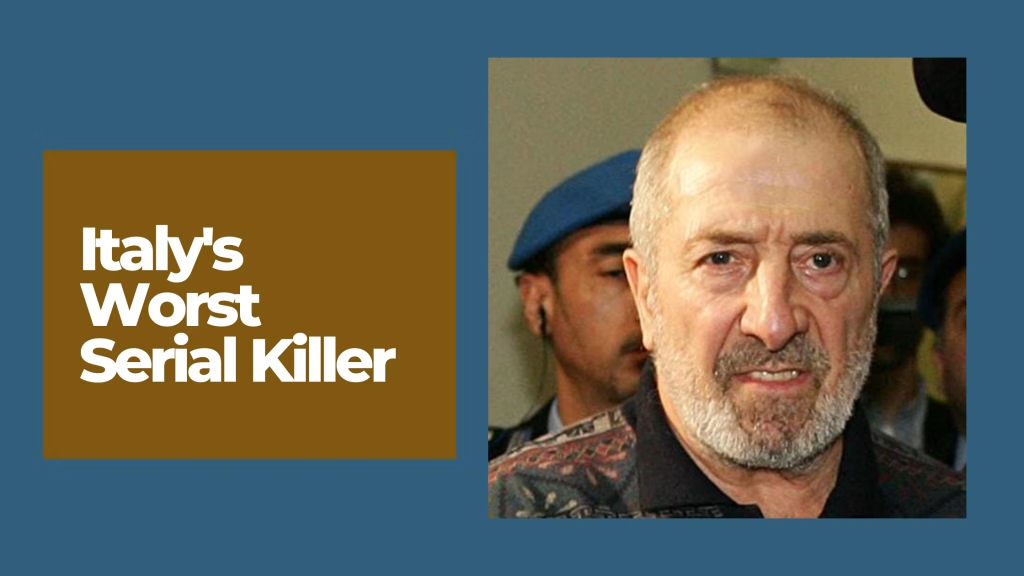
Donato Bilancia didn’t look like a killer. At 47 years old, he was quiet. Unremarkable. Known for petty crimes, not violence. Friends described him as refined and polite. A gentleman who opened car doors and pulled out chairs. But between October 1997 and April 1998, this ordinary-looking man became Italy’s nightmare. The Monster of Liguria. The Train Killer.
By the time police caught him in May 1998, he had murdered 17 people across the Liguria region. Used the same gun. The same unusual ammunition. Left DNA at a crime scene. When detectives finally arrested him, Donato confessed to everything. Drew diagrams of each murder. Showed no remorse. And when asked why he killed, he had no clear answer. He just wanted to kill.
This is the story of how Italy’s worst serial killer terrorized an entire region for six months. And why nobody saw it coming.
Genoa in the 1990s: A City Already Struggling
Liguria in Italy is a narrow strip of land squeezed between the Alps and the Mediterranean. A region marked by its own beauty. Hills covered by vineyards. Salty breeze rising from cliffs. At the heart of this coastal strip sits Genoa. The capital of tight alleys and interwoven lanes like a labyrinth. Carrying the famous Italian charm.
The Economic Collapse
But behind all this romanticism, Genoa also guarded deep scars. Until the mid-1990s, the city always dealt with problems. Starting from the 1950s, when Genoa began feeling the weight of unbridled modernity.
Real estate speculation took over neighborhoods. Suffocating small communities. While a wave of immigration from southern Italy made everything more turbulent. Rapid growth, poorly planned, brought instability and tension.
Over time, neglected areas emerged. Where crime began infiltrating like a parasite. Small thefts became routine. The general feeling was unease and rebellion. Giving rise to small gangs.
Rising Crime Rates
In the following decades, Genoa also dealt with economic crisis. Unemployment increased. Businesses closed. Many Genoese began looking to the future with distrustful eyes. Genoa seemed to be adrift.
It was in this scenario of social wear that something even more sinister emerged. Serial homicide victims. These victims appeared suddenly. From a guard. A woman returning home. An elderly man. Or a young prostitute. People who had nothing in common. Except being in the wrong place at the wrong time.
Genoa was always resilient. Accustomed to the unexpected. Authorities, in a way, always managed to restore order. But this? This was different. Something nobody was prepared to face.
The First Murder: October 16, 1997 – Death Disguised as Natural
The morning of October 16, 1997, began like any other in the discreetly dusty apartment buildings of Genoa. Soon, however, the community was shaken by disturbing news.
Giorgio Centanaro Found Dead
According to local press, in one of those apartments, the body of Giorgio Centanaro, 58 years old, was found stretched out in the living room. Giorgio was a known face in the region. Especially in the underworld of betting and gambling. In the past, he’d been a promising businessman. But in recent years, he frequented gaming houses scattered throughout Genoa. Mainly the more hidden ones in outlying neighborhoods.
When they found him, the apartment lights were still on. An open deck of cards rested on the living room table. The absence of signs of invasion or violence made his death a mystery.
However, upon being examined by coroners, authorities quickly declared the case simple. Death by natural causes. A sudden heart attack that came as a surprise. According to them, a solitary end. Without apparent mystery. At least that’s what they believed.
Something Felt Wrong
But something about that scene left neighbors uncomfortable. The way the body was arranged. The environment too organized. The lack of signs of struggle seemed strange for someone like Giorgio Centanaro.
Still, investigators disagreed. Archived the case quickly. Although rumors circulated in the following days, the matter soon fell into oblivion. But this lasted only eight days. Until another event would mark the beginning of something strange in Genoa.
October 24, 1997: The Newlyweds Murdered
It was October 24, 1997. A common Friday for most. Except for Maurizio Parente, 42 years old, and his wife Carla Scotto, 34. Married less than three weeks. Still living under the spell of their honeymoon. Newly installed in a modest but comfortable house in the Alvaro neighborhood. A quiet area sought by families looking for peace.
The Honeymoon That Ended in Blood
The couple’s happiness, however, was interrupted brutally. Early in the evening, Maurizio and Carla were found dead. Executed in cold blood inside their home.
Both were shot several times with a .38 caliber weapon. But the scene shocked even more. The bodies were tied with marks from handcuffs and industrial tape. Everything indicated the killer controlled his victims before killing them.
Police also discovered that the house safe had been forced open. They took five valuable watches. A large amount of cash. Curiously, there were no signs of break-in on doors or windows. No apparent struggle.
This made investigators believe the criminal knew the couple. Knew exactly where to look. The hunt was beginning. But Genoa would soon be shaken by another case.
October 27, 1997: The Elderly Jewelers Shot Dead
Just three days later, on October 27 of that year, a Monday, the bodies of Bruno Solari, 65 years old, and his wife Maria Luigia Pitto, 71, were found dead in the apartment where they lived.
Respected Jewelers Targeted
The death of the elderly couple shocked even more. Bruno and Maria were respected jewelers. Owners of a store that for decades served the entire region. Even retired, they maintained a valuable collection of jewelry. Stored as inheritance from a lifetime of work.
According to the press, the couple was shot with multiple shots from a .38 caliber weapon. They had no chance of defense. The safe hidden behind a bookshelf was found forced open and empty.
Just like before, there were no signs of invasion. Intact doors. Closed windows. The killer entered and left through the front door. Police classified the crime as intentional homicide with qualified robbery. But the similarities with the previous case made it impossible to ignore.
Genoa might have a serial killer.
November 13, 1997: The Money Changer in Ventimiglia
Fifteen days passed since then. The climate in the city changed. The press talked about nothing else. Panic spread throughout Liguria. Two brutal crimes. Same signature. Point-blank shots. Violated safes. No clues.
Then on November 13, 1997, horror advanced toward the coast. Crossing the Ligurian coastline. Reaching Ventimiglia, a small commune known for tourist traffic.
Luciano Marro’s Office
There, in a discreet building without commercial signs, operated the office of Luciano Marro. A famous money changer for his contacts and large volumes of money he handled.
That afternoon, Luciano’s workday ended abruptly and violently. He was found dead. His body riddled with bullets. Fallen between the desk and the back safe. Nobody heard anything. The door was intact. No signs of struggle. The safe, once again, had been opened and emptied.
For those who knew Luciano, his death seemed like more than a simple robbery. Ventimiglia police believed in a settling of accounts. Despite similarities with previous cases, lack of communication between jurisdictions made the crime go unnoticed.
In the following months, each police station would continue investigating in isolation. While winter came to Italy. And new deaths emerged with the cold.
January 25, 1998: The Night Watchman
The first occurred on January 25, 1998, on a freezing night. It was a merciless night when night watchman Giorno, 52 years old, was found fallen on the concrete floor of one of the buildings he patrolled.
Shot Multiple Times
He had been shot several times. There were no signs of struggle. No personal objects were taken. Giorno worked alone in an industrial area of Genoa. Nobody heard anything.
Preliminary reports spoke of frustrated robbery or personal revenge. Some suspected he had seen something he shouldn’t have. But for authorities, the crime was treated as isolated. Without relation to the couple murders the previous year.
March 1998: The Sex Workers Start Dying
More than a month later, a few days before winter’s end, the naked body of sex worker Bandeerana Almerina, 25 years old, was found among bushes on a remote hill near Varazze.
A Single Shot Behind the Ear
The coroner concluded the cause of death was a single shot behind the right ear. The ballistics team confirmed: .38 caliber weapon. There were no signs of sexual violence. Something uncommon for such cases.
Investigators noted the location was difficult to access. Far enough that nobody would hear the shot. Death probably occurred between 3 and 4 AM the previous day. Due to the victim’s profile, the case was treated as isolated.
Until three days later, another body appeared.
Ludmila Subscova Found Dead
This time in Pietra Ligure, about 70 km away. Near Corona General Hospital. On vacant land. The cadaver was Russian sex worker Ludmila Subscova, 23 years old.
Unlike Bandeerana, Ludmila was fully dressed. But she also presented only one fatal wound. A single .38 caliber shot behind the right ear. The coroner also found no signs of sexual violence or physical aggression.
The similarity between cases was evident. In both, victims were executed cleanly. Without excess brutality. These murders left investigators intrigued. The murder weapon was the same.
Still, lack of communication between authorities made cases be seen as isolated. Common when women like them are killed by pimps.
March 1998: More Bodies, Same Gun
March continued with new deaths. Back in the Ventimiglia region, money changer Enzo Gorne was found dead. Fallen over his work desk.
The Pattern Becomes Clear
Just like Luciano Marrow, he was shot by a .38 caliber weapon. Had his office safe emptied. Again, there were no witnesses. No traces of the killer.
And it didn’t stop there. A few days later, another crime shocked Genoa. Two night watchmen, Massimo Galilo and Candido Rando, were found dead. Shot several times by a .38 caliber weapon. Their bodies were near the base of a tree. As if they had been surprised during their rounds. No chance of reaction.
The Survivor: Lorena Castro
However, they weren’t alone. Nearby, among bushes, there was a third body. When found, rescuers noticed the victim was still breathing. She was rushed to the hospital. After hours of surgery, she survived.
It was a transsexual named Julio Castro. Better known as Lorena, 24 years old. In her statement, Lorena said she was shot twice in the abdomen. But pretended to be dead until the killer left.
According to her, the criminal clearly wanted to kill her. Had strange and cold behavior. Lorena still claimed to be certain he was also responsible for the deaths of other sex workers.
Investigators couldn’t ignore the similarities.
The First Sketch
Ballistics confirmed that shots against the watchmen and Lorena came from a .38 caliber weapon. For the first time, it became impossible not to connect the crimes. Something the press was already doing.
With the help of a forensic sketch artist, Lorena helped create the first composite drawing of the suspect. According to her, the man was tall. With striking features. An empty look.
When the sketch was released to the public, investigators believed the killer would reduce his attacks. However, they were completely wrong.
April 1998: Killing on Trains
With authorities’ silence, newspapers began speculating. Residents started avoiding going out at night. Thus, only five days later, on March 29, 1998, another victim was registered.
Evelyn Eori Murdered
Once again, it was a sex worker. Nigerian 27-year-old Evelyn Eori. Known on the streets as Tess Adopo. Just like the previous ones, Evelyn was executed with a single shot from a .38 caliber weapon.
At that moment, investigators could no longer deny the similarities. Despite ballistics reports repeatedly confirming use of the same weapon, they insisted on treating the murders as isolated cases.
For them, they were crimes of passion. Mafia disputes. Or revenge from the local underworld.
The Easter Sunday Murder
The climax occurred on April 12, Easter Sunday. When he showed himself even bolder. That afternoon, nurse Elizabetta Zopet, 32 years old, married and mother of a 4-year-old child, boarded Intercity train 631. Linking Genoa to Venice.
The trip should have been peaceful. But it wasn’t. Her body was found in one of the train bathrooms. She had been executed with a single shot to the head. Again, a .38 caliber weapon.
Maria Angela Rubino: The Second Train Victim
The murder aboard an interstate train marked a turning point. But authorities still hesitated to connect the case to other homicides. Because it was a different victim profile.
Two days later, on April 14, another body appeared. Now in the hills around Genoa. The victim was sex worker of Slavic origin Mema Valbona. Known as Cristina Cuala, 22 years old.
She was also killed with a single shot to the head. No signs of struggle or sexual violence. Execution followed the same pattern. Point-blank shot in an isolated location during early morning.
Newspapers exploded with suspicions and rumors that haunted Genoa. When just four days later, another young woman was murdered. This time chaos spread even more. The crime happened again inside an operating train.
The Public Demands Action
The victim was Maria Angela Rubino. A 32-year-old nanny. Respected woman. Discreet. Without any connection to the underworld or prostitution.
Just like Elizabeth, Maria was found inside one of the train bathrooms. Making the route from Genoa to Ventimiglia. She was executed with a shot to the head. .38 caliber.
Her death marked a new stage of terror in Genoa. Making it clear the killer crossed the line between underworlds. Attacking women of completely different profiles.
While sex workers were taken to hills and killed at dawn, “respectable women” were killed in broad daylight. With this crime, no doubts remained. The serial killer hypothesis was real.
The Investigation Finally Gets Serious
Tension surpassed investigations. Took over Italian society. The murders of two women they considered more respectable in public transport provoked national revolt.
The Task Force Forms
Radios, newspapers, and TV talked about nothing else. Headlines stamped faces. Theories. Police failures. The population demanded answers.
For the first time since the beginning of the massacre, the state had to act accordingly. Then a task force was created. Bringing together the best available investigators.
However, an uncomfortable truth became evident. Italian public safety was flawed. The press exposed broken cameras. Poorly conducted forensics. Lack of communication between police departments.
It was clear the killer’s success was due to investigative errors. And the monster knew it. For the first time, Italy, proud of its police tradition, saw itself facing an enemy that tested everything.
The Unusual Ammunition
Newspapers imposed the nickname Monster of Liguria. Or simply the Train Killer. Finally, Genoa authorities admitted suspecting a single man was responsible for all women’s bodies found since March 1998.
With this, thousands of police were sent to northwest Italy. While the government asked for caution from the population. Women traveling alone were instructed to stay in cars near the engineer. Or if possible, avoid unaccompanied travel.
However, this great hunt caused a new crime to go unnoticed at first.
April 20, 1998: The Gas Station Attendant
On April 20, 1998, violence hit a gas station. Between Arma di Taggia and Imperia. On the calm coast of the Italian Riviera. The victim wasn’t a woman. But Giuseppe Mileto. Former 51-year-old police officer who worked as a gas station attendant.
The Last Victim
He was on his routine shift when the killer surprised him. Shot several times. After the crime, the killer fled. Taking a considerable amount of money from the cash register.
Giuseppe’s death went unnoticed for a short time. But soon the task force discovered he was also killed with the same .38 caliber weapon.
When investigators gathered all cases, they realized it wasn’t just the caliber. Probably from a revolver that caught attention. The most unusual detail? The ammunition choice.
Wad Cutter Bullets
The killer used wad cutter projectiles. Flat-fronted bullets. Cylindrical. Different from common pointed ones. This type of ammunition is traditionally used in target shooting competitions. It perforates paper cleanly and circularly. Facilitating point counting.
They’re subsonic velocity projectiles. Discreet. Ideal for close-range shots. This choice indicated a meticulous signature from the criminal.
The DNA Evidence: Following Donato Bilancia
The task force began tracing his profile. Realizing the contact location was also where victims died. Where bodies were left. In other words, he didn’t worry about hiding corpses.
The Trophies
Another point: in four scenes, victims’ purses were never found. Suggesting he took them as trophies. Locations also seemed chosen on purpose. Probably places he knew well. Like trains.
There were no exaggerations. No signs of sexual violence or irrational fury. Deaths were quick. The ritual followed a pattern. Bodies were left where they fell. Without real attempt to hide or move. At most, minimal effort.
Attacks happened by surprise. Catching victims in moments of vulnerability. With joint work, they discovered some scenes had tire marks. Possibly from the killer’s car.
The Breakthrough: Lorena’s Information
The task force also noted he tried eliminating any trace. Mainly fingerprints. But was starting to get careless. In one of the victims killed on the train, the killer masturbated at the scene. Leaving semen behind.
That was the best clue they had. When contacting the FBI, American agents said the killer didn’t fit the classic profile. While most such criminals act with method and coldness, the Monster of Liguria seemed lost. Without clarity about what he was doing.
There was no deep motivation. Like hatred of women. Revenge. Or desire to destroy something about victims. For him, killing was an end in itself. This made him even more dangerous.
Despite already knowing a lot about the killer, real progress only began thanks to Lorena. The surviving transsexual. She informed investigators the criminal might use a black Mercedes-Benz. This started a large search for the car.
The Mercedes That Caught Him
Luck, however, helped. A man appeared at Genoa police station with a curious story. He said there was something strange about the black Mercedes model W201190 he bought from a subject he described as weird.
The Suspicious Seller
According to him, the seller seemed anxious to get rid of the car. To the point of not helping even with transfer documents. The buyer said the man was suspicious. Could be a criminal.
He also noticed the vehicle accumulated a high value of fines. From at least 41 unpaid tolls. This motivated him to seek police. Toll records showed the car circulating through different Ligurian locations. Like Genoa and Ventimiglia.
The clue led the vehicle to analysis. Wheels were compared with tire marks found at crime scenes. When results came out, it was proven. Tires were compatible with evidence. They had the killer’s car in their hands.
Blood Evidence
New forensic tests also detected traces of human blood on one of the seats. So, following the buyer’s information, investigators located the car seller. Donato Bilancia, 47 years old.
A solitary man with a history of petty crimes. Record of psychiatric hospitalization. When found, many didn’t believe he could be the feared Ligurian killer.
After all, he was just a man in his late 40s. Faded appearance. Known for minor offenses. No history of serious violence. He didn’t fit the cold and threatening stereotype of a serial killer.
Donato Bilancia: The Unassuming Killer
The task force’s disbelief was immediate. Could it really be possible that this introverted subject was behind so many crimes?
The Contradictory Descriptions
When interviewing Donato’s friends, investigators heard few strange episodes. Nothing indicating who he really was. What most caught attention was that frequently he arrived accompanied by provocative women. About whom he made offensive comments. Always relating them to prostitutes.
On the other hand, several women who knew him described Donato oppositely. A refined and gentle man. Courteous. Educated. The type who opens car doors. Pulls out restaurant chairs. Compliments with smoothness. A true gentleman.
Faced with this, investigators kept asking themselves: could he be the killer? There was one way to remove this doubt.
The DNA Trap
The task force had genetic samples from the criminal. All that was missing was getting one from Donato to compare. Just a single cell of his DNA to confront him.
However, this wouldn’t be simple. A direct approach could alert him. Leading to destruction of evidence. Even the murder weapon. Thus, investigators initiated a true espionage mission.
The objective was following him discreetly. Observing each habit. Waiting for the right moment to collect something containing his DNA. An abandoned cup. A cigarette butt. A hair forgotten on a chair. Any clue.
The hunt for Liguria’s killer was finally reaching its end.
The Arrest: May 6, 1998
For 10 days, the task force kept Donato Bilancia under constant surveillance. He was suspect number one in a series of crimes that shocked the country. Investigators knew any slip could compromise everything.
Collecting DNA Evidence
They followed each step carefully. Each habit. Each gesture was recorded. Mainly those that could leave him vulnerable. That’s how they managed to discreetly collect his DNA. Cigarette butts left in ashtrays. A coffee cup forgotten on a table.
These details became key pieces for the case. Samples were taken to the laboratory. Compared with genetic material found at murder scenes. Days later, results confirmed: “The DNA was compatible.”
Donato Bilancia was the killer they were looking for.
The Loaded .38 Caliber Revolver
On May 6, 1998, with evidence gathered, police knocked on his door in Genoa. He didn’t resist. Showed no surprise. In the residence, besides physical evidence, they found a loaded .38 caliber revolver. With wad cutter ammunition.
Under custody, Donato remained silent. But after eight days of intense interrogation, he finally broke silence. For two days, he told everything. Spoke. Even drew detailed diagrams of each murder.
To the task force’s surprise, he confessed to 17 homicides. Even being official suspect in only nine. Donato didn’t care. Simply decided to tell everything. Even knowing this would result in a more severe sentence.
The Confession
Among confessed homicides was Giorgio Centanaro’s from 1997. A case closed as natural death. This made clear he escaped justice longer than imagined. His killing ability was even more treacherous.
The press was perplexed seeing the number of victims jump to more than a dozen. Everyone wanted to understand how Donato Bilancia became a killer.
Until then, Italy had never dealt with a serial killer like him. The case’s nature was unprecedented. Donato’s profile didn’t help explain. A man of common appearance. Without history of extreme violence. Was at the center of brutal murders.
That didn’t make sense. Awakening interest from investigators, journalists, and criminal behavior specialists.
Donato Bilancia’s Life: From Poverty to Prison
In interviews before trial, Donato would tell everything about his life. He was born in 1951 in the commune of Potenza. In the heart of Basilicata. A poor and forgotten region in southern Italy.
The Move North
When he was about 5 years old, his family decided to seek better opportunities. Moved to northern Italy. First they lived in Piedmont. Then settled in Genoa, capital of Liguria.
Donato’s first years were marked by a difficult environment. With a controlling and rigid mother. Much of the conflict came from the fact Donato suffered from chronic nocturnal enuresis. He wet the bed frequently.
The Public Humiliation
Instead of support, he received punishment. His mother exposed the problem publicly. Putting the wet mattress on the balcony. Where all neighbors could see. This repeated until he was 12 years old. When he stopped wetting the bed.
But his problems didn’t stop there. Donato had an underdeveloped penis. An aunt used this to constantly humiliate him. According to him, the aunt pulled down his underwear in front of cousins to show.
Trying to Reinvent Himself
In adolescence, between 14 and 15 years old, he decided to change his name. Started calling himself Walter. Not legally. But as an attempt to reinvent himself.
He abandoned high school. Tried working. But couldn’t keep jobs. Ended up jumping between odd jobs. As mechanic. Barman. Baker. Delivery person. Without stability, he soon got involved in petty crimes.
The first was stealing a motorcycle. Donato was arrested. Taken to trial. Evaluations concluded he didn’t know how to distinguish right from wrong. This resulted in his release.
The Criminal Pattern
Later, he was arrested again. For stealing a truck loaded with Christmas sweets. Which he tried reselling in front of a supermarket. Arrested again, the court reached the same conclusion. His young age and inability to understand what was right or wrong made him a problematic youth.
In 1974, at 23 years old, he was detained for illegal weapon possession. Years later, he was admitted to the psychiatric ward of Genoa General Hospital. But didn’t stay long. He escaped. But was soon captured again. Sentenced to 18 months in prison for robbery.
From then on, his life became a cycle of imprisonments and escapes. Served sentences in Italy and France. For thefts. Armed robberies. Assaults.
The Brother’s Suicide
In 1981, he was arrested with two accomplices for armed robbery. Receiving a sentence of 2 years and 4 months. In 1985, he was reported for involvement in illegal gambling.
Two years later, a disturbing episode shook the family. His older brother committed suicide. Throwing himself and his 4-year-old son under a train. Both died instantly.
In following years, Donato got involved in other problematic situations. Like assault against a sex worker. Reports for sexual insinuations against a woman.
During his killing spree, he was also cited several times for involvement in casinos. In the communes of San Vincente and San Remo.
Never Violent Until 47
Despite extensive criminal record, until 47 years old, Donato had no history of lethal violence. Never committed homicide or attempted murder. Never raised his hand to kill someone.
He was indeed a marginal. But far from being a killer. As was discovered. However, over time, Donato became a distorted reflection of his own troubled history. The fury was there. Dormant until the day he decided to release it. Destroying dozens of innocent lives.
The Trial: 13 Life Sentences
Donato Bilancia’s trial lasted 11 months. Throughout the process, the serial killer never showed remorse. Italian prosecution managed to link him to 13 of 17 homicides.
The Verdict
Thus, in April 2000, Donato was sentenced to 13 life sentences. Plus 20 more years for attempted murder of Lorena Castro. The only victim who escaped alive.
The prosecution used Donato’s own confession to detail how he murdered women on trains. He stole the master key from the locomotive. Watched the victim until she entered the bathroom. Opened the door with the key. Executed her.
His acts were so merciless that the press began calling him the worst serial killer in Italian history.
No Chance of Release
In the end, the judge determined Donato should never be released. Excluding any chance of sentence reduction. Evaluation. Or appeal.
From the beginning, media dove into case coverage. Popular interest only grew with each revealed detail. It didn’t take long for the story to surpass courts. Reach TV.
In 2003, the case inspired the miniseries “Ultima Pallottola” (Last Bullet). Which dramatized the police chase. Reignited debate about what leads someone like Donato Bilancia to kill.
The Controversial TV Interview
The following year, in 2004, presenter Paolo Bonolis, famous on Italian TV, brought Donato on air. In a live interview on Rai 1. The decision caused enormous controversy.
Critics accused the program of giving a platform to a killer. Who didn’t deserve a voice. Much less in prime time. After that, Donato continued imprisoned. Without new public appearances.
Only in 2015 did the case return to TV. When channel High 3 revisited his story. In a special episode of series “Stelle Nere” (Black Stars). Dedicated to the darkest figures of Italian crime.
Once again, Donato Bilancia haunted the country’s screens.
The Model Prisoner
This time, it was revealed Donato had become a model inmate. Calm. Disciplined. Dedicated to studies. In 2016, after 5 years of effort, he obtained an accounting diploma. With grade 83 out of 100. Soon after, he started a university course focused on tourism.
In 2017, perhaps believing he deserved a second chance, Donato asked that his multiple life sentences be commuted. To a single 30-year sentence.
He relied on a decision from the European Court of Human Rights. That he should have access to summary trial. Something non-existent at the time of his proceedings. But Italy’s Supreme Court of Cassation denied the request. The country wasn’t ready to forgive him.
The Cemetery Visit
Still, the same year, Donato obtained special authorization. To leave prison for a few hours. Under armed escort, he visited his parents’ tomb. In Nizza Monferrato cemetery in Piedmont.
At the end of 2019, he tried getting a second temporary authorization. The Criminal Surveillance Court of Padua denied it. The reason? He was considered dangerous.
The evaluation came from his own psychologist. Who reported Donato didn’t know how to deal with frustration or anger. Outside prison’s controlled environment. Moreover, he never participated in a psychological rehabilitation program. And worse, never showed remorse for crimes he committed.
“Possessed by Disease”
On one occasion, Donato tried exempting himself. Saying he had been possessed by a disease during the homicide years.
It was on December 17, 2020, at 69 years old, that Donato Bilancia met his end. After contracting COVID-19. During the pandemic that was devastating Italy.
The Psychology: Why Did He Kill?
To this day, Donato Bilancia’s profile is a subject of debate. Unlike many serial killers, who even brutal demonstrate coldness and complex justifications for their acts, Donato seemed not to have this rationalization.
The Confusion About His Own Motives
Others create internal narratives. Seek to explain the horror they commit. Trying to make sense of the absurd. Donato, however, seemed confused even about his own motivations. He killed because he wanted to kill. Without a clear reason that could explain.
Specialists like Dr. Nicola Davis in the blog Health Psychology Consultancy point out he never reached real introspection.
The Midlife Crisis Theory
However, some question this when considering the classic midlife crisis. After all, Donato was never violent until reaching almost 50 years old. Precisely when many face a period of deep self-evaluation.
In this phase, it’s common for feelings to emerge. Frustration. Fear of death. Loss of identity. Emptiness. For many, this results in radical behavior changes. Changing jobs. Betraying partners. Spending compulsively. Or adopting new lifestyles.
In people with disorders or unresolved traumas, this crisis can trigger much more extreme responses. Even violent ones.
47 Years Old When It Started
Donato was 47 years old when he started killing. Until then, his history was marked by property crimes. Psychiatric problems. Imprisonments. Social marginalization. But not by homicidal violence.
Upon reaching near 50 years, Donato had already failed at everything. Personal relationships. Professional stability. Emotional fulfillment. He left no achievements. Legacy. Or significant bonds.
His own childhood reinforced this. Just remember the frustrated attempt to reinvent himself as Walter. Which led to nothing. Under this perspective, Donato may have felt there was no more time to change. Perhaps he abandoned any morals or limits he still had.
The Symbolic Victims
He started killing people who somehow represented something in his distorted mind. Old retirees, like himself. Businesspeople. A gas station attendant. Sex workers. Common women. All these victims seemed to symbolize different pillars of his life. Professional. Social. Emotional.
But of course, this doesn’t totally explain his motivation. If there was a crisis, it only found space because Donato was a tormented man. Unstable. With a dysfunctional past. Without real emotional support.
Moreover, perhaps there was in him a deep need for control. Over everything around him. Donato channeled for a long time a darkness that still today remains impossible to fully understand. Something deeper than we can glimpse just with facts.
All this made him a singular criminal within Italian criminology studies.
Death by COVID-19: December 17, 2020
It was on December 17, 2020, at 69 years old, that Donato Bilancia found his end. After contracting COVID-19 during the pandemic that was devastating Italy.
He died in prison. Never showing remorse. Never truly explaining why he killed 17 people across Liguria. Never giving families the closure they desperately needed.
The Unanswered Questions
To this day, several questions remain unanswered about Donato Bilancia:
Why did he start killing at 47? After decades of petty crimes but no violence, what triggered the sudden explosion of homicidal rage?
Were there more victims? He confessed to 17 murders. Was convicted of 13. But were there others? Victims never connected to him?
What was his real motive? He gave no clear answer. No coherent explanation. Just killed because he wanted to kill.
Could it have been stopped sooner? If police departments had communicated better? If they’d connected the cases earlier? How many lives could have been saved?
Lessons From Italy’s Worst Serial Killer
Donato Bilancia’s case teaches us several important lessons about serial killers and law enforcement.
The Importance of Communication
The biggest failure in this case was lack of communication between jurisdictions. Each police department investigated independently. Didn’t share information. Didn’t connect obvious patterns.
If they had worked together from the beginning? Donato might have been caught after three murders. Not seventeen.
The Danger of Assumptions
Authorities made assumptions that cost lives. They assumed elderly couples died in robberies gone wrong. Assumed sex workers died at the hands of pimps. Assumed train murders were isolated incidents.
These assumptions prevented them from seeing the obvious pattern. One killer. One gun. One type of ammunition.
Serial Killers Don’t Always Fit Stereotypes
Donato Bilancia didn’t look like a serial killer. He was quiet. Polite. Unremarkable. Some women described him as a gentleman. This shows that predators come in all forms.
The most dangerous ones often blend in perfectly. Look normal. Act normal. Until they don’t.
Midlife Can Trigger Violence
The midlife crisis theory is fascinating. Donato committed no violent crimes until 47. Then exploded into a six-month killing spree.
This suggests that life transitions, especially in unstable individuals with unresolved trauma, can trigger extreme violence. It’s something law enforcement and mental health professionals should watch for.
Related Cases:
Pingback: Charles Cullen: The Nurse Who Murdered Up to 400 Patients - Serial Killers Perspectives