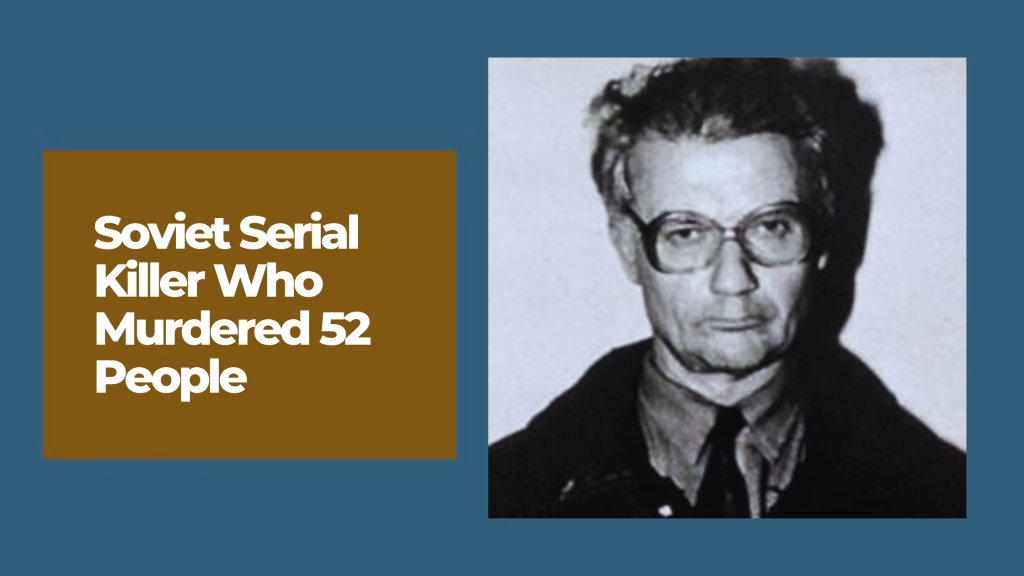
Svetlana Ganova was waiting for a ride home on December 22, 1978, in Shakhty, Russia. As she stood there, she noticed a young girl in a red coat standing not far away.
Beside her was a tall middle-aged man with large glasses, a long black coat, and a shopping bag. What caught Svetlana’s eye was how he was whispering to the young girl and staring at her.
They didn’t look like relatives. They didn’t seem to know each other.
The man walked away. Soon after, the young girl followed.
Svetlana watched them walk off together. Then her streetcar arrived.
That was the last time anyone saw nine-year-old Yelena Zakotnova alive.
The next day, her body was found in the Grushevka River. Svetlana went to the police to tell them what she’d seen.
Yelena had told a friend that she’d met a nice old man who could get her imported chewing gum. She walked with him to a rundown house he called his “secret house.”
He opened the door and let them both inside. Then he locked it behind them.
Yelena was trapped. Unable to escape.
He overpowered her, removed her coat and underwear, and strangled her while sexually assaulting her. When she began to stir, he pulled out a large knife and stabbed her three times in the abdomen.
He carried her body across the road to the river and watched as she floated downstream.
He didn’t realize he’d left the light on in the house. Or that Yelena’s blood had dripped onto the doorstep.
Police brought in a sketch artist. Svetlana described a middle-aged, tall, thin man with glasses.
That evening, police arrested 25-year-old Alexander Kravchenko. He wasn’t middle-aged. He didn’t wear glasses. But he’d just served six years for the rape and murder of a 17-year-old girl.
Under intense interrogation, Kravchenko confessed.
He was tried, found guilty, and sentenced to death. He was executed in 1983.
But Alexander Kravchenko didn’t kill Yelena Zakotnova. The real killer had slipped away from right under police noses.
By the time of Kravchenko’s execution, the real killer had murdered more women and children. He was on a path of brutality and destruction that would last 12 years.
His name was Andrei Chikatilo. And he would become known as the Butcher of Rostov.
The Soviet Union’s Serial Killer Problem
In the 1980s, the Soviet Union was just a decade away from collapse. Decades of repression, purges, and famine had marked its recent history.
Rostov-on-Don was located about 600 miles south of Moscow. At the time, it was home to 1.4 million people.
For reasons nobody has fully understood, Rostov became home to a disproportionately high number of killers. From 1989 to 1999, 29 multiple murderers and sex offenders were caught there.
The Moscow Times called Rostov “the serial killer capital of the world.”
But in the 1980s Soviet Union, serial killers weren’t supposed to exist.
Serial killers were considered a Western phenomenon. The USSR refused to acknowledge that such things could happen under communism. Information was concealed. Cases were covered up. All to maintain the illusion of public order.
This denial would allow Andrei Chikatilo to kill for more than a decade.
The Killings Begin
Three years after Yelena’s murder, the killer struck again.
September 3, 1981: Larisa Tkachenko, 17, had run away from boarding school. She sat at a bus stop outside the Rostov public library. A man promised her food in exchange for sex. She agreed to go with him.
After walking into the woods, he suddenly attacked her. He tore off her clothes. She tried to fight and scream, but he repeatedly punched her in the head, filled her mouth with mud, and strangled her.
He mutilated her body, gouged her eyes out, and bit off one of her nipples. Then he danced around her body, euphoric about what he’d done.
June 1982: 13-year-old Lyubov Biryuk got off a bus, unaware she was being followed. She was abducted, stabbed repeatedly, and sexually assaulted. Her eyes were mutilated. It would be two weeks before her body was found. Due to the brutal summer heat, all that remained was a skeleton.
The killer struck again and again:
- July 1982: 14-year-old Lyubov Volobuyeva
- August 1982: Nine-year-old Oleg Podzhigailo and 16-year-old Olga Kuprina (three days apart)
- September 1982: Irina Karabelnikova and Sergey Kuzmin
- December 1982: Olga Stalmachenok
The male victims confused the police. They believed this was the work of two different killers.
The cases went nowhere.
Moscow Steps In
By September 1983, frustrated with the lack of progress, Moscow sent Major Mikhail Fetisov and his team to lead the investigation.
Fetisov sent a withering report back to Moscow. Local police were incompetent and unable to deal with the situation. This was obviously the work of one brutal, sadistic killer.
They dubbed him the “Forest Strip Killer.”
What they didn’t use was the term “serial killer.” That phrase was forbidden.
Fetisov requested help from Viktor Burakov, a highly experienced forensic analyst. A special task force was put together. Operation Forest Strip had launched.
The killer had a pattern. He targeted women and children at bus stops or train stations. After gaining their trust, he’d lure them into nearby woods.
The level of brutality was shocking. Victims had internal organs removed, genitals mutilated, tongues cut out, nipples bitten off, and eyes gouged out. Some were decapitated. He also appeared to cannibalize some victims.
Investigators believed these crimes might have been committed by gangs collecting organs or possibly satanists.
Police scoured psychiatric hospital records looking for someone with similar behavior patterns or a history of sex offenses. Anyone suspicious was pulled in for questioning. Blood samples were taken for comparison with semen samples found at the scenes.
But the murders continued.
The Wrong Men
Police arrested a man named Shaburov after he was spotted acting suspiciously near a streetcar depot. Shaburov had learning difficulties. He told officers he’d stolen a car with four men and that they’d killed several children.
All five were arrested and intensely questioned for 24 hours. They quickly confessed to several Forest Strip killings.
But there was one glaring problem: they couldn’t say where the murders took place, how many they’d committed, or who the victims were.
As months passed, the men remained in custody. But the murders continued.
Instead of realizing they had the wrong men, police believed they were part of a wider gang. More men with learning difficulties were brought in. The brutal questioning these vulnerable men endured was horrific.
One of them took his own life while in custody.
Eventually, as murders continued, police had to admit the truth. They’d got it wrong. The men were released.
Attention then turned to the gay community in Rostov. They were subjected to horrible discriminatory treatment. Police now believed the killer was a gay man.
This yielded no leads either.
Police then focused on people who drove for a living, since the killer could cover huge areas quickly. They interviewed more than 150,000 people with driving licenses.
Despite enormous manpower, this theory also went nowhere.
A Bureaucratic Nightmare
The Soviet system made investigation incredibly difficult. Author Robert Cullen, who covered the case for Newsweek and later wrote a book about it, explained:
“Like so many other branches of the Soviet system, law enforcement had overlapping bureaucracies. The militia patrolled the streets and apprehended criminals. The procurators supervised cases and questioned suspects. On paper, the division of labor looked neat. In practice, it was blurred. There were lots of opportunities for the two agencies to get in each other’s way.”
A 1997 Observer article stated there was “chronic rivalry between the police and investigators from the prosecutor’s department which blights difficult cases.”
Hundreds were involved in the case. The card index of suspects comprised approximately 15,000 individuals.
The impact on the police force was enormous. One officer began hallucinating that he was the killer, murdering in a trance-like state. Another spoke of extreme paranoia for more than 10 years, never knowing if he was walking past the killer or sitting next to him on the bus.
Nearly 200,000 people would be blood tested. Tens of thousands of ex-convicts were endlessly interrogated.
And still, the killer was free.
The Profile
In September 1984, Burakov took a different route. He approached the Rostov Medical Institute for help from sexual pathologists and psychologists.
Due to a lack of information, many refused. But one agreed: Dr. Alexander Bukhanovsky.
This was unusual. The USSR had refused to acknowledge the existence of psychopathic tendencies or sexual deviancy. Bukhanovsky needed to invent a new methodology.
Read more: Florencio Fernandez: The Notorious Vampire Of Argentina
Ten days later, he generated a report describing the man they were looking for:
- Between 45 and 50 years old
- Gained sexual satisfaction from death and suffering (a necro-sadist)
- History of sexual problems
- Impotent with extremely low self-esteem
- Educated but with a history of sexual deviancy
- Unable to make and maintain friendships
It wasn’t much. But it was better than nothing.
The First Arrest
Police increased presence at transport links, especially Rostov bus station, where the last two victims disappeared.
Inspector Alexander Zanasovsky stuck to what he knew: killers always return to where they’ve had success.
Within days of patrol, he noticed a middle-aged man with glasses walking around. He was obviously interested in young girls.
Zanasovsky watched, then approached and asked for identification.
The man was nervous. He said he used to be a teacher and was just bored. That’s why he was talking to young girls.
His name was Andrei Romanovich Chikatilo.
He said he was coming home from a business trip. His paperwork showed he worked freelance for a KGB division.
With nothing to hold him for, his papers were returned. He was sent on his way.
But Zanasovsky had a bad feeling.
Weeks later, Zanasovsky saw him again. Same man, same black fur hat. “When I felt it in my guts was when I saw him the second time,” Zanasovsky said. “I thought you wouldn’t get away from me.”
He and his colleague kept their eye on Chikatilo. They followed him all day, watching him get on and off buses, trying to talk to several women and girls.
At one point, he put his arm around a young woman who appeared intoxicated. He put his hand under her shirt. She didn’t react at first, but minutes later spoke sternly to him and walked away.
Zanasovsky made his move. They’d watched him pursue women relentlessly all day. He was under arrest.
Chikatilo was nervous. Drops of sweat the size of raindrops appeared on his forehead. “I’d never seen that before,” Zanasovsky said.
What was in his briefcase? A knife, Vaseline, and rope.
Usually, authorities could only hold a citizen for 72 hours. But they charged him with harassing women in public places. This minor charge meant 15 days in custody.
When they checked his files, they realized he was under investigation for theft of supplies from work. Theft of state property was serious, especially for a Communist Party member.
This meant he could be kept in custody for several months.
The Background Check
A thorough background check revealed disturbing information.
Chikatilo had a sexual interest in children. He’d previously worked as a teacher but couldn’t control his classes. Students and teachers considered him extremely strange.
There were complaints about inappropriate sexual behavior and assaults on children at school. He was kicked out of one school in 1974.
At another, he was in charge of a boys’ dorm. Students ridiculed him endlessly. After a few months, he was caught trying to sexually assault a boy as he slept. Senior students attacked him for this. He started carrying a knife around school.
He was never reported to the authorities. One report said this was likely because it would reflect badly on the faculty.
The picture was becoming clearer. Allegations of voyeurism. Assault on the boy in the dorm. Stalking train corridors. Owning a deserted house by the river.
Everything pointed to Chikatilo being their killer.
Then they took a blood sample.
It was type A. The semen samples from the killer were type AB.
The news was crushing. Due to outstanding offenses, Chikatilo was sentenced to a year, but he only served three months. He was expelled from the Communist Party.
Upon his release, police had no idea they’d just let their killer go.
Why the Blood Didn’t Match
It was later determined that Chikatilo’s blood was type A, but his semen was type AB. He was a “non-secretor,” meaning his blood type could not be inferred by anything other than a blood sample.
If they’d taken samples of hair, saliva, or semen, they would have had the AB match they needed.
For Zanasovsky, this wasn’t the end. He was sure Chikatilo was their man. Everything fit.
His superiors disagreed. Zanasovsky was demoted for being “overly zealous.”
And Chikatilo was free to continue his killing spree.
The Murders Continue
With Chikatilo free, the body count rose dramatically.
August 1, 1985: Natalia Pokhlistova, 18, with learning difficulties, disappeared near Domodedovo Airport in Moscow. Two days later, her body was found. She’d been stripped, slashed, and stabbed 38 times with a rope around her neck.
August 27, 1985: Irina Gulyaeva, 18, was looking for somewhere to sleep. Chikatilo offered accommodation in exchange for sexual favors. When he failed to maintain an erection, she laughed at him. He responded with extreme violence, stabbing her to death.
Armed with Bukhanovsky’s profile, Burakov went to Novocherkassk Prison’s death row to interview serial killer Anatoly Slivko, a necrophile responsible for the torture and deaths of seven boys awaiting execution.
Burakov wanted insight from someone similar to the killer they were searching for.
December 1985: Helicopters patrolled woodlands and railway lines. Plain-clothes officers were out in full force. A volunteer militia was drafted.
Little did they know, the killer walked among them as a volunteer, pretending to search for himself.
He now knew these areas were the focus. So he moved his crimes further afield.
From 1987 to 1990, Chikatilo killed 19 more times. The victims were now predominantly young boys. Many were taken and killed in places far more public, with significantly higher risk of being caught.
Mikhail Gorbachev Changes Everything
In March 1985, Mikhail Gorbachev became General Secretary of the Communist Party following Constantin Chernenko’s death.
With this new leader came glasnost and perestroika: transparency and restructuring across the USSR.
Moscow assigned Issa Kostoyev from the KGB Department of Crimes of Special Importance to the case.
He restructured the department into three teams focusing on Shakhty, Novoshakhtinsk, and Rostov. Anyone convicted of sexual offenses was systematically checked. Nightclubs and adult video stores were put under surveillance.
Hundreds of officers were deployed undercover. Hidden cameras were placed in train stations. Policewomen dressed as drifters to try to lure the killer.
All efforts were in vain.
They caught more than 200 rapists, sexual offenders, and other murderers. But not Andrei Chikatilo.
The Final Arrest
On November 6, 1990, Chikatilo murdered 22-year-old Svetlana Korostik, a homeless woman, in woodland. Her body was found seven days later. Her nipples had been bitten off.
As Chikatilo walked back to the station, Sergeant Igor Rybakov watched from the platform. He saw a tall, sweaty, bespectacled man stagger out of the woods.
The man had a bandage on his finger and blood on his ear and cheek.
Rybakov approached and asked for his papers. But just as he was going to ask more questions, the train arrived.
There wasn’t a real reason to keep him. He was allowed to board the train and leave.
Rybakov filed a report about the encounter. Days later, a body was found near the station. Svetlana Korostik.
The policeman remembered the odd man. When looking back over files, officers wanted to know if anyone had been acting strangely.
One name from Rybakov’s report stood out: Andrei Romanovich Chikatilo.
General Kostoyev asked officers to check where Chikatilo was on May 14, 1988. They knew for a fact that one victim had been killed that day in Revda. His work record showed he’d been there that day, too.
His strange behavior, his description fitting witnesses, and his history of sexual abuse. It was all coming together.
They needed to find Chikatilo before he struck again.
November 20, 1990: Chikatilo went to get his finger x-rayed after it had been broken by his last victim. He then went to buy beer and tried to talk to a young boy. A woman appeared and scared him off.
He tried to talk to another boy who was called back by his mother.
Then three plain-clothed officers walked up to him and took him into custody.
He was carrying a briefcase containing a knife, Vaseline, and rope.
The same items he’d been carrying when arrested in 1984.
The Confession
Chikatilo sat in isolation. Officers searched his house and found a hammer, more than 20 knives, and shoes matching the footprints found at a murder scene.
Interrogation began with Issa Kostoyev in charge. Chikatilo wasn’t admitting anything.
A week later, he wrote to the prosecutor general: “I felt a kind of madness and ungovernability in perverted sexual acts. I couldn’t control my actions because, from childhood, I was unable to realize myself as a real man.”
It wasn’t a confession. But it was progress.
Dr. Bukhanovsky was asked to help with interrogation. He agreed, as long as his notes weren’t used as evidence.
On November 30, 1990, Bukhanovsky told Chikatilo he believed his actions were rooted in mental illness. He said he’d talk to his family to help them understand.
The tactic started working. Chikatilo felt flattered. He began to talk.
Bukhanovsky had Chikatilo’s wife come in. This resulted in the first display of emotion. He broke down in tears.
He read Bukhanovsky’s profile. “Yes, it’s me,” he cried.
On December 5, 1990, he finally confessed.
He’d been accused of 36 murders. But he said this was wrong.
He admitted to the rape and murders of 56 women and children.
Finally, after a 12-year reign of terror, the Butcher of Rostov had been caught.
His Childhood
Andrei Romanovich Chikatilo was born on October 16, 1936, in Yabluchne, Ukraine. The population had been through and was still suffering from a devastating famine following Joseph Stalin’s collectivization policies.
A few years later, Nazi Germany launched Operation Barbarossa and invaded the Soviet Union. The USSR would lose 24 million people in the conflict.
Chikatilo’s father, Roman, was conscripted but later captured by Nazi forces and held prisoner. In 1943, Chikatilo’s sister was born while his father was away.
The family lived in a tiny one-room house. It was reported that potentially his mother had been the victim of sexual assault by a Nazi soldier, and Chikatilo had witnessed it.
Roman was eventually released after the war. But the stigma of having been captured followed him. Andrei was bullied as a result.
He criticized his own father’s alleged betrayal.
As a child, Andrei didn’t typically play with other children. He preferred being by himself, reading, with a particular interest in stories of Soviet partisans who’d captured and tortured German prisoners.
Despite having extremely poor vision, he refused to wear glasses, fearing they’d make him a bigger target for bullies.
His excellent reading skills saw him become the political information officer and editor of the school newspaper.
He had little social life and even less experience with girls.
When he was 15, he had his first sexual experience. He overpowered a girl, and during a brief struggle, he ejaculated.
This led to more bullying. For Chikatilo, it solidified a connection: sexual pleasure and extreme violence went hand in hand.
Adult Life
It’s believed Chikatilo suffered a buildup of excess fluid in his brain at birth, leading to genital urinary tract problems throughout his life.
He wet the bed until his teenage years. He failed to sustain erections, though he could ejaculate.
He did national service from 1957 to 1960. Afterward, he relocated to Rodionovo-Nesvetayevsky. After saving money, his parents and sister moved in with him.
His sister worried about his stunted love life. She arranged for him to meet a girl. The pair married in 1963.
Despite Chikatilo’s sexual problems and apparent lack of interest in sex, they had a son and a daughter.
He enrolled at Rostov Liberal Arts University. In 1970, he left his job as a telephone engineer and began working at a school, having gained degrees in engineering, Russian literature, and Marxist-Leninism.
This job didn’t last long. Allegations began about attempted sexual assaults, abuse, and voyeurism. He was out by 1978.
He ended up at Vocational School Number 33 in Shakhty. He bought a small, rundown house opposite the Grushevka River.
This would be where he took his first victim, Yelena Zakotnova.
After killing Yelena, Chikatilo went quiet. There were no reported victims for three years.
During this time, he couldn’t hold down a job after repeated allegations of sexual abuse. He was dismissed from the mining school in 1981.
He began working as a clerk at a raw materials factory in Rostov. This job allowed him to travel for work, giving him more access to potential victims.
The Trial
On April 14, 1992, the trial began. Standing in the dock with his head shaved, the 57-year-old former teacher and father of two stood accused of depraved crimes against society’s most vulnerable.
Throughout the trial, Chikatilo was confined to a metal cage. Not to protect the public, but to protect him from them.
The court was filled with bereaved, devastated, and angry families. They would have torn him limb from limb.
Just to read out what Chikatilo had been accused of took Judge Leonid Akubzhanov two days.
The nature of the crimes was so graphic that some in the courtroom fainted. Even the guards were so overwhelmed that they needed to sit down.
After charges were read, Chikatilo addressed the court for nearly two hours. He described himself as someone persecuted and suffering since childhood.
“I dreamed of a big political career,” he said, “and ended up with this nothing life in stations and on trains.”
His bizarre behavior included singing, talking nonsense, and, at one point, pulling his trousers down and exposing himself. Many saw this as an attempt to present himself as mentally ill.
The judge repeatedly asked him to explain why he’d done what he’d done.
“Don’t you imagine what excruciating pain it caused your victims when you bit off their tongues? For one minute of pleasure, you demanded the life of a child. Didn’t you think about that?”
Chikatilo mumbled back, “I can’t explain.”
Lidia Kova, mother of 10-year-old Alexei, whom Chikatilo had murdered, said, “They should rip him apart like a dog. I hope he dies the most horrible death.”
As tensions rose, the courtroom began to smell of valerian drops, a tranquilizer distributed by court-appointed nurses.
The trial continued until August. When it was time for the verdict, a man in the public gallery threw a metal bar through the cage. It missed Chikatilo’s head by inches.
The verdict arrived in October 1992. Judge Akubzhanov read 330 pages. His voice broke with emotion.
Andrei Romanovich Chikatilo was found guilty of 52 of 53 counts of murder.
His victims included:
- 21 boys ranging from 8 to 16
- 14 girls aged 9 to 17
- 17 women aged 18 and older
His crimes had been committed across southern Russia, Uzbekistan, and Ukraine over 12 years from 1978 to 1990.
Every guilty verdict came with a separate death sentence.
The court erupted in applause.
From inside his cage, Chikatilo shouted, “Why me? I demand the podium! Get me a lawyer!”
He kicked over his wooden bench and called the judge a swindler.
He was led out of court. The trial was over.
The Execution
While on death row, Chikatilo gave an interview: “I’m nothing but an actor who’s performed a role to earn an Oscar and get into the Guinness Book of Records.”
On February 14, 1994, Andrei Romanovich Chikatilo was taken from his cell and executed with a bullet to the back of the head.
Following his conviction, his wife and children changed their names and moved away.
The Legacy
The story of the hunt for Andrei Chikatilo has been told in countless books, television shows, and films.
The 1995 film Citizen X showed the bureaucratic problems facing investigators. The book The Killer Department by Robert Cullen detailed the systemic failures.
The level of destruction Chikatilo caused is impossible to fully comprehend. People were relentlessly and wrongly pursued. Many were mercilessly interrogated. So many lives were ruined.
One person was wrongly executed. Alexander Kravchenko died for a murder he didn’t commit. In 1991, Russia’s Supreme Court posthumously rescinded his sentence. But it was too late.
One suspect attempted to take his own life. Another succeeded.
We’ll likely never know the true extent of Chikatilo’s offending.
The least we can do is remember his victims. More than 50 women and children. Human beings with hopes and dreams are treated with disgraceful inhumanity.
Their names deserve to be remembered. Their stories deserve to be told.