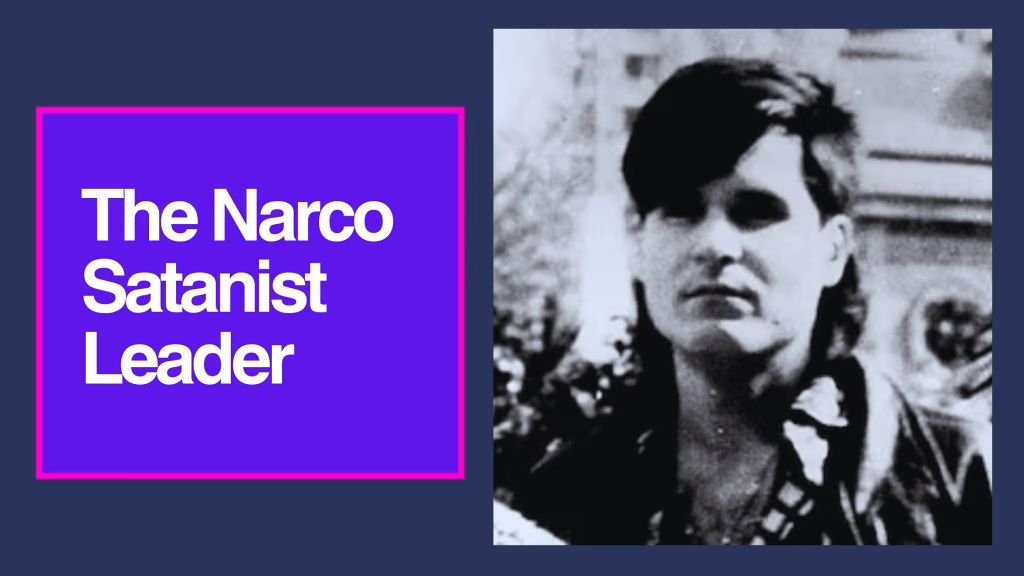
The Narcosatanists: How Adolfo Constanzo Sacrificed 13 People in Satanic Drug Rituals
Meta Description: Adolfo Constanzo and Sara Aldrete led a cult that performed human sacrifices for Mexican drug cartels in the 1980s. Thirteen bodies were found at Rancho Santa Elena in 1989.
URL Slug: /adolfo-constanzo-sara-aldrete-narcosatanists-matamoros-murders/
On April 11th, 1989, police in Matamoros, Mexico, opened the door to a small wooden shack on Rancho Santa Elena and were immediately hit with an unbearable stench. The floor was soaked in coagulated blood. Strange symbols covered the walls. And in the center sat an enormous black cauldron filled with human brains, blood, and rotting organs.
Outside, thirteen bodies were buried in shallow graves. All had been tortured horrifically. Some were missing spines. Others had their chests split open, organs removed. Many had been decapitated or had their eyes and genitals cut out.
At the head of this operation was Adolfo de Jesús Constanzo, a 26-year-old Cuban-American witch doctor who provided “magical protection” to Mexico’s most powerful drug traffickers. His second-in-command was Sara María Aldrete, a 24-year-old Mexican-American college student with striking looks who became known as “La Madrina” – The Godmother.
Together, they orchestrated one of the most disturbing cases in true crime history: a cult that blended drug trafficking, Afro-Caribbean religion, and human sacrifice. Their crimes would spark international outrage and create massive tensions between Mexico and the United States.
This is the story of the Narcosatanists.
The Spring Break That Ended in Murder
On March 15th, 1989, Mark Kilroy was living every college student’s dream. The 21-year-old pre-med student from the University of Texas was on spring break with three friends in South Padre Island, just across the border from Matamoros, Mexico.
Thousands of young Americans crossed the Brownsville-Matamoros International Bridge every spring break. The drinking age in Mexico was 18, not 21. Prices were cheap. The dollar exchange rate was favorable. And for college students looking to party, Matamoros offered dozens of bars, clubs, and restaurants.
Around 2 AM on March 15th, Mark and his three friends – Bradley Moore, Bill Huddleston, and Brent Martin – left a bar in Matamoros in a state of intoxication. They walked toward the international bridge along with an enormous crowd heading back to the U.S.
But at some point, they lost sight of Mark.
They thought they’d find him crossing the border or that he’d arrive shortly after. That didn’t happen.
Bill Huddleston said that while walking toward the bridge, he had to stop to urinate in an alley and thought he saw Kilroy talking with an apparently Mexican man. Since the place was full of people, he didn’t give it much importance. He never imagined something bad could happen.
Shortly after, he caught up with his friends Bradley Moore and Brent Martin, who kept walking ahead until they crossed the bridge and stopped waiting for Kilroy. But minutes passed and the young man didn’t appear.
They began questioning people passing by, and only one thought they recognized him after hearing the description. He wasn’t sure, but he thought he’d seen him getting into a white van with two other men.
The three young men returned to Matamoros to continue searching for their friend. They visited all the bars and nightclubs in the city but couldn’t find him. Several hours later, they crossed the border again and went to their hotel in South Padre, where they spent the night after calling Kilroy’s parents to inform them of his disappearance.
The next morning, they went to Brownsville to file a report.
The Investigation Begins
Sheriff George Gavito of Cameron County couldn’t do too much. At that time, relations between Mexico and the United States were extremely tense due to conflicts related to drug trafficking, illegal immigration, corruption of Mexican authorities, and certain economic policies that affected diplomatic relations between both countries.
Intervening in a disappearance case that occurred in Mexico without authorization had serious implications. The recommendation was for the Matamoros police themselves to take charge.
However, while Gavito was interrogating the three young men, he received a phone call from Oran Neck, chief of the Brownsville customs service. He reported that he urgently needed his help because the nephew of one of his colleagues from the Los Angeles customs department had disappeared in the city of Matamoros.
The young man’s name was Mark Kilroy.
George Gavito and Oran Neck contacted Commander Juan Benítez Ayala of the Matamoros Federal Police to inform him of the case. Benítez had carried out several raids to stop local drug trafficking gangs. He had a reputation for being a tough guy, was respected by both his colleagues and criminals in the area, and had collaborated with Gavito and Neck on other occasions, so he immediately joined the investigation.
The first steps were carried out in jails, hospitals, and morgues in Tamaulipas and Texas, but no results were obtained.
Jim and Helen Kilroy, the parents of the missing young man, carried out their own crusade. They distributed thousands of flyers with his image in both Matamoros and Brownsville. They requested public cooperation in various media and offered a $15,000 reward for anyone who could help them find their son’s whereabouts.
It didn’t take long before Mexican authorities began to feel the pressure being exerted from the other side of the border. A dozen American journalists stationed themselves in the city to report on the strange disappearance. The young man’s photograph was posted on every corner. At the same time, police departments in both cities were working together to find him.
The news was made known by various media in both the United States and Mexico. On March 26th, the renowned program “America’s Most Wanted” presented the case, which considerably increased its circulation.
The Theories
As days passed, the first rumors emerged about what could have happened to Mark Kilroy.
While Matamoros was a tourist place where thousands of young people, both Mexican and American, gathered to drink beer, smoke marijuana, and hang out, the presence of drug traffickers in the area meant a latent risk. It was possible that Kilroy had gotten involved with the wrong people.
There was also the possibility that he was in the hands of a group of kidnappers, but so far no one had contacted his parents to demand money in exchange for his release.
The most macabre theory had been delivered by a psychic who occasionally collaborated with the police. He claimed to have had a vision in which Kilroy’s remains were next to a huge witch’s cauldron and that he had been the victim of a satanic ritual.
A few days later, a young satanist from Brownsville would be detained because he had apparently told a couple of friends that he had sacrificed Kilroy in a satanic rite and then buried his body on a beach. However, after a brief investigation, it was proven that it was all a lie and he was released.
The Satanic Panic
In the early 1980s in the United States, a social phenomenon called “satanic panic” had emerged. This was characterized by widespread and excessive fear among the population about the existence of sects that performed rituals and human sacrifices.
Some sensationalist media outlets exploited this fear, creating publications and television programs that touched on the subject to exhaustion and reached a large audience. But certainly, many of these stories were exaggerated.
Perhaps the first suspicion related to supposed satanic crimes in the country occurred with the Zodiac Killer case. Between December 1968 and October 1969, the Zodiac claimed the lives of at least five people in California. The enigmatic encrypted letters that the Zodiac sent to the media contained a series of signs that several mistakenly interpreted as satanic messages.
One of the most emblematic cases that set a precedent was that of Charles Manson and “The Family” in 1969. While they weren’t ritual crimes, the general public associated the occult components, esoteric beliefs, and Manson’s apocalyptic views with satanism.
Between 1976 and 1977, David Berkowitz terrorized the entire nation after carrying out a series of shootings in New York, leaving six people dead and several injured. Berkowitz, better known as “Son of Sam,” claimed that his neighbor’s dog had been possessed by a demon and ordered him to commit the attacks. He later retracted and admitted to being part of a satanic sect and that several members were involved in the murders.
Another case that sparked terror and indignation in late 1983 was the McMartin Preschool in Los Angeles. Supposedly, hundreds of sexual abuses of minors had been carried out there within the framework of aberrant satanic rituals. Although the trial lasted 7 years, becoming the longest and most expensive in U.S. legal history, no one was ultimately convicted.
In 1984, a 17-year-old teenager named Richard Kasso brutally murdered a friend in Northport, New York, influenced by satanism and drug use. The media impact of this crime increased families’ fear that their own children would become involved in this type of activity.
Other emblematic and more explicit cases, such as serial killer Richard Ramírez in 1985, continued feeding Americans’ imagination. In fact, when Ramírez raised the palm of his hand at the preliminary hearing on July 22nd, 1988, and showed a pentagram he had drawn, then said out loud “Hail Satan,” he not only shocked everyone present in the room, but the scene would go around the world.
The influence of satanic panic certainly extended to Mexico, but beyond a couple of crimes in Monterrey in the early 1980s where police suspected a satanic group might have participated, no similar case had been registered to date.
That’s why theories that Mark Kilroy had been the victim of a satanic ritual in Matamoros were disturbing but unlikely.
The Break in the Case
Kilroy’s disappearance continued to be a mystery for almost a month, and there wasn’t a single clue to his whereabouts. This began to worry Sheriff George Gavito, who had previously worked with Matamoros police on drug trafficking cases and generally obtained all the necessary collaboration from his Mexican colleagues.
This time, however, he noticed that the only one who seemed genuinely interested in helping was Commander Juan Benítez Ayala. The rest of the Matamoros federales limited themselves to speculating that Kilroy had probably gotten into trouble with some drug gang or criminals in the area and should already be dead.
On Monday, April 10th, Commander Juan Benítez Ayala contacted George Gavito by phone and asked him to immediately go to Matamoros because he believed he had found Mark Kilroy’s whereabouts.
While Benítez had committed to collaborating in the search for the young man, his priority was dismantling drug trafficking gangs in the area. For months, he had organized roadblocks to stop them and had seized large quantities of cocaine and marijuana being smuggled to the United States.
Nine days earlier, on April 1st, a truck evaded one of the police checkpoints in Matamoros, and a couple of agents began following it discreetly through the desert until they stopped at a remote ranch called Santa Elena, located about 28 kilometers from the city center.
The site seemed to belong to a drug trafficking gang, so they kept it under surveillance until April 9th, when a group of police decided to raid the ranch.
Five people were arrested: David Serna Valdés, Sergio Martínez Salinas, Serafín Hernández García, his uncle Elio Hernández Rivera, and the ranch foreman, a man identified as Domingo Reyes.
Inside the property, they found more than 100 kilograms of marijuana, cocaine residue, and a .38 caliber revolver, so they were immediately taken to the station.
“Which One?”
For Commander Benítez, the subjects of greatest interest were Serafín and Elio Hernández. They belonged to a well-known family of drug traffickers operating on both sides of the border, so he was eager to put them in jail.
However, while interrogating Domingo Reyes, the ranch foreman, he observed a flyer with Mark Kilroy’s photograph that Benítez had on his desk and told him he knew him.
The man stated that in mid-March, he had seen the young man inside the Santa Elena ranch and had even given him food because the Hernándezes apparently had him kidnapped. However, the next day he had disappeared and he never saw him again.
While Reyes insisted he wasn’t aware of his bosses’ activities, he claimed the site was visited from time to time by a group of unknown people and that on one occasion he saw them digging a grave.
Serafín Hernández was subjected to intense interrogation led by Commander Benítez, who spared no effort to make him talk. He finally admitted to kidnapping Kilroy in the early morning of March 15th in Matamoros, who was subsequently tortured, murdered, and buried at the Santa Elena ranch, though he denied being responsible for his death.
He confessed to being part of a cult led by a mysterious man of Cuban-American descent named Adolfo de Jesús Constanzo, 26 years old, whom he respectfully referred to as “El Padrino” (The Godfather). Constanzo had allegedly killed the young man by striking him with a machete on the back of the neck to remove the top of his skull and tear out his brain during a ritual.
Supposedly, Constanzo was not only related to drug trafficking but was a witch with magical powers and great influence who offered protection to the most powerful drug traffickers on the Mexico-United States border. His rituals included animal sacrifices and he was seconded by a witch whom he identified as Sara María Aldrete, a striking 24-year-old Mexican woman with light eyes and standing 1.85 meters tall, whom they called “La Madrina” (The Godmother).
Serafín Hernández assured that Kilroy was murdered inside a small wooden shack where Constanzo and Aldrete carried out their macabre rituals.
Inside the House of Horrors
At 5:30 AM on April 11th, George Gavito and Juan Benítez Ayala went to the Santa Elena ranch along with the detainees and a large police contingent. But carrying out the search would not be an easy task.
Some officers were reluctant to enter a site where black magic had supposedly been practiced. The day before, Benítez himself had ordered a healer to bless the shack to expel demons, as most Mexican agents and even himself were superstitious and feared being victims of a curse or demonic possession.
When the healer finally performed the cleansing, the agents opened the door and were horrified.
The place was infested with flies and emanated an unbearable stench, a mixture of burnt wood, alcohol, tobacco, and decomposition. The walls were scratched with strange symbols and the floor soaked in coagulated blood, along with a machete, hammer, and other grim tools.
Ritual figures decorated the corners, along with a couple of containers with chicken feet and heads, animal bones, and human remains in a state of putrefaction. They also found a large quantity of aguardiente bottles, Cuban cigar butts, horseshoes, and an improvised altar with a goat’s head stuck on a trident, surrounded by coins and black candles with the image of the Virgin of Guadalupe.
One of the objects that most caught attention was an enormous blackish cauldron from which small wooden stakes protruded, submerged in a viscous and fetid substance containing several organs in a state of putrefaction, including blood and brain matter that was later proven to belong to Mark Kilroy.
Thirteen Bodies
When Commander Juan Benítez Ayala asked Serafín Hernández where the body was buried, he responded: “Which one do you mean? Because there should be about 13 people buried on the ranch.”
According to him, all were murdered in Constanzo’s rituals. The man walked with the incredulous agents for a couple of meters and led them to a wooden fence where there were several spaces with disturbed earth.
He approached a grave from which a wire protruded and stated that Kilroy was buried there. When they asked how he knew, Serafín assured that Constanzo had ordered them to thread the wire through the body’s spinal column and leave it visible after burial.
Weeks later, when the body was decomposed, they pulled part of the wire and ripped out the vertebrae, with which Constanzo planned to make a necklace.
Dozens of Mexican and American journalists showed up at the location within hours as the news spread quickly. The police couldn’t even cordon off the area, and reporters wandered freely around the ranch, recording the macabre findings with their cameras without any type of restriction.
Meanwhile, David Serna, Sergio Martínez, and Serafín and Elio Hernández seemed to be enjoying the agents’ shocked faces. When they were confronted for mocking, Serafín became defiant. He challenged them to shoot him with their weapons, claiming that thanks to his Godfather’s protection and magic, he was immune to bullets.
That’s when Commander Benítez Ayala lost his patience. He grabbed his Uzi and started firing several bursts into the air, something that not only surprised the detainees but also the other police officers who didn’t understand what was happening.
That was enough for Serafín to be more cooperative. Benítez forced him to grab a shovel and dig himself in the grave where Mark Kilroy was buried.
At approximately one meter depth, the young man’s body appeared. His face was covered with adhesive tape. Both legs had been amputated at the knees. His spinal column and the upper part of his skull were missing, and his brain had been removed.
Within 48 hours, twelve other male bodies were unearthed from the muddy terrain. The vast majority had their chests and ribs opened and were missing several internal organs. They also showed signs of torture and horrible facial mutilations, in addition to the extraction of eyes and genitals.
The raw images were broadcast by various television chains around the world.
The Narcosatanists
David Serna, Sergio Martínez, and Serafín and Elio Hernández were presented to the media on a balcony in the rear courtyard of the Federal headquarters.
Commander Juan Benítez Ayala showed the more than 50 journalists present several ritual scars that the suspects had engraved on their bodies, which had supposedly been made by the Godfather to protect them.
Elio Hernández confessed to having murdered a couple of victims because Constanzo had authorized him to become one of his executioners. The rest had participated in the rituals, also collaborating in kidnappings and tortures.
The journalists decided to baptize the sect as “Los Narcosatánicos” (The Narcosatanists), a nickname as intimidating as it was sensationalist.
The truth is that the rituals performed at the Santa Elena ranch had nothing to do with satanism but were practices linked to Santería, Voodoo, and mainly Palo Mayombe.
The situation became even more complicated when agents carried out a raid on Constanzo’s house at number 47 Papagayos Street in Atizapán, Mexico City.
Inside, they found an enormous cauldron surrounded by candles, incense, apples, Cuban cigars, and aguardiente. Inside it were 21 machetes, several daggers, pieces of wood, and a complete human skeleton submerged in blood.
They also found a wall with a huge mirror behind which was a hidden room. Inside were millions of dollars in cash, gold bars, jewelry, and a couple of accounting notebooks where not only the names of the greatest drug traffickers from Matamoros and surrounding areas appeared but also those of police officers, businessmen, politicians, lawyers, judges, and well-known celebrities from both sides of the border.
In fact, several of Constanzo’s clients held high positions and constantly requested his services, such as the chiefs of the Federal Security Directorate Miguel Nazar Haro and José Antonio Zorrilla, in addition to Commander of the Federal Security Directorate Florentino Ventura.
Among the most prominent entertainment figures who appeared in photographs with Constanzo were renowned artists such as Yuri, Lucía Méndez, Irma Serrano, and even Juan Gabriel, for whom he had supposedly performed certain Santería works.
They also found several recording tapes from a closed-circuit security system where some chiefs of the Federal Judicial Police could be seen visiting Constanzo’s house. This made it clear that his influence was much greater than they imagined.
Sara Aldrete’s apartment was also raided, and they found an altar surrounded by candles dedicated to Changó and Santa Bárbara, important figures of religious syncretism between Santería and Catholicism. In one of the corners, they also found a pile of children’s clothing smeared with blood.
Authorities held a press conference requesting help from the entire community. They had to capture Adolfo de Jesús Constanzo and Sara María Aldrete at all costs.
Born to Be a Witch
Adolfo de Jesús Constanzo González was born in Miami, Florida, on November 1st, 1962. He was the son of a couple of Cuban-American immigrants who had fled the Castro revolution in Cuba. But a year later, his father left without explanation, and he remained under the care of his mother and grandmother, who practiced Santería, Voodoo, and Palo Mayombe, Afro-Caribbean religions that mixed African traditions, Christian beliefs, and spirit worship.
Although he was baptized Catholic, his mother Delia González was so convinced that Constanzo was destined to become a powerful witch that at age 2, she took him to Haiti to be named Prince of Palo Mayombe, an Afro-American religion spread in Cuba by slaves from Central Africa, specifically from the Congo.
Shortly after, the family moved to Puerto Rico. Delia had a second son and married a local businessman, which ensured them a comfortable life.
Constanzo proved to be an intelligent and methodical boy, but arrogant, selfish, and extremely serious. Both his mother and grandmother instilled their religious beliefs in him from a young age, and he witnessed various rites that included animal sacrifices.
In 1972, they moved back to Miami, but Delia was widowed months later, receiving a small inheritance. She remarried and had a third son with a drug trafficker who was impressed with the strange rituals carried out by Delia and her mother.
In fact, both women acquired considerable recognition as witches in Miami’s Latino community, and several people turned to them to heal sick family members or wish harm on their enemies.
For his part, Constanzo became an apprentice of a local sorcerer who practiced Palo Mayombe. One of the essential elements of this religion is the “nganga,” a cauldron into which sticks, blood, bones, and organs from both animals and humans must be introduced to invoke the dead and get them to grant all kinds of favors.
The nganga would become one of Constanzo’s objects of worship, and he began performing small blood rituals that for now only included chicken sacrifices.
Constanzo’s sex life was quite precocious. He became a father at age 14 but never formalized the relationship with his child’s mother. He liked having sex with girls his age but preferred men above all, and this became a problem because homosexuality was not well regarded by society at the time.
At age 18, Constanzo not only worked to get new clients for his mother and grandmother but began showing great abilities as a medium and witch himself. Supposedly, he was capable of communicating with the dead and predicting future events so accurately that even his own family was impressed.
In fact, he predicted a few days in advance that U.S. President Ronald Reagan would be the victim of an assassination attempt, which occurred on March 30th, 1981.
Over time, Constanzo and his mother became involved in several problems with the law. They were arrested on a couple of occasions for theft, robbery, fraud, and vandalism, and in 1983, they moved to Mexico.
Building His Empire
Constanzo was a quite attractive young man, and although he finished his studies and had the opportunity to enter university, he wanted to become an actor and model. He joined an agency and got a couple of jobs, but beyond his appearance, his mysterious and charismatic personality began attracting attention.
He was usually surrounded by friends who followed him everywhere and attended parties where he read tarot cards to guests, making a great impression.
Constanzo’s fame grew quickly. Many people who were with him claimed he wasn’t a simple con man and possessed extraordinary abilities like reading minds, invoking spirits, and predicting the future with astonishing accuracy.
He wasn’t just a clever guy but also someone extremely manipulative and ambitious.
By 1984, his magnetic personality opened doors to circles of influential people, including agents of the Federal Judicial Police. He identified in these connections a golden opportunity to obtain favors and benefits that would boost his position.
While he earned good money, his plan was to work for drug traffickers because he was convinced they moved much larger amounts of money. He presented himself to some subjects linked to drug trafficking as a Santería priest, witch, healer, and prophet, offering his service of magical protection and cleansings.
However, at first, he wasn’t taken too seriously and only got a couple of clients.
Constanzo had decided to make witchcraft his own business but understood he wouldn’t get far working alone. He needed to recruit a group of followers who, like the hitmen of drug cartels, would be willing to give their lives for their leader.
That’s when he added three men to his ranks identified as Martín Quintana, Omar Orea, and Jorge Montes, who also became his lovers. They had been impressed with his abilities as a witch, so they converted to the Palo Mayombe religion, accepted being sponsored by him, and helped him organize much more spectacular and bloody rituals.
Constanzo began using a nganga and sacrificed chickens, goats, snakes, zebras, and even lion cubs before his clients’ astonished gaze. He also used human remains that he desecrated from cemeteries with his accomplices, which made his ceremonies even more macabre.
Constanzo’s strategy worked. For each of his jobs, he could charge from $20,000 to $50,000. Soon he gained the respect of several influential people who agreed to let him protect them with his magic in exchange for significant sums of money.
The Magic Protection Racket
To provide protection, Constanzo performed a “rayamiento” (marking ceremony) in which the subject’s body is marked with scars in the form of crosses, lines, and arrows, and the person becomes part of the Palo Mayombe cult.
Constanzo, acting as godfather, would invoke a dead person and assign them for protection. He also swore to watch over the person receiving the rayamiento from all types of illnesses and misfortunes, in addition to procuring great economic benefits.
The godchild owed absolute obedience to his godfather. Otherwise, the consequences were terrible.
Constanzo offered all kinds of magical favors for the right price: from cleansings and healings to the possibility of harming an enemy by casting a curse. However, one of the most sought-after services by cartel bosses was for him to indicate what route they should follow to send their drug shipments to the United States without being discovered.
At that time, U.S. authorities had major conflicts with Mexico due to this problem, and there were hundreds of border checkpoints to prevent the entry of cocaine, marijuana, and smuggled alcohol into the country. Several seizures valued at millions of dollars were made, which began making Mexican drug traffickers nervous.
Curiously, those who consulted Constanzo always managed to cross the border without any problems.
It didn’t take long before the heads of criminal organizations realized that those who hired Constanzo’s services grew exponentially, and they had no choice but to contact him to help them with his power of divination.
What was really happening was that Constanzo had sponsored extremely important people, including several high-ranking police agents and chiefs. Thanks to this, he could offer free passage to drug traffickers who became his clients to send drugs to the United States through certain routes that he himself was in charge of clearing.
One phone call from the Godfather was enough for some border checkpoints to turn a blind eye for a couple of hours. Likewise, he would snitch on those who didn’t associate with him and ruin their businesses.
The Human Sacrifices Begin
The exact date is unknown, but it’s likely that around 1987, Constanzo began performing human sacrifices, claiming that this way his spells would be even more powerful.
Together with his group of followers, they kidnapped drug traffickers and police agents who had refused to negotiate with him to torture and murder them in frightening ways during their ceremonies.
In the book “Evil: Serial Killers in Their Own Words” by Charlotte Greig, it’s indicated that during this period, Constanzo and his accomplices murdered seven members of a drug trafficking gang known as the Calzadas because they didn’t agree to his demands for association.
The bodies were found without fingers, without ears, without brains, and one was missing his spinal column.
From then on, Constanzo not only became someone respected but also feared because he proved to be someone unpredictable, tenacious, and with chilling cold blood.
Enter Sara Aldrete
It was in April 1987, while his business continued growing, that he would meet a young woman who would become his right hand and the priestess of his macabre rituals.
Sara María Aldrete Villarreal was a 24-year-old Mexican-American student at Texas Southmost College in Brownsville. She was intelligent, attractive, stood 1.85 meters tall, and had ambitions of becoming a teacher.
She met Constanzo at a party in Mexico City, and he was immediately captivated by her beauty and intelligence. He began courting her, showing off his wealth and supposed magical powers.
Read more: The Freeway Killer (William Bonin) Lost Murder Tapes
Sara was fascinated by Constanzo’s charisma and the luxury lifestyle he offered. She became his lover and eventually his most devoted follower. She converted to Palo Mayombe and began participating in rituals, earning the title “La Madrina” (The Godmother).
Together, they formed a deadly partnership. While Constanzo was the brains and magical authority, Sara helped recruit new members and manage the business side of their operation. She also participated directly in murders, reportedly torturing and killing victims alongside Constanzo.
By early 1989, their cult had grown significantly. They had multiple followers, connections to major drug cartels, and protection from corrupt police officials. They felt invincible.
That’s when they made a fatal mistake: they kidnapped Mark Kilroy.
The Manhunt
After the discovery of the bodies at Rancho Santa Elena on April 11th, 1989, authorities launched a massive manhunt for Adolfo Constanzo and Sara Aldrete.
Investigators knew the couple had fled with at least two other cult members identified as Martín Quintana and Álvaro de León Valdez. The problem was they didn’t know if they would try to cross into the United States or remain in Mexico.
The case had become international news. Images of the bodies, the cauldron, and the ritual shack were broadcast worldwide. The Mexican government faced enormous pressure from the United States to capture those responsible.
For six weeks, Constanzo and his followers remained at large, moving between safe houses in Mexico City.
On May 6th, 1989, police received a tip that Constanzo and his group were hiding in an apartment building at 14 Río Sena Street in the Cuauhtémoc neighborhood of Mexico City.
Federal police surrounded the building. Constanzo looked out the window and saw the police presence. He knew it was over.
What happened next shocked everyone. Rather than surrender, Constanzo ordered Álvaro de León, one of his followers, to kill him and Martín Quintana. When de León hesitated, Constanzo reportedly said: “Do it! Don’t be a coward!”
De León opened fire with a machine gun, killing both Constanzo and Quintana instantly. Police stormed the apartment and arrested de León and Sara Aldrete, who was found hiding in a closet.
Adolfo Constanzo died at age 26, ensuring he would never face justice for his crimes.
Sara’s Trial
Sara Aldrete was tried and convicted in Mexico for multiple murders. She claimed throughout her trial that she was an innocent victim, that Constanzo had brainwashed her, and that she never participated in any killings.
The evidence said otherwise. Witnesses testified that Sara actively participated in rituals, helped torture victims, and recruited new cult members. She was sentenced to 62 years in prison.
The other cult members received various sentences. Serafín Hernández García was sentenced to 35 years. His uncle Elio Hernández Rivera received 30 years. Álvaro de León Valdez, who killed Constanzo and Quintana on Constanzo’s orders, was sentenced to 30 years.
All remain in Mexican prisons to this day.
The Victims We Know
Of the thirteen bodies found at Rancho Santa Elena, only some have been identified:
Mark Kilroy, 21, an American student from Santa Fe, Texas. Kidnapped March 15th, 1989. Found April 11th, 1989.
Rubén Vela García, a drug trafficker who refused to work with Constanzo.
Ernesto Diaz Rivera, 22, was murdered for ritual purposes.
Jorge Valente del Fierro Gómez, 14, a young boy who disappeared near Matamoros.
Several victims remain unidentified to this day, lost to history except as numbers in a horrifying tally.
Pingback: The Yorkshire Ripper: Peter Sutcliffe’s Reign of Terror -
Pingback: List of serial killers in the United States - Serial Killers Perspectives