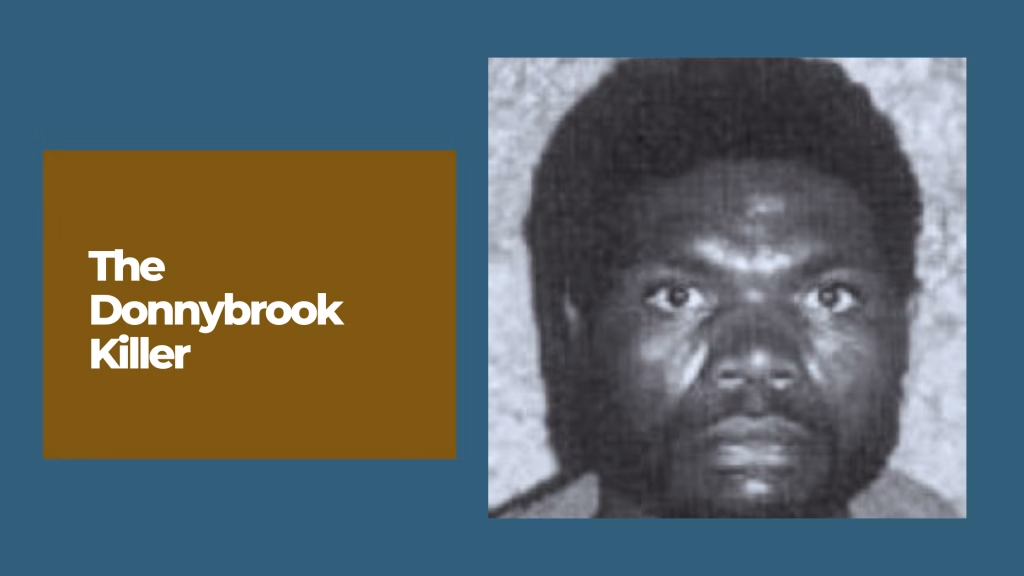
In 1995, the residents of Donnybrook, a rural area in KwaZulu-Natal, South Africa, grappled with a different kind of menace. Among them lived a psychopathic serial killer who randomly terrorized the community.
His method was brutally simple: kick down the front door in the middle of the night, stun the occupants inside, kill every male in the house regardless of age, then drag the women outside to nearby crop fields where he would assault them for hours.
The first time Christopher Mhlengwa Zikode was arrested was in July 1995 when he attacked a young woman named Beauty Zulu. He was charged with attempted murder but was unfortunately set free on bail.
Instead of reforming after his prison encounter, Christopher only grew more vicious.
By the time police caught him again in September 1995, he’d been linked to at least 18 different crimes, including 8 murders, 5 sexual assaults, and 5 attempted murders. The most disturbing part? He was only 21 years old.
This is the story of the Donnybrook Killer, a man who grew up witnessing tribal violence and somehow twisted that experience into a campaign of terror against his own community.
Born into Violence
Christopher Mhlengwa Zikode was born in 1974 in Donnybrook, right in the midst of violent tribal disputes that had been raging since the early 1970s. Back then, this rural area was home to two rival cultural groups, and it was quite common for both parties to fight and stake claim to land.
Tragedy struck immediately. Christopher’s mother passed away during childbirth, leaving young Christopher to be raised by the men in his family: his father, uncles, and brothers.
Growing up in a time of constant fighting, Christopher knew from a very young age how to modernize a weapon, how to create weapons out of different types of objects, how to fight, how to defend, and most importantly at the time, how to kill another person.
Christopher witnessed ferocious fighting as a very young boy. Being brought up by mostly men, he was limited in the amount of social interaction he had with females. His interaction with women was mostly seen through his father, brothers, and uncles.
Sadly, what Christopher witnessed was the men going into different tribes and vice versa, with women being subject to violence and assault during these raids. Maybe he thought this type of ferocity and violence was normal.
As Christopher grew, he became an extremely strong, tall, and ferocious fighter. But he wasn’t interested in fighting for land or tribal honor. He was interested in something else entirely: women.
Christopher became obsessed with sex. Being with women was all he really thought about. And that obsession would soon turn deadly.
The First Attack
In 1993, when Christopher was roughly 19 years old, massive drama and chaos rang out in his community. Christopher had been accused of trying to murder the community head’s daughter, a woman named Beauty Zulu.
Beauty came forward to her father, claiming Christopher had tried to murder her. Christopher said he never tried to murder her, that it was apparently a misunderstanding,g and she mistook what he was trying to do to her.
It caused enough chaos that police were called. They arrested Christopher, but there was no evidence. He was released on bail.
Looking at what Christopher would go on to do, this was probably one of the biggest mistakes the police made at the time.
After Christopher was released on bail, he slipped away into the night. He was never seen again for over a year.
But what would happen just a year later would be absolutely horrific.
18 Crimes in Two Years
Roughly a year after Christopher left Donnybrook, 18 different crimes took place between the end of 1993 and the middle of 1995. These crimes included rape, murder, and attempted murder.
But these were no ordinary murders. They were incredibly horrific and incredibly brutal.
Families were being attacked in their homes. They were being gunned down in their houses, and the women were then taken out and dragged into the nearest crop field.
Here’s how it would happen:
This mysterious person would smash down the front door of a property, stunning the occupants inside. Once he entered, he would look for any males, whether children, adults, or teenagers. He would kill them instantly. All of them.
Then he would set his sights on any woman inside the house. He would drag these women outside to the nearest field or where crops were being planted, and then he would continue to assault them. This could go on for hours until he was done, bored, or finished.
If a woman refused, he would kill her inside the house, still drag her body into the field where crops were being planted, and then continue to assault her corpse.
It was clear that this person, entering the homes in Donnybrook, knew exactly what he wanted to do. And he would stop at nothing to make sure he had it done.
The Pattern Emerges
As this person kept attacking different homes, people noticed that the women being targeted were from a specific church in the area. All the women lived on the outskirts, where crops were being planted and where the tall brush was.
People in the church community, for good reason, started to fear for their lives.
When police were called, they quickly figured out the serial killer’s pattern:
- He targeted specific women between the ages of 20 and 30
- All the women were Black females
- His method was to kick the door down, stun the occupants, kill the males no matter their age, then drag the women out
- He operated within a seven-kilometer radius
- He always attacked homes near farm fields or tall brush
Micki Pistorius, commander and head of the psychology unit for the South African Police Department, said the person they were looking for came from the same community, had a sadistic and ruthless sexual urgency evident in his torture, and enjoyed being cruel to women, specifically during assaults.
The Most Horrific Detail
One article reported that when this man entered a specific home, he murdered all the men inside. While walking over these bodies, he came across a young girl and her mother in the same bed.
He then proceeded to assault both the young child and the mother in the same bed.
The level of depravity is almost incomprehensible.
But here’s what makes this case even stranger: he would keep most of the women alive unless they fought against him or protested. If they resisted being dragged out of the house, he would murder them. Otherwise, he left them alive.
Think about that for a moment. If you’re any type of murderer going into someone’s house and killing an entire family, leaving one person alive means that person is a potential witness.
By keeping all these women alive after torturing them for hours in the fields, he left behind numerous witnesses. And all of these women who were attacked by this man recognized him instantly.
They said this person grew up in the area, left, came back, and then attacked all of them.
The Witnesses Come Forward
As soon as the women survived their attacks and were brave enough to go to the police, they reported that they knew who had come into their home in the middle of the night.
His name was Christopher Zikode.
The police were incredibly confused. Why would Christopher come back to Donnybrook? Why would a man leave his town, leave his village, then assault as many women as he could inside this village? Why would you go to an area where people could easily identify you?
The answer might lie in his psychology. Christopher wanted these specific women from his community. The women from that church. The women who lived near the crop fields where he’d grown up.
This wasn’t random hunting. This was targeted stalking of women he knew or had seen growing up.
The Undercover Operation
Now that the police knew who the person was and had multiple women come forward with the same story and the same pattern, they devised a plan.
They decided to have a cop go undercover and try to lure Christopher out.
This undercover officer would walk through the fields and brush every day to see if she noticed anything different. She would pretend to stay with her family near the crop fields. She would leave the house at night and come in during the day, making it very obvious that she was a woman and she was alone.
Eventually, this worked. Like clockwork, a couple of days after this young, vulnerable police officer started walking back and forth through the fields, someone popped out of the tall brush and tried to talk to her.
Luckily, many police officers were watching her. They managed to grab him red-handed.
On September 29th, 1995, when Christopher was 21 years old, he was arrested and taken to trial.
The Trial and Sentence
Christopher Zikode was charged with at least:
- 8 counts of murder
- 5 counts of rape
- 5 counts of attempted murder
- 1 act of indecent assault (against the young girl in bed with her mother)
In total, Christopher faced over 21 different charges.
Christopher’s trial lasted from 1996 to 1997. On January 7th, 1997, Christopher Zikode was charged and sentenced to 140 years in a South African maximum-security prison.
He was 23 years old.
The Parole Question
Recent reports suggest that Christopher may be eligible for parole soon, though this remains unconfirmed and is just chatter at this point.
The idea that he might be considered for parole is, frankly, disgusting to many people. Christopher was so young when he was arrested, yet there was no stopping him. He knew exactly what type of woman he wanted, where he was going to get them, and he was going to stop at nothing to get them.
He was only around 21 years old when arrested, yet he had so much murder and violence under his belt already.
South Africa has one of the best constitutions in the world and is very democratic. But it’s how the law is applied that determines how good the constitution can be. While rehabilitation is important and many people can be rehabilitated, the question remains: can someone like Christopher Zikode truly be rehabilitated?
Nature vs. Nurture: The Unanswerable Question
The Donnybrook Killer case raises one of criminology’s most persistent questions: are children born bad, or do circumstances make them bad?
Christopher Zikode’s childhood was undeniably traumatic. He was born into tribal violence. His mother died during childbirth. He was raised only by men during a time of constant fighting. He witnessed violence against women from a young age and may have internalized that this was normal.
But thousands of children grow up in similar circumstances and don’t become serial killers and rapists. Many people witness violence and trauma without turning into monsters who kick down doors and murder entire families.
So what made Christopher different?
Was it something inherent in his psychology? Was it the specific combination of factors in his upbringing? Was it the loss of his mother at birth, creating some fundamental inability to empathize with women?
We may never know. What we do know is that by age 19, he was already attacking women. By age 21, he’d committed at least 18 horrific crimes. The violence escalated quickly and showed no signs of stopping.
The Victims Who Survived
One of the most remarkable aspects of this case is the bravery of the survivors. These women endured unimaginable trauma, watched their husbands, sons, brothers, and fathers murdered in front of them, were dragged out and assaulted for hours, and then dared to come forward to the police.
In many communities, especially in the 1990s, reporting sexual assault carried enormous stigma. For these women to speak up, knowing they’d have to testify in court and relive their trauma, took incredible strength.
Their testimony was crucial to catching and convicting Christopher Zikode. Without their bravery, he might have continued his reign of terror indefinitely.
These women are the real heroes of this story. They survived, they spoke up, and they helped bring a monster to justice.
The Seven-Kilometer Killing Field
What’s particularly chilling about Christopher’s crimes is how localized they were. He operated within a seven-kilometer radius, specifically targeting women from one church who lived near crop fields.
This wasn’t the work of a drifter moving from town to town. This was someone hunting in his own backyard, attacking people he’d grown up around, women he likely knew or had seen for years.
The fact that he returned to Donnybrook specifically to commit these crimes suggests something deeply personal about his motivations. He didn’t want just any victims. He wanted these specific women from his community.
Maybe it was about power and control over people who knew him. Maybe it was twisted revenge for perceived slights. Maybe he specifically wanted to terrorize the community that had seen him arrested for attacking Beauty Zulu.
Whatever his reasoning, the localized nature of his crimes made him all the more terrifying to residents. This wasn’t a stranger passing through. This was one of their own, someone who’d grown up walking the same paths, attending the same markets, living in the same small world.
Lessons from Donnybrook
The Christopher Zikode case offers several important lessons:
Take first offenses seriously. When Christopher was arrested for attacking Beauty Zulu in 1993 and released on bail due to lack of evidence, it was a missed opportunity. If he’d been held, investigated more thoroughly, or monitored after release, the subsequent crimes might have been prevented.
Read more: The Novosibirsk Ripper: Yevgeny Chuplinsky
Believe survivors. The women who came forward after being attacked were immediately believed, and their testimonies were taken seriously. This allowed police to quickly identify Christopher and set up the undercover operation.
Patterns matter. The specific targeting of women from one church who lived near crop fields helped police understand they were dealing with one perpetrator, not random crimes.
Childhood trauma isn’t an excuse. While Christopher’s upbringing was undoubtedly difficult, it doesn’t excuse his crimes. Many people face trauma without becoming violent predators.
Community policing works. The undercover operation that caught Christopher relied on understanding local geography, patterns, and community dynamics. It was effective because officers understood the specific circumstances.
Where He Is Now
Christopher Mhlengwa Zikode remains in a South African maximum-security prison, serving his 140-year sentence. He’s now in his early 50s.
Whether he’ll ever be released on parole remains to be seen. The possibility has sparked outrage among those familiar with his crimes, and rightfully so.
A man who committed such horrific acts before age 21, showing no remorse and targeting vulnerable women in his own community, raises serious questions about whether rehabilitation is possible or appropriate.
The women he assaulted carry their trauma for life. The families whose fathers, brothers, and sons he murdered will never fully heal. The young girl he assaulted in bed next to her mother will live with that horror forever.
Does a man who created so much suffering deserve a second chance?
The Community That Remembers
Donnybrook has moved on, but the scars remain. The residents who lived through 1993-1995 remember the fear, the locked doors, the warnings to women not to walk alone near the crop fields.
They remember the families torn apart, the funerals, the whispered conversations about who might be next.
They remember when one of their own came back and turned their community into his personal hunting ground.
The church that lost so many members to Christopher’s violence still stands. The crop fields where he dragged his victims are still planted and harvested. Life goes on in Donnybrook.
But the memory of the Donnybrook Killer, the young man who grew up among them and then terrorized them, will never fully fade.
What aspect of the Christopher Zikode case disturbs you most: that he was only 21 when caught, that he left survivors who could identify him, or that he might be eligible for parole? Share your thoughts below.