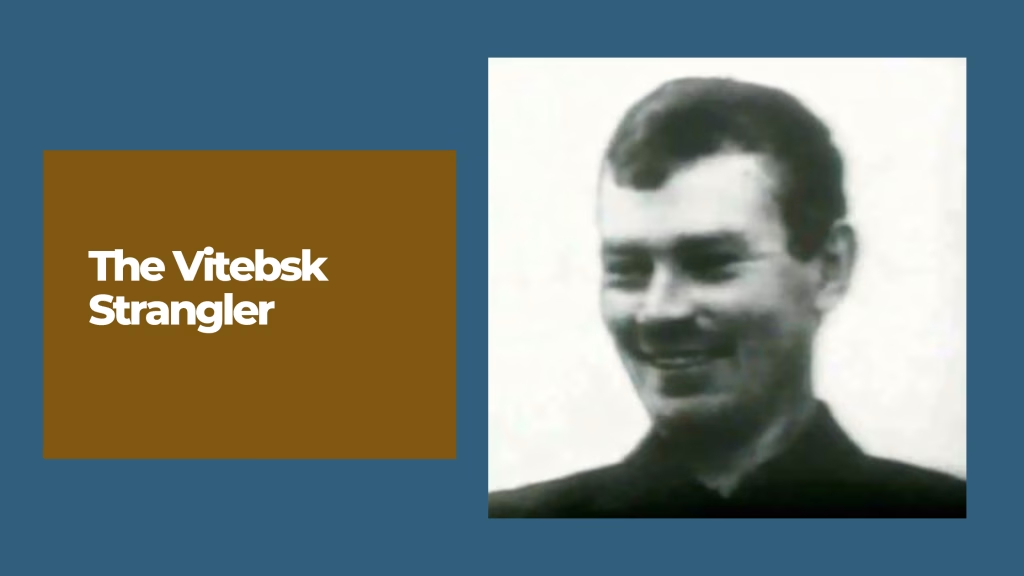
In 1982, Soviet Minister of Internal Affairs Vitaly Fedorchuk reviewed crime statistics across the USSR and identified two cases that demanded immediate resolution. The first was Andrei Chikatilo, the Butcher of Rostov. The second was the Vitebsk case, a nightmare that would expose the dark underbelly of Soviet justice.
The Vitebsk case wasn’t just about a serial killer. It was about a system so corrupt that innocent men were tortured into confessing to murders they didn’t commit while the real killer walked free for 15 years. By the time authorities caught him, Gennady Mikhasevich had murdered at least 36 women. Fourteen innocent people sat in prison for his crimes.
This is the story of the Soviet Union’s first officially recognized serial killer and the investigation that changed everything.
The Alcoholic’s Son
Gennady Modestovich Mikhasevich was born on April 7th, 1947, in Obol, a tiny village in the Vitebsk region of Belarus, 160 kilometers from the regional center. There’s not much to say about Obol. It had a church, ruins of an old aristocratic mansion, and people who worked the collective farm and drank when they weren’t working.
Gennady’s father, Modest, had an extreme thirst for alcohol. Like many Soviet men of his generation, he turned violent when drunk. Gennady’s mother, Maria, often had to flee their home to escape his rage. Young Gennady witnessed it all.
Modest also traumatized his son with terrifying war stories. World War II was still fresh in people’s memories, and Belarus had seen some of the worst horrors. The combination of domestic violence and war trauma created a toxic environment for any child.
In the village, everyone knew everyone’s business. Instead of sympathy, Gennady received a cruel nickname: “the alcoholic’s son.” Both children and adults called him this. If an entire village singles out one man’s drinking as exceptional in a culture of heavy alcohol use, you know it was bad.
Gennady grew up withdrawn and quiet, painfully shy. He struggled to form relationships with peers, especially girls, who often mocked what they saw as weakness. Yet nobody noticed anything sinister about him. His mother later recalled that once, when Gennady saw a man kill a chicken, he cried from concern about the animal’s suffering. He seemed gentle, even sensitive.
As Gennady became a teenager, the childhood teasing lost its power. He began dating a local girl named Yelena. The two seemed genuinely in love.
The Betrayal That Changed Everything
Around 1965, Gennady was drafted into the Red Army and served in the Navy. During his service, he allegedly suffered a head injury, which can affect impulse control. After a year or two, he fell ill, and doctors diagnosed him with hepatitis. He was quickly discharged.
Gennady looked forward to returning home to Yelena. But before he could reunite with her, devastating news arrived. During his nearly two years in the army, Yelena had found another man and gotten engaged.
This wasn’t unusual for the time. Young couples often broke up when their partner left for military service, assuming the man might not return. But Gennady took the breakup extremely hard. He fell into a deep depression and eventually had to leave his hometown, where his beloved remained.
In the 1970s, he enrolled at an agricultural academy 55 kilometers from Vitebsk, studying mechanics and locksmithing. He only returned home to visit his parents. Student life didn’t lift his depression. The romantic rejection had left deep wounds.
Whether due to his head injury, hepatitis (which can cause psychological effects, including depression), or the crushing rejection, Gennady experienced dark episodes where he wanted to end his life. These suicidal thoughts became constant companions.
One of these dark episodes changed everything.
The First Murder: A Coin Flipped
On May 14th, 1971, 24-year-old Gennady Mikhasevich set out from Gorodok to visit his parents in Obol. He traveled by public transport, planning to go first to Polotsk, then take a bus 50 kilometers to his birthplace.
He arrived in Polotsk in the evening after all the buses to Obol had left. He had two options: find a place to sleep or find someone to drive him. But Gennady found a third option. He decided he’d had enough. He found a glass shard and cut a piece of washing line, the perfect material for a noose.
The only question was where to do it. For some reason, he was drawn to the village of Oboltsy on the outskirts of Polotsk. There’s speculation that his ex-girlfriend used to visit this settlement, and he hoped to see her one last time before ending his life.
At the Oboltsy bus stop, an unexpected sight interrupted his suicide plans.
Nineteen-year-old Lyudmila had just returned from a holiday at a Soviet resort. She came back with a good tan, which she wasn’t shy about showing off on the warm May evening while waiting for the bus. There were no other people around.
The young, attractive, well-tanned girl caught Gennady’s attention. All thoughts of suicide evaporated. But what formed in his mind wasn’t the normal thought of asking for her number.
Instead, this idea took shape: “Why the hell should I be bitter about a woman now? I’d rather strangle someone myself.”
It’s a disturbing transformation when someone flips a coin from wanting to end their own life to deciding they can kill others instead. Whether it was his difficult childhood, his father’s violence, the head injury, the rejection by Yelena, or all of these factors, we’ll never fully know what made Gennady choose this path.
That evening, Mikhasevich crept up on unsuspecting Lyudmila, grabbed her by the neck, and dragged her away without anyone noticing. He tore at her clothes. He raped her first, then strangled her with his bare hands. Strangling someone manually takes time. You have time to realize what you’re doing, time to stop. Gennady didn’t stop.
After she was dead, he tied her hands with the rope he’d brought for his suicide and dragged her body to a nearby orchard. He threw earth and grass on the body and left. He tossed her belongings into the river.
After this horrific act, Gennady experienced what he called an “enlightenment.” He later explained: “When I was strangling, drawing strength through my hands, crushing her neck, I was my own doctor. I was particularly pleased when the victim trembled. The pleasure only intensified when she resisted, braved, and fought.”
Mikhasevich now saw killing as therapy, a way to fight his depression, suicidal thoughts, and feelings of inferiority. The official version, based largely on his own accounts, claims the first murder calmed him down for a while.
But we all know how crimes motivated by such impulses end. They never stop.
The Second Attack: One Who Got Away
About six months later, on October 29th, 1971, Gennady again had dark, angry thoughts. In the evening, he found himself in the suburbs of Vitebsk near a local factory. He saw a woman moving toward the bus station.
He caught up with her and asked what time it was. When she glanced at her wristwatch, he got what he expected. He pulled out a loop of rope he’d already prepared and weighted, throwing it around her neck.
This wasn’t an impulse. He’d come prepared, with purpose.
But something unexpected happened. The girl managed to slip her hand between her neck and the noose as it tightened, creating a barrier that delayed her death. Mikhasevich had no choice but to struggle with his victim.
The girl didn’t give up easily. She bit him hard on the hand when he tried to cover her mouth. She screamed as loud as she could, hoping someone would hear. Her gamble paid off. Local schoolchildren hanging around heard the screams and started shining flashlights in all directions, yelling and singing.
Mikhasevich realized he might soon face not just the girl but a crowd of citizens. He threw her aside, grabbed his rope, and walked away.
She survived. She would be Mikhasevich’s only surviving victim. Sometimes, suspicious schoolchildren can be useful.
But the defeat only made things worse. Now Gennady dealt not only with the dark contents of his mind but also with an overwhelming thirst for revenge that had to be quenched immediately.
He jumped on a bus to flee the scene. On the bus, he spotted 24-year-old Ekaterina returning home after her work shift. Gennady followed her off at her bus stop and coldly waited for his moment. The girl’s body, raped and strangled with a rope, was found the next morning with a rag stuffed in her mouth.
The Corrupt Investigator
Here’s where the Vitebsk case becomes more than just another serial killer story. It becomes a damning indictment of Soviet justice.
Mikhasevich’s first victim, Lyudmila, was found a couple of days after her murder on May 16th, 1971, discovered by a shepherd who noticed his cows strangely munching fruit in an orchard. Because her belongings were missing, investigators assumed robbery was the motive.
After a month of inconclusive investigations, the officer in charge was suspended. The Belarusian prosecutor’s office brought in heavy artillery: Mikhail Knyazhevich.
Knyazhevich had neither legal nor criminological training. But thanks to his alleged merits in partisan warfare and his great ambition, he’d earned a reputation as an investigator who solved 100% of his cases. At the time, his perfect record didn’t raise any red flags. It should have.
Arriving to investigate Lyudmila’s murder, Knyazhevich quickly found a suspect based on testimonies: Sergei Glushchikov, an unremarkable citizen. There was just one problem. Glushchikov wasn’t even in Polotsk at the time of the murder, let alone in the village of Oboltsy where the crime was committed.
This didn’t bother Knyazhevich. He assured everyone he’d extracted a confession. This was technically true, except the confession had been dictated to him after Glushchikov broke down under interrogation. According to reports, Knyazhevich wasn’t shy about hitting suspects over their heads with boots, threatening them, and ordering them to confess or else.
Sergei Glushchikov got 10 years in prison for a murder he didn’t commit.
The attack in October 1971, in which the girl survived, was sidelined. Blood type was determined from the bite on the attacker’s hand, but since the girl survived, Soviet officials decided to work on “more important things.” They said it had nothing to do with the second victim, Ekaterina, because the place and manner were different. The two incidents weren’t linked.
The same thing happened with Ekaterina’s murder. At the scene, a rope tied in a noose was found that reminded some officials of Lyudmila’s murder back in May. But according to officials, they’d already arrested the perpetrator for that murder. So they threw away the rope to avoid unnecessary questions.
Admitting they’d made a mistake would only cause problems. So the evidence was destroyed.
For Mikhasevich, this was great news, even though he wasn’t aware of all the investigations. He continued his normal existence, studying at Gorodok College, trying his luck with women.
And killing.
More Murders, More Innocent Men Imprisoned
In April and July 1972, Mikhasevich murdered two more girls: 23-year-old Stanislava and 18-year-old Melania. According to one version, he met one of these victims at a dance party. They hit it off and decided to be intimate. But the inexperienced and shy Gennady couldn’t perform. The girl made jokes about his failure. Mikhasevich became furious and strangled her.
All these intimate details came from the killer himself, so their accuracy is unclear.
Investigator Knyazhevich was assigned to one of these murder investigations. Based on testimonies later confirmed as false, three guys were supposedly seen with a German Shepherd near the murder scene around the time of death. The trio of friends was soon found: Valery Kovalyov, Vladimir Pashkovich, and Nikolai Ionchenko.
They had been walking a dog in the area. Just one detail: it wasn’t a German Shepherd as witnesses claimed. This fact should have immediately made a serious investigator suspicious. When interrogation began, Knyazhevich threatened them with the death penalty if they didn’t confess.
Under pressure, Kovalyov and Ionchenko confessed. Pashkovich resisted to the end, but his defense lawyer eventually persuaded him to confess. As a result, Kovalyov was sentenced to 15 years’ imprisonment, Pashkovich to 12 years, and Ionchenko to 2.5 years.
Investigator Knyazhevich had now put four innocent people in prison without any real evidence.
A Double Life
Gennady was killed again on April 11th, 1973, near the Luchosa train station in Vitebsk. He raped, strangled, and left 17-year-old Larisa next to the train tracks. After this murder, he went quiet for a while.
This may have been due to life changes. In June 1973, he graduated from college, became a mechanical engineer, returned to his home village of Obol, and took a job as a mechanic there.
In May 1975, he strangled 22-year-old Anastasia near his village. At the end of September that same year, 25-year-old Tatyana was walking along a secluded path through the village of Obol. Gennady, going through another manic episode, was passing through the area.
Everything went according to his typical pattern. He jumped on the girl, raped and strangled her. When she lost consciousness, he released his grip. Since things had been going so well, he didn’t bother dragging the body off the path.
As he was about to leave, he noticed the girl was still moving, trying to stand up after what she’d been through. Shocked, Mikhasevich rushed to finish the job. But after grabbing her neck again, he realized he couldn’t strangle the same victim twice.
Then he noticed her handbag with items that had escaped from it. As if by design, it contained scissors. Gennady took them and didn’t stop stabbing until he was sure she was no longer breathing.
After this incident, he modified his method. From now on, he would leave a noose as tight as possible around each victim’s neck just to make sure they didn’t suddenly get up.
In spring 1976, 29-year-old Mikhasevich married his wife Anna and changed jobs to work as a locksmith on a farm. The new job and family came with a new home. Gennady moved to a small village called Solovniki, just a few kilometers from Polotsk.
In 1976 alone, Mikhasevich killed at least four girls. The youngest was 16, the oldest 23. This brought his tally to 11 victims. The pattern was the same everywhere: strangulation, sometimes rape. Eventually, he stopped raping and just strangled. Dead victims were found with their mouths gagged, usually with gloves or underwear. For unclear reasons, he began removing their shoes and covering their bodies with grass, soil, or moss.
The Model Citizen
Gennady had two children with Anna: a son and a daughter. He was particularly fond of his daughter, whom he named after his first love, Yelena. He pampered her constantly, buying toys, taking her to kindergarten, weaving ribbons into her hair himself, trying to spend as much free time with her as possible.
He tried to pamper his wife, too. The killer didn’t shy away from bringing Anna cosmetics taken from victims, claiming they were gifts from work. The unsuspecting wife could only be proud of her successful, handsome, and respected husband.
According to accounts, they got along quite well. She was even jealous that her friend had a husband free of bad habits, calm, always helping with housework. Gennady and Anna didn’t talk much about intimate topics, but this wasn’t unusual in alienating Soviet society. Although the relationship was emotionally cold, his wife had significance for him. During conflicts, Gennady would instinctively grab his wife’s neck in her sleep, but he always managed to stay within boundaries.
Read more: Gerald Stano: Serial Killer Who Confessed to 41 Murders
Gennady wasn’t only a model husband but also a model citizen. He was active in the local Communist Party, at one point becoming chairman of the local party committee for meritorious work. His face appeared on the honor board. Volunteers from this party assisted local law enforcement in all kinds of matters.
After joining the Communist Party, Gennady even got a red Zaporozhets car.
Think about that for a moment. The serial killer was helping police investigate his own crimes.
The Killing Intensifies
From 1977 to 1980, only three murders were attributed to Mikhasevich. But in 1981, he began changing his pattern. Until then, he’d mostly hunted in evenings and at night, often at bus stops. But now that he was at the party, he could see where the investigations were going, where the focus was.
With 14 victims to his name, Gennady was getting bolder. He stopped attacking victims in the streets or on roads and stopped killing at night. Now he had a new tool: his car. He would pick up hitchhikers or girls just hanging out by the roadside, take them to remote locations, and often strangle them in the car itself, sometimes raping them first, then dumping bodies in forest clearings or fields.
Between 1981 and 1982, he murdered at least seven more women, bringing the total to 21.
While 1983 was quiet, 1984 was particularly active. That year alone, Mikhasevich killed 12 women. Sometimes he committed crimes during lunch breaks. In one case, he murdered two women one after another in the course of one day, throwing both bodies in the same place. He planned to find a third victim immediately, but ran out of fuel on the way back to the city. When he got to the petrol station, he calmed down while queuing and talking to people, which probably saved at least one woman that day.
In the village where Gennady lived, women were afraid to leave their homes in the dark. Nobody suspected Mikhasevich, the model citizen, could be the reason. In Vitebsk and Polotsk, this fear turned into an economic problem. The majority of the population in the Vitebsk district was female. As the list of missing women grew, many refused to work evening or night shifts.
The crimes were a major headache for the militia (Soviet police). But authorities refused to accept that the deaths and disappearances could be the work of one man. It was more important to produce good statistics than to seriously look for perpetrators.
Fourteen Innocents
Investigator Knyazhevich was assigned an increasing number of cases in the Vitebsk region. Over time, at least 14 completely innocent people were convicted because of him, only to have the cases filed as closed. All confessions were extracted using violence and threats.
One of the men unnecessarily accused was Nikolai. According to Knyazhevich, Nikolai and his partner, Lyudmila, had raped and murdered one of the victims. Knyazhevich targeted Lyudmila as the weaker link and tortured her until she admitted that Nikolai, with her help, had raped and murdered the girl.
This was enough to give Lyudmila 10 years in prison and sentence the young man to death. Nikolai was shot.
Mikhasevich laughed at this police work and decided he could go about his business in peace. But this arrogance would be his downfall.
The Investigator Who Cared
1985 was the fatal year. Soviet authorities in Belarus, seeing that the situation wasn’t improving despite all the trials, decided to renew investigations in the Vitebsk region and appoint more officers.
Nikolai Ivanovich Ignatovich deserves special mention in this new wave. The 35-year-old officer was characterized by an uncharacteristically principled approach to the system. In other words, he actually wanted to solve crimes, not just report nice statistics.
He was sent to Vitebsk as a kind of dead-end assignment where any ambition he might have had was supposed to be stifled. However, Ignatovich didn’t sleep on the job. He immediately began analyzing the wave of murders.
He quickly saw patterns between the geographical area of crimes and the method of killing. He concluded that the murders, which had been going on for almost 15 years, were most likely the fault of one person.
Using available material and testimonies, he constructed a profile of the Vitebsk strangler. According to him, the killer would be:
- 32 to 42 years old
- Light brown curly hair
- Height of 1.75 to 1.85 meters
- Good knowledge of the area around Vitebsk, Polotsk, and Lepel
- Most likely vocational school education
- Access to law enforcement investigative information
- A red car
- Well-spoken and good-looking (several victims were last seen getting into cars of their own accord)
Although Ignatovich was mistaken about some details (for example, saying the killer was lonely), the portrait was surprisingly accurate to Mikhasevich’s characteristics.
The Letter That Changed Everything
In September 1985, Gennady killed his 35th victim.
In October 1985, a surprising letter reached the editorial office of a local newspaper in Vitebsk. It stated that all the women, including almost adolescent girls, killed over the past decade, were victims of their own husbands and partners. According to the letter’s author, this was their well-deserved reward for the infidelity they’d shown.
The editorial board took the letter seriously and referred it to law enforcement.
Around the same time in late October 1985, another girl was found strangled to death. The pattern seemed usual: strangled with her own headscarf, signs of violence, body left on the roadside. Witnesses said the girl got into a car before disappearing.
The only difference: a piece of paper was stuffed in her mouth with a note matching the editorial office’s letter. The handwriting read: “Death to the police and communists.”
The KGB, which had been watching with indifference, was suddenly enraged. Underground organizations? Letters threatening death to communists? Now they cared.
Blood type was determined from saliva on the letter sent to the editor. The KGB and Ministry of Interior sent spelling experts from Moscow to Vitebsk. They began analyzing written documents. More than 550,000 pieces of handwriting were examined. Almost the entire official male population of Vitebsk was checked.
This had an immediate benefit: solving at least 220 other crimes, including 27 murders.
The breakthrough in the Vitebsk strangler case came from traffic offenses. In the Soviet Union, it was customary to write official explanations for any road violations, creating a substantial database of written documents.
One explanation caught the graphology experts’ attention. It had a different style of writing, but too many similarities with the letter and note to be a coincidence. It was obvious the author was trying to use a different style, but not skillfully enough to fool a good analyst.
The explanation was signed by Gennady Mikhasevich.
The noose finally began tightening around the killer’s neck.
The Arrest
Once accuracy was assured, three task forces were assembled to arrest Mikhasevich as a suspect. He couldn’t be found at home or work, but a pile of items belonging to the victims was found in his house.
After gathering information, the trail led to the village of Gony near Solovniki, where Mikhasevich had relatives he’d allegedly gone to visit.
On December 9th, 1985, 38-year-old Gennady Mikhasevich was found sitting on a bed in his underwear at his relatives’ house. He was carrying a suitcase and train tickets for himself and his family to Odessa.
Mikhasevich initially behaved calmly when arrested. He even told his shocked wife it was a mistake and he’d be home soon.
He was met at the station by Ignatovich, who brought him back for questioning. Gennady claimed that one day, strangers stopped his car, threw him into their vehicle, drove him somewhere, and forced him to write the letter to the newspaper.
Nobody believed him. He tried to play insane, but the psychiatrist declared him sane.
Gennady grabbed his last straw and decided to confess. What followed was a marathon lasting several months, during which Mikhasevich spent the whole time with a smile on his face and without the slightest remorse. He talked about what he’d managed to do in the last 15 years.
During tours of crime scenes, the remains of five more women who had never been found by law enforcement were discovered. Mikhasevich seemed to be enjoying his new celebrity status. The fact that his interrogations and transport to crime scenes would be filmed made him happy.
The Trial and Execution
During the trial, mainstream newspapers gave Mikhasevich’s personality and methods plenty of coverage. This means all his victims were sidelined, and little information about them has survived, making the story even sadder.
In court, Mikhasevich behaved calmly and coolly, never once showing nervousness or shock at the crimes he’d committed. He even sang in his cell between sessions. He said that when locked up, he was finally free from all his desires so he could read and have fun.
In one hearing, Mikhasevich stated, “I do not consider women to be human beings. Women have often hurt me, and I have built up hatred towards them. I did not feel any anger towards men, even when they insulted me, but women are to blame for all the troubles in my life.”
The only time he showed emotion, wiping away a tear, was when talking about his first failed love, Yelena. Whether this was performance or genuine pain remains for you to decide.
In 1987, Mikhasevich was found guilty of 33 murders, although he’s officially credited with 36, and he confessed to 43 (not enough evidence was gathered for all). He was shot dead in Minsk at age 40 that same year.
The Legacy
The Mikhasevich case was significant in several respects. It finally led to official recognition of the existence of serial killers in the Soviet Union. Serial killers were separated into their own category of criminals requiring specific investigative methods. Gennady can be considered the first official modern Soviet serial killer.
As a result of this investigation, more than 200 officials working in the Belarusian legal system received penalties for abuse of office.
However, Knyazhevich, who put 14 innocent people in jail, received no serious punishment. He was sent into retirement. For the rest of his life, he reacted to the whole story with the thought: “And who doesn’t? They admitted it themselves.”
When Mikhasevich was convicted, many of the wrongly convicted had served their sentences in full and came out of prison crippled and crushed. Nikolai, who was executed for a crime Mikhasevich committed, never came home at all.
What This Case Reveals
The Vitebsk case isn’t just about one man’s depravity. It’s about a system that valued statistics over truth, confessions over evidence, closed cases over justice.
Think about what had to go wrong for this to happen. A corrupt investigator torturing confessions from innocent men. Authorities are destroying evidence to avoid admitting mistakes. A serial killer became a party official who helped police investigate his own crimes. Women were disappearing for 15 years while officials insisted it couldn’t be one person.
And when the truth finally came out, the man responsible for jailing 14 innocents and executing at least one faced no real consequences.
The victims deserve more than to be footnotes. Lyudmila, the 19-year-old with the good tan. Ekaterina, 24, is returning from her work shift. Larisa, only 17. Tatyana, 25, is walking home along a secluded path. And 33 others whose names barely survived in the historical record.
They were daughters, sisters, mothers, friends. They had futures that Gennady Mikhasevich stole. And for years, as they died one by one, the Soviet system was too corrupt to stop him.
What aspect of the Vitebsk case disturbs you most: the 15-year killing spree, the 14 innocents imprisoned, or the investigator who faced no consequences? Share your thoughts below.