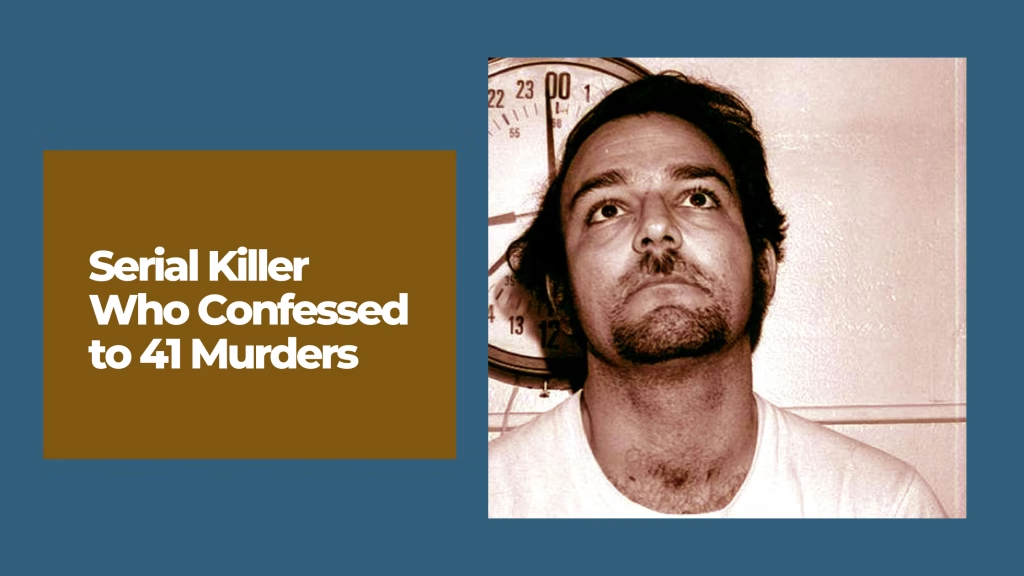
On March 23rd, 1998, Gerald Stano sat in his cell at Florida State Prison, waiting for his fourth scheduled trip to the electric chair. Three times before, he’d been granted last-minute stays of execution. This time would be different.
Outside the prison walls, a crowd gathered. Among them was Raymond Neil, whose sister Ramona had been murdered by Stano 22 years earlier. “I hope he says he’s sorry,” Neil told a reporter. “But I don’t care. It’s time. I want to look at Stano, look at his face when they strap him in. I want the bad dreams to stop.”
What makes Gerald Stano’s case so disturbing isn’t just the body count. It’s how an awkward, unremarkable man managed to kill dozens of women over nearly a decade while barely registering on law enforcement’s radar. His story reveals how serial killers can hide in plain sight, and how close he came to never being caught at all.
The Boy Nobody Wanted
Gerald Stano wasn’t always Gerald Stano. Born Paul Eugene Stano on September 12th, 1951, in Schenectady, New York, he entered the world already unwanted. His birth mother had given up three of her other children for adoption and kept only one, a daughter with severe brain damage. When Paul arrived, she immediately contacted social services.
The baby they found was in terrible shape. At 13 months old, Paul was severely malnourished and emotionally neglected. He functioned at what doctors called “an animalistic level,” constantly removing his diaper to play with his feces. The agency labeled him unadoptable.
But Norma and Eugene Stano, desperate for a child, wouldn’t take no for an answer. Norma worked as a county social worker and saw something in this broken little boy. Six months later, despite warnings from psychologists, they officially adopted him and renamed him Gerald.
Here’s what haunts investigators about cases like this: at least 16% of known serial killers are adopted. Was it the adoption itself that damaged Gerald? The abandonment? Or did his biological mother pass along something darker in his genes? Dr. David Kushner, who studied 12 cases of adoptees who became killers, noted that therapy for these individuals rarely addresses the adoption’s impact. “It’s a subject no one ever wants to talk about,” he said.
Warning Signs Everyone Ignored
As Gerald grew up, the red flags appeared one after another. He wet the bed until age 10, a trait found in 60% of serial killers according to FBI profiler Robert Ressler. He couldn’t connect with other kids his age and became an easy target for bullies. Teenage girls mocked him relentlessly.
In the late 1960s, his behavior escalated. He was arrested for pulling a false fire alarm, then again for throwing rocks at cars from a highway overpass. Desperate, his parents enrolled him in military school. It didn’t help. He started stealing money from fellow students.
The Stanos moved to Norristown, Pennsylvania, in 1967, hoping a fresh start would help. Instead, things got worse. Gerald skipped school regularly, stole from family and classmates, and once paid track team members to run behind him so he’d finish first. After flunking and repeating three grades, he finally graduatedfrom high school at 21.
What’s striking is how his parents kept trying. They believed love and structure could fix whatever was broken inside their son. They were wrong.
The Unraveling
After graduation, Gerald showed brief flashes of potential. He graduated from computer school with flying colors and got a job at a local hospital. But within weeks, he was fired for stealing from employees’ purses. He bounced from job to job, eventually moving back home.
In the early 1970s, Gerald met a young woman in New Jersey and got her pregnant. When her father found out, he came after Gerald with a gun, demanding that he pay for an abortion. Gerald agreed, then spiraled into heavy drinking and drug use.
His parents convinced him to move to Ormond Beach, Florida, with them to care for his elderly grandmother. For a while, Gerald seemed to stabilize. In 1975, he fell in love with a 22-year-old hairstylist, and they married on June 21st. He even got a job at his father-in-law’s service station.
The marriage lasted six months. Gerald’s drinking returned, and he began physically abusing his wife. By early 1976, they were divorced. With nowhere else to go, Gerald moved back in with his parents.
This is when something shifted. According to Dr. Sam Vaknin, author of “Malignant Self-Love,” serial killers often embody malignant narcissism. The divorce, the public failure, the humiliation of returning home at 24 years old may have been the narcissistic injury that pushed Gerald over the edge. He couldn’t handle rejection, couldn’t bear being exposed as a failure.
And that’s when women started dying.
The Killing Begins
On February 17th, 1980, two drunk college students stumbled upon decomposed remains behind Daytona Beach Airport. Detective Sergeant Paul Crow, a Vietnam veteran trained in criminal psychology, took charge of the crime scene.
The body had been carefully posed on its back, arms at the sides, head tilted upward. She was fully clothed with no obvious signs of sexual assault. But when they turned her over, they found multiple deep stab wounds, suggesting a frenzied rage.
The victim was 20-year-old Mary Carol Maher, a local college student. The autopsy revealed stab wounds to her back, chest, and legs. Someone had attacked her in a fury, then took time to arrange her body afterward. Detectives had a brutal homicide and almost no leads.
Then, on March 25th, 1980, everything changed.
The Break in the Case
A sex worker walked into the Daytona Beach Police Department with an incredible story. A man driving a red Gremlin with tinted windows had picked her up, taken her to her motel room, then refused to pay. When she argued, he pulled out a knife and slashed her thigh, requiring 27 stitches. Before fleeing, he berated her for being a prostitute.
She gave Detective Jim Gadbury a detailed description: average height, slightly overweight, glasses, mustache. More importantly, she’d seen his distinctive car recently at a nearby apartment complex.
Gadbury drove to the area and found a red 1977 Gremlin matching her description. He ran the plates. The car belonged to Gerald Eugene Stano, 28, of Ormond Beach. When Gadbury pulled Stano’s file, he discovered something chilling. Stano had been suspected in multiple assaults on local prostitutes but had never been convicted.
The sex worker identified Stano from his mugshot without hesitation. She signed an affidavit charging him with aggravated assault and battery.
Inside the Mind of a Killer
Detective Crow had already developed a profile of Mary Carol’s killer: white male, late 30s or early 40s, Daytona Beach area, unremarkable car, targeting hitchhikers and prostitutes. Volatile temper. Deep-seated hatred of women. Unable to handle rejection. Likely killed before and would kill again.
Gerald Stano, at 28, fit almost perfectly.
On April 1st, 1980, they brought him in for questioning. Crow used a clever technique, asking Stano questions he already knew the answers to, establishing a baseline for truth and lies. He noticed something fascinating: when Stano told the truth, he leaned forward eagerly. When he lied, he leaned back, retreating.
After an hour, Stano confessed to assaulting the prostitute. That’s when Crow made his move. He slid a photo of Mary Carol across the table.
“Yeah, I’ve seen her before,” Stano said, leaning forward. He claimed he’d given her a ride to Atlantic Avenue weeks earlier.
Crow changed tactics. “Gerald, what are you upset about today?”
Stano’s answer was haunting: “Today’s the day you got me day. Today’s the day my parents adopted me.”
The Confession
As Stano talked about his childhood and adoption, Crow carefully steered the conversation back to Mary Carol. Stano’s story began changing. Now he claimed he’d driven her around, stopped at a supermarket for beer.
“She just sat in the car while you went in?” Crow asked.
“Yeah.”
“Are you sure you didn’t try to get in her pants, Gerald?”
“Yeah.”
“You wanted a little something, and she didn’t want to give it to you. Is that about right?”
“Yeah.”
“She told you no. She hit you, didn’t she? Hit you pretty hard.”
“You’re goddamn right she did.”
“So what did you do? You lost it, didn’t you?”
“Goddamn right I did. I got so goddamn mad. I stabbed her as hard as I could.”
Stano described keeping a knife under his seat. He grabbed it and struck Mary Carol in the chest repeatedly. When she tried to escape, he cut her leg and pulled her back. She hit her head on the dashboard and started gurgling. He stabbed her several more times in the back until she went limp.
“I was pissed because she was messing up my car,” he said.
Crow didn’t need to hear more. “Let’s go for a drive. You direct. I’ll drive.”
Stano led them directly to where he’d dumped the body, pointing out exactly where he’d posed her corpse. He signed a written confession to the murder of Mary Carol Maher.
The Bodies Start Piling Up
Detective Larry Lewis approached Crow with a question: had Stano confessed to any other crimes? When Crow said no, Lewis mentioned a missing prostitute, 26-year-old Toni Van Haddocks, last seen on February 15th.
Crow showed Stano her photo. He leaned back immediately. “Never seen her before.”
Crow knew he was lying.
They charged Stano with first-degree murder of Mary Carol and transferred him to the county jail. Then, on April 15th, a Holly Hill resident found a human skull while gardening. The remains were identified as Toni Van Haddocks. Cause of death: multiple stab wounds to the head.
When Crow brought Stano back in, he eventually broke down and confessed to this murder, too. That’s when Crow realized something terrifying: there might be many more victims.
A Pattern Emerges
Crow started digging through unsolved homicides dating back to 1975. The pattern was unmistakable.
July 22, 1975: 16-year-old Linda Hamilton, a Massachusetts tourist, was found murdered near an old Indian burial ground. Last seen walking down Atlantic Avenue.
January 1976: 24-year-old Nancy Heard was discovered near Bulow Creek Road, north of Ormond Beach. Body posed and partially hidden beneath tree branches. Last seen hitchhiking on Atlantic Avenue.
May 1976: 18-year-old Ramona Neal from Georgia was found in Tomoka State Park. Branches covered her body. Same location, same method.
The signature was consistent: young women, often hitchhikers or sex workers, picked up along Atlantic Avenue in Daytona Beach. Stabbed to death. Bodies were posed and covered with branches.
But Crow discovered something else. Stano had lived in multiple parts of Florida and had spent time in New Jersey. Similar murders occurred in Stuart, Florida, during the mid-1970s. Two more in New Jersey in the early 1970s. Same signature, same victim profile.
Gerald Stano hadn’t just been killing in Daytona Beach. He’d been hunting across state lines for nearly a decade.
The Plea Bargain
Facing overwhelming evidence, Stano negotiated a deal. If he admitted guilt in the murders of Mary Carol Maher, Toni Van Haddocks, and Nancy Heard, and allowed his other confessions to enter the court record, he’d receive three consecutive life terms with 25-year minimums.
On September 2nd, 1981, Judge S. James Foxman accepted the agreement but made his feelings clear: “Based on the information presented to me in these three cases, I find it entirely plausible that a death sentence could have been deemed suitable for any one of them, possibly even for all three.”
Gerald was transferred to Florida State Prison. But life there wasn’t what he expected. At the county jail, he’d basked in media attention, bragging about his crimes. At the state prison, nobody cared. The lack of recognition irritated him deeply.
Craving attention again, Stano wrote to Detective Crow, offering to confess to more murders.
The Full Horror Revealed
In a series of interviews, Stano confessed to murder after murder:
17-year-old Cathy Lee Scharf of Port Orange was found in a ditch outside Titusville in January 1974.
24-year-old Susan Bickrest from Daytona Beach was discovered floating in Spruce Creek in December 1975.
23-year-old Mary Muldoon from Ormond Beach was found in a roadside ditch in November 1977.
19-year-old Janine Ligotino and 17-year-old Ann Arceneaux were both found dead near Gainesville in 1973.
17-year-old Barbara Bauer was discovered near Starke, Florida, in 1974.
The list kept growing: 34-year-old Bonnie Hughes. 18-year-old Diana Valick. 21-year-old Emily Branch. 17-year-old Christina Godfrey. 23-year-old Phoebe Winston. 18-year-old Joan Foster. And horrifyingly, 12-year-old Susan Batsie.
Just when Crow thought they were finished, Stano remembered two more: 35-year-old Sandra Dubose and 17-year-old Dorothy Williams.
In total, Gerald Stano confessed to murdering 41 women across Florida, Pennsylvania, and New Jersey between 1973 and 1980.
Death Row and the Long Wait
On June 8th, 1983, Stano pleaded guilty to murdering Susan Bickrest and Mary Muldoon. Judge Foxman sentenced him to death.
Three months later, he was convicted of murdering Cathy Lee Scharf. The prosecution played his taped confession. The jury recommended death. The court identified four aggravating factors: prior violent felony conviction, murder during a kidnapping, especially heinous and cruel, and cold and calculated. The death sentence was upheld on appeal.
But Gerald Stano proved remarkably skilled at delaying his execution.
July 2, 1986: First execution date. Stano filed for post-conviction relief one day before. Granted a stay.
August 26, 1987: Second execution date. Filed another petition. Another stay.
April 29, 1997: Third execution date. Stano filed a notice of conflict with his lawyers. Postponed to May 30th.
Then fate intervened. During the execution of Pedro Medina, the electric chair malfunctioned, sending a 12-inch flame from the condemned man’s head. Medina’s lawyer called it “a burning alive, literally.” It was the second similar malfunction in seven years.
The court issued another stay while they investigated the chair. After a thorough review, they ruled that the problems were fixed. The new execution date: March 23rd, 1998.
This time, there would be no more delays.
The Final Moment
Gerald Stano ordered his last meal: Delmonico steak with bacon bits, baked potato with sour cream, French bread with butter, and a tossed salad with blue cheese dressing. For dessert, a half gallon of mint chocolate chip ice cream and two liters of Dr. Pepper.
Read more: Ronald Dominique: The Bayou Strangler
As guards led him to the death chamber, he remained silent. He offered no last words, showed no emotion as they strapped him into Old Sparky.
Raymond Neil watched from behind the witness window, just three feet away. “I said, ‘Die, you monster,'” Neil later told reporters. “The power slammed into him, and he jerked as much as he could, and that was it. I saw the life leave his hands. It was like having a ton of bricks lifted off my back. Afterward, my brothers and I smoked cigars to celebrate.”
Neil added, “I’m thankful Florida dared to keep the electric chair. At least there was a split second of pain. With lethal injection, you just go to sleep.”
The Legacy of Gerald Stano
Gerald Stano confessed to 41 murders, though he was never formally charged with many of them. Several victims remain unidentified to this day. Yet most law enforcement officials consider the cases resolved and closed.
What makes Stano’s story so chilling isn’t just the number of victims. It’s how unremarkable he was. Not particularly intelligent or charming like Ted Bundy. Not organized like BTK. Just an awkward, angry man who killed women because they rejected him, because they represented everything he couldn’t have, because murdering them was the only time he felt powerful.
He killed for nearly a decade before anyone connected the dots. He might have continued indefinitely if that sex worker hadn’t walked into the police station in March 1980. How many more women would have died?
The victims of Gerald Stano weren’t just statistics. They were daughters, sisters, mothers. Mary Carol Maher was 20 years old. Linda Hamilton was 16. Susan Batsie was only 12. Each had dreams, futures, and people who loved them. Ramona Neal’s brother waited 22 years to see justice served.
Their names deserve to be remembered far more than his.