On January 18, 2013, 14-year-old Barbara Costa sat alone at a public bus stop in Goiânia, Brazil. She’d just finished school and was waiting for her grandmother to get off work. It was an ordinary afternoon in the city of about 1.5 million people.
A man on a motorcycle pulled up beside her. He yelled, “Robbery!” Then, without waiting for a response or attempting to take anything, he shot Barbara point-blank in the chest with an automatic weapon.
He fled the scene immediately. He didn’t take her phone, her bag, or anything else. He just killed her and left.
Less than 24 hours later, the same man spotted 23-year-old Beatrice Mora walking alone. He shot and killed her, too, again taking nothing.
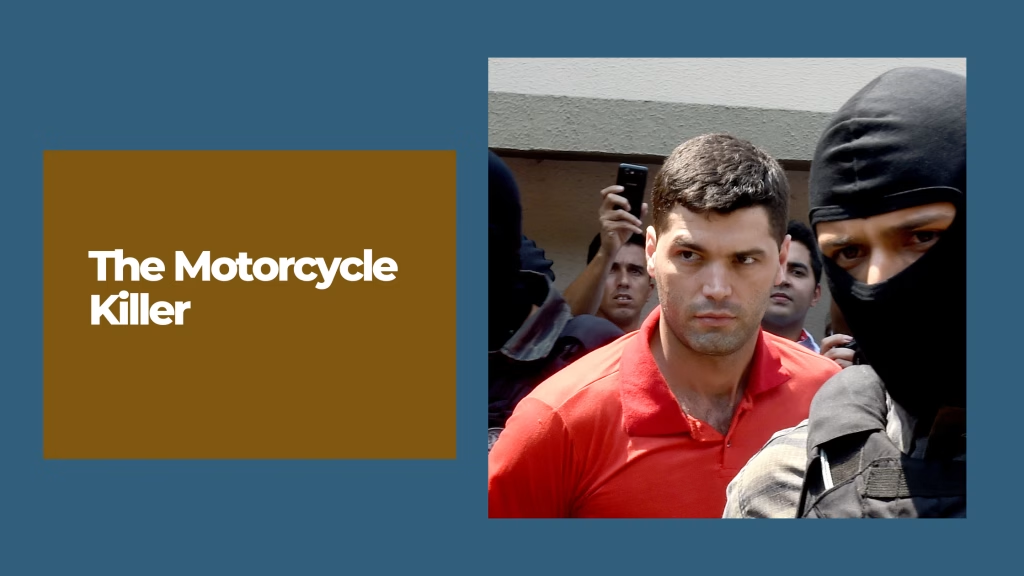
The man was 26-year-old Thiago Henrique Gomes da Rocha, and these were just two victims in a killing spree that would claim at least 39 lives between 2011 and 2014.
What makes this case particularly disturbing is that Thiago had no motive beyond the simple desire to kill. He didn’t rob his victims. He wasn’t eliminating witnesses or covering up other crimes. He just wanted to murder people, so he did.
And while he was actively killing, he worked as a security guard at a children’s hospital.
This is the story of Brazil’s Motorcycle Killer.
A Childhood Marked by Absence and Abuse
Thiago Henrique Gomes da Rocha was born on February 4, 1988, to a single mother and an absentee father. Thiago recalled never having seen or even known his father, who had abandoned the family before he was born.
Thiago was raised primarily by his grandparents. His mother worked multiple jobs, leaving early in the morning and returning home late in the evening. His grandparents did all they could to raise young Thiago to the best of their ability.
But they couldn’t protect him from what was happening in his own home.
When Thiago’s mother started seeing another man, she became even more absent. She was never around. As a result, Thiago was left by himself frequently.
A sick neighbor used this opportunity to carry out his crimes. This neighbor would sexually abuse Thiago whenever his mother wasn’t home. And as we’ve established, that was often.
Young Thiago was being violated in his own home. He didn’t feel safe anywhere.
The only place where he might have felt some safety was at school. But even that didn’t work out. His classmates constantly bullied him for being shy and quiet. The bullying was so bad that at some point, Thiago expressed a desire to stop going to school altogether.
Going on to high school, Thiago thought his bullying phase was finally over. He hoped for a somewhat normal school experience. But even that proved difficult.
Struggling with Identity and Anger
At some point during high school, Thiago began feeling attracted to both girls and boys. He had a hard time articulating his feelings. He would recall feeling anxious whenever he tried to talk to girls.
That anxiety would quickly turn to anger when girls laughed at him and turned him down.
The anger got so bad that he became even more reclusive. He would lash out at anyone who talked to him in the wrong way.
Despite his struggles, Thiago still lived with his mother for much of his early adult life. He occasionally brought dates home. His girlfriend would later testify at his trial, explaining that he was a loving boyfriend who treated her with respect.
As an adult, Thiago had a more open personality. People recalled him being quiet and friendly, not the kind of person you would expect to commit heinous murders. With a tall frame and kind face, Thiago landed jobs pretty easily.
Working Security While Killing
Thiago worked various security jobs at different firms and shopping centers for several years. His last job before being arrested was working as a security guard at a children’s hospital.
Staff at the hospital reported that he was a pretty quiet guy who came in, did his rounds, and left when his shift was over. The hiring manager noted that Thiago went through a rigorous hiring process and passed with flying colors.
He only worked at the children’s hospital for less than two months before his arrest. This means he had already killed people and was still actively killing while watching over a hospital full of children.
Think about that. Parents brought their sick children to this hospital, trusting they’d be safe. A serial killer was walking the halls, doing security rounds.
The Killings Begin
As far as police who investigated the case know, there was no set point or triggering event in Thiago’s life where he snapped and instantly started killing.
Thiago himself revealed during interrogation that he didn’t recall having a triggering instance right before he committed the murders. Only a burning desire and urge to kill.
He revealed that when he began killing, he had no particular preference or discrimination among victims. He stated that he simply picked at random, depending on who he met after thinking about killing for days on end.
Thiago began killing sometime in 2011. His method was really disturbing and peculiar.
After a night of drinking alcohol for liquid courage, he would get on his motorcycle and proceed to do the most bizarre thing before killing his victims. He would ride up to the victim, yelling “robbery!” before pulling out an automatic weapon and shooting them at point-blank range.
After the murder, Thiago would flee the scene, but not before stealing a license plate to replace his motorcycle plates so he couldn’t be traced.
To show that Thiago didn’t kill for any reason beyond being a cold psychopath, he didn’t take any valuables from his victims. He didn’t take money or jewelry that would have been an easy steal at that point.
The First Victim
Thiago’s very first victim was a man whom he recalled having little memory of during interrogation. He only remembered having a lot to drink that night before getting on his motorcycle, driving to a nearby highway, and shooting the first guy he found alone on the street.
This unidentified man would be the first of many who would fall prey to Thiago’s depraved appetite for killing.
Thiago later revealed he didn’t have any selection process when it came to victims. He would normally just kill the person who “felt right to die at his hands that day.”
But contrary to this claim, there was an obvious pattern in his choice of victims, even if he didn’t want to admit it.
The Pattern Emerges
Thiago would normally target young women who were mostly alone or in secluded areas at the time of the murders. He would also target homeless people, as well as cross-dressers and gay people.
I guess even killers have a fear of being seen as misogynistic or homophobic. But the pattern was clear in his actions, if not his words.
After his first victim, Thiago killed several other men, mostly using the same motorcycle and fake robbery routine. Then he eventually turned his attention to young women who were unlucky enough to be in the wrong place when Thiago decided to go on a killing spree.
Barbara Costa and Beatrice Mora
On January 18, 2013, 14-year-old Barbara Costa had just finished school and was waiting at a bus stop for her grandmother to get off work. Thiago was prowling that evening for his next victim when he spotted Barbara sitting by herself.
He decided she was the one.
Thiago rode up to Barbara on his motorcycle and shot her point-blank in the chest before leaving instantly without stealing anything.
Still high from the rush of killing 14-year-old Barbara, Thiago decided he hadn’t had enough. He was on the prowl for another victim the very next day.
Again, he spotted a woman walking alone. He didn’t hesitate in making her his next victim. Twenty-three-year-old Beatrice Mora was shot and killed by Thiago less than 24 hours after he killed Barbara.
Once again, he fled the scene without stealing anything.
The Body Count Rises
Thiago didn’t stop with his initial victims. He went on to kill more women, seemingly fearless at the thought of getting caught or arousing suspicion.
Thiago killed a total of 15 women in the city of Goiânia. His victim pool was made up mainly of young women aged between 14 and 29. Among the women, two would later be identified as prostitutes. The rest were either students or working-class women.
In one particular case, Thiago physically assaulted a woman and shot her in the foot just because she didn’t compliment him on his good looks.
Let that sink in. He shot someone because they didn’t tell him he was handsome.
The Investigation Begins
The alarming number of bodies Thiago had been stacking up from 2011 to 2014 finally caught the attention of Brazilian police. They opened an investigation into the case.
With all his drive-by shootings at bus stops and streets, police had images of Thiago from security cameras. The images showed him holding an assault rifle. He appeared to always be on his motorcycle.
On August 14, 2014, after the murder of 14-year-old Ana Gomes, a task force was set up for the sole purpose of catching the man dubbed the Motorcycle Killer.
Unfortunately for Thiago, he’d already had a brush with the law back in 2013. He’d been arrested for using a stolen license plate on his motorcycle.
On October 14, 2014, Thiago was arrested again for using a stolen license plate. The arresting officer had no idea he had the Motorcycle Killer in custody.
After he was identified, the task force was alerted. Thiago was immediately transferred to the homicide department for interrogation.
The Shocking Confession
Police knew Thiago was a serial killer responsible for some drive-by shootings and murders. What they didn’t know or expect was for 26-year-old Thiago to confess to killing 39 people.
What was equally shocking: the same day he was apprehended, he’d tried to kill another woman but failed when his gun jammed and didn’t go off.
He was caught with knives, a hammer, and handcuffs in his possession at the time of arrest.
During interrogation, Thiago told detectives that he was moved by a greater power to commit the crimes. He claimed he regretted the crimes.
Detectives who interrogated him stated that his demeanor during questioning was very bizarre. He would describe a crime and would immediately bury his face in his hands in a somewhat catatonic state, seemingly out of shame and shock at his actions.
When asked about the murders, he would refer to his victims only by numbers: “Number 15,” “Number 26.”
Officers were shocked at his coldness and sheer disregard for human life, all just to gratify a feeling he had.
Reliving Each Murder
Officers stated that Thiago described each crime with so much detail and excitement that they wondered if what he said about regretting his actions was true.
While describing his crimes, he told police he was reliving each moment in his mind. He would occasionally smile between sentences.
Thiago’s lawyer, Thiago Vidal, stated that he reminded his client of his right to remain silent. But Thiago was insistent on talking, stating, “I have to get this out of me.”
The lawyer revealed that at first, he thought his client was pressured by the police. But when he heard for himself how Thiago described each crime with so much detail and accuracy, he was equally shocked.
After being held in jail and awaiting trial, Thiago attempted suicide with a broken light bulb. Guards intercepted him before he bled out. He was put on suicide watch.
Justice Served, Questions Remain
In May 2016, Thiago Henrique Gomes da Rocha was convicted of 11 of the 39 murders and sentenced to 343 years in prison.
Even while in prison, Thiago still has the urge to kill. Guards have reported him asking if he could kill other inmates.
The case of Thiago da Rocha is sad and bitter. On one hand, we have a man with pent-up anger issues and a history of being sexually assaulted as a child. On the other hand, we have a grown man who made the conscious decision to kill innocent people out of sheer desire.
Justice was served in this case. But it still raises difficult questions.
The Uncomfortable Questions
Would Thiago have turned out the same if he hadn’t molested as a child? Would proper intervention after the abuse have changed his path? What about the bullying he endured throughout school?
These are uncomfortable questions without easy answers.
Many people experience childhood sexual abuse. Many people are bullied. The vast majority don’t become serial killers. But for some individuals, these traumas combine with other factors in ways we still don’t fully understand.
What we do know is that Thiago Henrique Gomes da Rocha made a choice. Regardless of what happened to him as a child, he chose to get on his motorcycle night after night. He chose to hunt for victims. He chose to pull the trigger on 39 innocent people who were simply in the wrong place at the wrong time.
Fourteen-year-old Barbara Costa was waiting for her grandmother. Twenty-three-year-old Beatrice Mora was walking home. Fourteen-year-old Ana Gomes was going about her day. None of them did anything to deserve what happened to them.
They were murdered by a man who killed simply because he wanted to. A man who worked security at a children’s hospital while actively hunting people on the streets. A man who smiled while describing his crimes to the police.
The Victims Deserve to Be Remembered
The case of the Motorcycle Killer dominated Brazilian news for years. Thiago Henrique Gomes da Rocha’s name became infamous.
But what about the victims? Do we remember their names?
Read more: The Beast of Ukraine: Sergey Tkach
Barbara Costa was 14 years old. She was waiting for her grandmother after school.
Beatrice Mora was 23 years old. She was walking alone.
Ana Gomes was 14 years old.
Thirty-nine people lost their lives to Thiago’s random violence. Thirty-nine families were destroyed. Thirty-nine futures were stolen.
They deserve to be remembered as people, not just statistics in a serial killer’s body count.
Lessons from Brazil’s Motorcycle Killer
The case of Thiago Henrique Gomes da Rocha offers several disturbing lessons.
First, serial killers don’t always fit the profile we expect. Thiago passed rigorous background checks to work security at a children’s hospital. His girlfriend described him as loving. Coworkers found him quiet and friendly. Evil doesn’t always look like what we think it should.
Second, childhood trauma affects people in complex ways. Thiago’s abuse and bullying don’t excuse his actions, but they may have been contributing factors. Better systems for identifying and helping abused children might prevent some future tragedies.
Third, random violence is perhaps the most terrifying kind. Thiago’s victims couldn’t have prevented what happened to them. They were simply in the wrong place when a killer decided to hunt. This randomness makes us all feel vulnerable.
Finally, the case reminds us that monsters can hide in plain sight. For three years, Thiago rode through Goiânia on his motorcycle, hunting and killing. He went to work. He dated his girlfriend. He passed background checks. And all the while, he was murdering people for no reason beyond the fact that he wanted to.
Thiago Henrique Gomes da Rocha will spend the rest of his life in prison, where he belongs. But the scars he left on Goiânia, on Brazil, and on the families of 39 victims will never fully heal.
The Motorcycle Killer’s reign of terror is over. But the questions his case raises about violence, trauma, and the nature of evil remain as relevant as ever.


Pingback: The Machete Killer: Juan Vallejo Corona