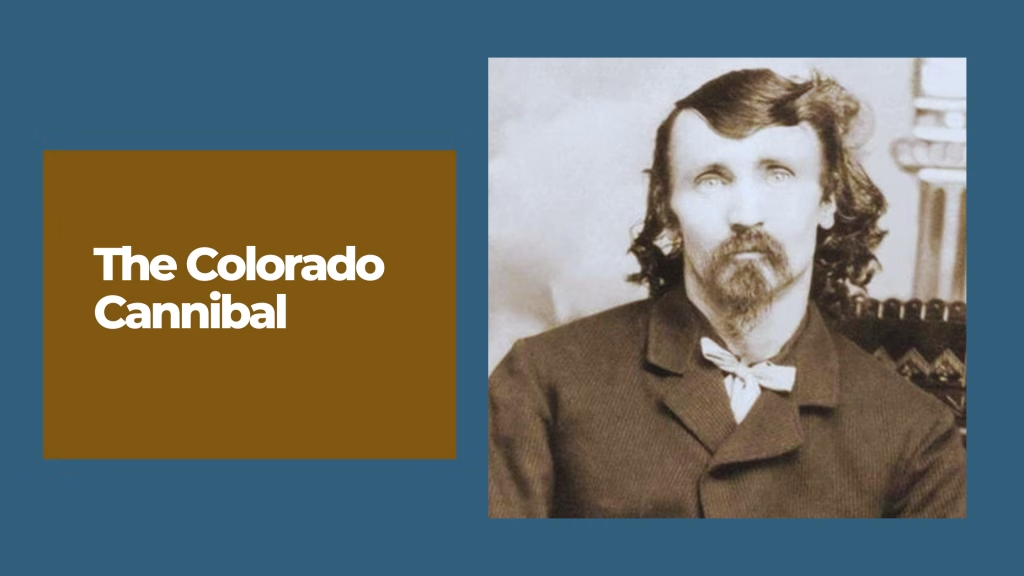
Picture this: five men disappear into the snow-covered San Juan Mountains in February 1874. Two months later, only one walks out, well-fed and carrying suspiciously large amounts of cash. That man was Alferd Packer, and his story would become one of America’s most notorious cases of cannibalism.
But here’s what makes this case different from other survival stories. When searchers finally found the bodies, they discovered something that contradicted every version of Packer’s story. The evidence suggested this wasn’t just about survival. It was something far darker.
Who Was Alferd Packer?
Alferd Packer wasn’t born a killer. Born on January 21st, 1842, in Allegheny County, Pennsylvania, he started life as an ordinary kid with parents James Packer and Esther Gryer. His early years seemed normal enough, though his relationship with his parents soured during his teens for reasons lost to history.
By the 1850s, Packer had moved to LaGrange County, Indiana, where he worked as a carpenter making cabinets. The young man couldn’t seem to settle anywhere. He bounced from Indiana to Minnesota, switching from carpentry to shoemaking, always searching for something better.
When the Civil War broke out, Packer enlisted in the Union Army on April 22nd, 1862, in Winona, Minnesota. He joined the 16th US Infantry Regiment, Company F, probably hoping for steady pay and a sense of purpose. But eight months later, something changed everything. Packer began suffering from epileptic seizures, experiencing attacks roughly every two days. The army honorably discharged him at Fort Ontario, New York.
Here’s where Packer’s determination, or maybe desperation, shows through. Despite his medical discharge, he tried again. On June 25th, 1863, he enlisted in the 8th Iowa Cavalry Regiment in Davenport, Iowa. The seizures continued, and once again, the army let him go.
A Difficult Man in a Difficult Time
The epilepsy wasn’t just a physical problem. Medical experts today recognize that mood disorders often accompany epilepsy. Depression, aggression, and irritability can all stem from the same neurological issues causing seizures. Packer displayed all of these traits throughout his life.
Those who knew him described Packer as quarrelsome and difficult to get along with. He was known as a pathological liar with a reputation for stealing. Depression in men often manifests as aggression rather than sadness, and Packer seemed to embody this. He drifted from job to job, town to town, burning bridges as he went.
After the war, Packer worked as a hunter, wagon teamster, ranch hand, and field worker. His seizures made keeping any job nearly impossible. Eventually, he tried becoming a guide for travelers heading west, which proved disastrous. He frequently got lost, upsetting clients who had paid for his supposed expertise.
By 1873, Packer had landed in the mining territories, bouncing between Colorado and Utah, looking for his big break. He was 31 years old, nearly penniless, and running out of options.
The Fatal Journey Begins
In November 1873, news of a massive gold strike in Breckenridge, Colorado, sent prospectors into a frenzy. A man named Bob McGrew organized a group of 20 miners to make the journey from Bingham Canyon Mines near Salt Lake City. They didn’t know each other well, but gold fever makes strange bedfellows.
Packer wasn’t originally part of this group. He encountered them 25 miles from their starting point, near Provo. When he learned they were heading to the San Juan Mountains, he saw his chance. He asked to join them, claiming he was an experienced prospector and guide who knew the mountains well.
There was one problem. Packer had virtually no money and lacked adequate supplies for such a journey. The other men hesitated, but Packer was persuasive. He insisted he knew the area like the back of his hand. They believed him.
They shouldn’t have.
As the group traveled, Packer’s lies became obvious. He had no idea how to guide anyone or how to prospect. He constantly argued with the other men and lacked even basic equipment, carrying only a Colt revolver instead of a proper rifle. His epileptic seizures slowed the group down, and he was greedy with rations, lazy, and obstinate.
Preston Nutter, one of the miners, fought with Packer frequently and later characterized him as a “whiny fraud.” The outlook on Packer was grim, but by then, they were already deep into dangerous territory.
The Warning They Ignored
Winter was closing in fast when the group reached the Mormon Trail. Heavy snow made the path nearly indistinguishable from pure wilderness. Their supposed guide, Packer, admitted he had no idea where they were. The men were forced to rely on compasses, wandering through the wilderness with provisions running dangerously low.
Then something incredible happened. They stumbled upon an encampment overseen by Chief Ouray, known among settlers as “the white man’s friend,” near Montrose, Colorado. The haggard, desperate miners must have looked terrible because the tribe’s young people ran away at first sight of them.
Chief Ouray took them in. He gave them food and shelter and made them an offer that would have saved everyone’s lives. He told them they could stay with the tribe until spring. He warned them repeatedly that the winter weather in the mountains was deadly, and none of his people, even those who knew the area intimately, would attempt such a trek in winter.
But the miners had full stomachs now. They had rested. And every day they waited, they imagined other prospectors descending on Breckenridge, taking the gold that should be theirs. Fear of missing out gripped them harder than fear of death.
In early February, despite non-stop snowfall and Chief Ouray’s continued warnings, 11 men decided to leave. They left the wagons and horses with the remaining group. Chief Ouray, seeing he couldn’t change their minds, gave them food and directions that bypassed the most dangerous mountain passes, following the Gunnison River instead.
The Fatal Split
What happened next sealed the fate of five men. Despite having gotten them lost before, despite having proven he knew nothing about the area, Packer proclaimed he knew this region extremely well. Five of the ten other men chose to believe him and follow him into the wilderness. The other five wisely stuck with Chief Ouray’s directions along the river.
Oliver Loutzenhizer led the group that followed the river. Their journey was brutal, with freezing temperatures and blinding snow, but they survived. Cowhands at a government cattle camp near Gunnison found them near starvation in late March. The experience frightened them so badly that they stayed in camp until April.
Meanwhile, Packer’s group left the Los Pinos Indian Agency on February 9th with just two weeks of provisions for a 75-mile journey through mountain passes. The group consisted of Shannon Wilson Bell, James Humphrey, Frank “Butcher” Miller, George Noon, and Israel Swan. They were poorly equipped: no snowshoes, barely any matches, no flint, medium-weight clothing insufficient for extreme cold, only two rifles and one pistol with minimal ammunition.
They chose the most dangerous path with the least experienced guide and minimal supplies. It was complete madness.
Two Months of Silence
After Packer’s group disappeared into the mountains, nobody knew what happened. Then, on April 16th, 1874, Alferd Packer burst through the front door of the mess hall at Los Pinos Indian Agency, half-alive but somehow not starving.
He had rags wrapped around his feet instead of shoes. He carried a rifle, a knife, a steel pot, and a satchel. When the men gave him food, he immediately vomited it up. He asked for whiskey, which they gave him, and then he started talking.
Packer claimed he’d been hired to guide five men from Chief Ouray’s camp to Breckenridge. During the journey, he said, he became snow blind, a painful condition caused by UV radiation reflecting off snow. Because of this, he lagged behind the party, becoming a burden. According to Packer, a man named Israel Swan gave him a rifle, and then the group abandoned him.
He said he survived alone for two months on roots and rose buds.
The men listening had seen many survivors of winter ordeals. Something wasn’t right here. Packer didn’t look malnourished or skeletal. His face looked bloated, and his physique seemed healthy. People who survive on roots and rose buds for two months don’t look like that.
Packer stayed at the outpost for ten days. He sold his rifle to the Justice of the Peace for $10 (about $240 today). He said he was heading back to Pennsylvania, eager to leave the West behind. When he reached Saguache, despite claiming to be broke, he suddenly had money to burn.
The Spending Spree That Raised Suspicions
At Dolan’s Saloon in Saguache, Packer spent roughly $100, equivalent to nearly $2,400 today. He even offered to lend Larry Dolan, the saloon owner, $300 (over $7,000 in today’s money). He spent another $78 at the general store.
People noticed. This newcomer was spending money like water and carrying multiple wallets. He drank heavily and told different versions of his story to different people. In a small town where strangers stood out, gossip spread fast.
Then Preston Nutter, one of the original miners who had stayed with Chief Ouray, arrived in Saguache with two other party members. He ran into Packer at the saloon.
Nutter asked where the rest of the group was. Packer’s story changed again. Now he claimed he got his feet wet and frozen, so he made camp during a winter storm. The others went ahead looking for food. Swan left him a rifle in case of trouble, but they never returned. He presumed they had abandoned him.
Nutter studied Packer carefully. Why would Israel Swan give away his rifle, leaving four men with only one gun to hunt with? Then Nutter noticed something chilling. The skinning knife on Packer’s belt belonged to Frank Miller.
Packer explained that Miller stuck it in a tree and walked off without it.
Nobody believed him anymore. Nutter threatened to hang Packer right there. He later said of Packer, “He was a sulky, obstinate, and quarrelsome man. He was a petty thief, willing to take things that did not belong to him.”
The Truth Begins to Emerge
Back at Los Pinos Indian Agency, the five men who had taken the safe route along the river told General Charles Adams that Packer couldn’t be trusted. They identified items Packer had: the rifle belonged to an older man, and a pipe he’d left behind belonged to Shannon Bell.
General Adams dispatched an officer to bring Packer back before he could flee. When Packer returned to the agency, he came face-to-face with the five Utah miners. An officer reported that Preston Nutter had seen Packer spend hundreds of dollars in Saguache, buy a new horse and saddle, and possess items belonging to the missing men.
When confronted, Packer repeated his original story. But then two Ute tribesmen rushed into the agency holding strips of dried human flesh they called “white man’s meat.” They’d found it on a hill near the agency while hunting.
Upon seeing the flesh, Packer reportedly fainted and crumbled to the floor.
When they revived him, he begged for mercy and agreed to make a full confession. After a long silence, he said cryptically, “It would not be the first time that people have been obliged to eat each other when they were hungry.”
The First Confession
Packer’s first story went like this: The men left Chief Ouray’s camp with what they thought was enough food for 14 days. The rough terrain exhausted their provisions faster than expected. They survived on roots, pine gum, rose buds, and occasional rabbits.
After days of finding no game, the men started eyeing each other in an unsettling way. A few days later, Packer went to gather firewood. When he returned, he found four men around the slain body of Israel Swan. Someone had struck Swan in the head with a hatchet, killing him instantly. The four men were butchering Swan’s body.
Packer accepted the situation and joined them. They found several thousand dollars on Swan and divided it among themselves. They ate what Packer called “the most agreeable parts” of Swan’s body, packed up meat, and moved on. Packer took Swan’s rifle.
Within two days, they ran out of meat again. The game continued to elude them. Packer, Bell, Humphrey, and Noon decided in secret that Miller would be next. Packer confessed that Miller was chosen because he was stocky with plenty of soft flesh. They killed him with a hatchet blow to the head while he was picking up firewood, then butchered and consumed him. Packer took Miller’s knife and his share of Swan’s money.
The winter showed no mercy. Humphrey was sacrificed next, followed by George Noon. At last, only Bell and Packer remained. They swore on Almighty God not to eat each other. Each had a rifle and thousands of dollars from Swan. They agreed to say the four men perished from the elements and were buried with dignity.
After trekking for days, the exhausted men camped next to a large lake surrounded by hemlock trees. According to Packer, Bell snapped. He screamed that he couldn’t take it anymore and that one of them had to die for food. Bell grabbed his rifle and rushed at Packer, ready to bash his skull in.
Packer deflected the blow and struck Bell in the head with his hatchet. He butchered Bell, ate as much as he could, and packed away meat for the journey. He took Bell’s share of Swan’s money and continued. When he finally saw the Los Pinos Indian Agency from a hilltop, he threw away the remaining strips of Bell’s flesh.
Packer confessed something chilling: he had grown quite fond of human flesh and found the portion around the breast especially delicious.
The Search for Bodies
General Adams organized a search party led by agency clerk Herman Lauter. It included the five Utah miners, agency officers, and Packer acting as a guide. After two weeks of searching the area around Lake Fork at the Gunnison River, Packer claimed he was lost, and the area didn’t look right.
Lauter called Packer a liar and a murderer. They found nothing and headed back. During the return journey, Packer tried to murder Herman Lauter with a large knife he’d concealed in his clothing. They caught him in the act, restrained him, and arrested him.
Packer was transported to Saguache and jailed. During detention, he changed his story again. Now he claimed a strong blizzard left them hopelessly lost. Provisions ran out quickly. They ran out of matches and had to carry hot embers in steel coffee pots. Days passed with no sign of the game. Ice fishing proved useless.
According to this version, the men made a pact: if one died, his meat would save the others from starvation. After days of hiking on virtually nothing, Israel Swan could go no further. They found a pine-shaded gulch near a lake and made camp. Shortly after, Swan died from hunger and exposure.
Packer signed a confession stating: “Old Man Swan died first and was eaten by the other five persons about 10 days out of camp. Five days afterwards, Humphrey died, and he was also eaten. Sometime afterwards, while I was carrying wood, the Butcher was killed, as the other two told me, accidentally, and he was also eaten. Bell shot California (Noon) with Swan’s gun, and I killed Bell. Shot him.”
In yet another amended version, Packer said James Humphrey also died of exposure. George Noon was killed days later by Shannon Bell for food. When the meat from three fallen men ran out, only Bell and Packer remained. They agreed to stand together until the end.
Days passed. Bell could no longer take the hunger and rushed Packer with his rifle, intending to bludgeon him. Packer shot Bell with his pistol.
The Grisly Discovery
In August 1874, John Randolph, an illustrator for Harper’s Weekly magazine, discovered all five bodies at the foot of Slumgullion Pass, two miles southeast of Lake City, Colorado. They lay in a pine-shaded gulch above the Lake Fork of the Gunnison River, now known as Dead Man’s Gulch.
The scene matched Packer’s description of where only Bell had died, not where all five men supposedly perished at different times and places. More damning, the men would have been within easy hiking distance of Lake City if they’d descended the Lake Fork instead of trying to cross it. But Packer was their guide.
When the local coroner, law enforcement, and about 20 volunteers reached the site, they found something that contradicted every version of Packer’s story. The bodies lay in various states of decomposition, having been exposed to elements and animals for four months.
Frank Miller’s head was missing entirely. His and Israel Swan’s corpses had been worked over by scavengers, leaving little more than scattered bones. Israel’s skull had jagged chunks missing. The bodies of George Noon and James Humphrey were largely flayed torsos of rotting flesh attached to skeletal legs. Both had received blows to the head, likely from a hatchet, and showed noticeable broken bones.
Shannon Bell lay with skeletal legs splayed and arms crudely cut to the bone. His corpse was a mass of viscera in an almost wholly flayed torso, but his face remained remarkably preserved with a thick red beard and bushy hair. The lack of decay in his face suggested he’d been the last to die. The top of Bell’s skull had been ripped open, and his brains lay on the ground beneath him.
The three men whose bodies remained partly intact had flesh and muscle exposed from all choice meaty locations. Nobody had attempted to consume bone marrow or organs. These men had been butchered selectively, like livestock.
Here’s what destroyed Packer’s story: all five bodies lay together in one spot, not scattered across miles. Both Humphrey and Noon still had large portions of flesh, muscle, and organs that could have been consumed long before Bell supposedly succumbed to hunger and attacked Packer.
The men wore tattered cloths lashed to their feet, having eaten their shoes in desperation. Moldy blankets lay beneath and beside them. A beaten path led from the corpses to a crude shelter Packer had used. Evidence suggested the deaths occurred before supplies were totally exhausted.
Inside the shelter were the possessions of the men Packer had left behind. The theory emerged that Packer killed the men before supplies ran out to rob them, got snowed in, and lived in his shelter for months, walking to his slain companions and slicing off meat as needed.
Preston Nutter identified the bodies. A rifle broken in two was found near them, presumably used to bludgeon one or more victims. Officials buried the remains at the site.
The Escape and Manhunt
When the search party returned to confront Packer, they found him gone. The jail was little more than a log cabin on ranch property. With no bodies discovered initially and no formal charges except the attempted murder of Lauter, authorities couldn’t hold him indefinitely without violating habeas corpus.
Saguache officials reportedly weren’t thrilled about taxpayer dollars being spent keeping Packer housed and guarded. He was allegedly passed a makeshift key for his irons, given supplies, and escaped easily. Nearly everyone in Saguache was convinced Packer was guilty of robbery or murder. His life was threatened constantly.
Read more: Andrei Chikatilo: The Soviet Serial Killer Who Murdered 52 People
Packer never revealed who helped him escape. The generally accepted theory was that his guard had been bribed.
Local newspapers picked up the story with sensational headlines. The incident received national and international attention. While the cannibalism was shocking, it wasn’t necessarily the main issue. People were familiar with the Donner Party, which had resorted to cannibalism during the winter of 1846-1847.
Cannibalism itself wasn’t illegal unless someone murdered to obtain the flesh. The real question was: did five men die due to Packer’s incompetence as a guide, or did he murder them for gold?
Capture and Trial
On March 11th, 1883, nearly nine years after his escape, Packer was discovered in Cheyenne, Wyoming, living under the alias John Schwartz. Frenchy Cabazon, one of the original Utah mining party members who had wisely stayed in Chief Ouray’s camp, encountered Packer by chance when Packer approached him looking to buy supplies.
Cabazon reported him to the local sheriff. General Adams confirmed Packer’s identity and accompanied him by train to Denver, where Packer signed his second confession on March 16th.
Packer’s story changed again. Now he claimed Bell killed the others after Bell told him to scout for a way out and find food. He’d been gone most of the day and returned in the late evening.
Packer told General Adams: “I found the red-headed man, Bell, who acted crazy in the morning, sitting near the fire, roasting a piece of meat which had been cut from the leg of the German butcher, Miller. His body was lying the furthest from the fire. His skull was crushed in with a hatchet, and the other three were lying near the fire. They were cut in the forehead with the hatchet. Some had two or three cuts. When the man saw me, he got up with his hatchet towards me, and I shot him sideways through the belly. He fell on his face. I grabbed the hatchet and hit him on the top of the head.”
Packer claimed he dropped his revolver in the deep snow during the struggle and lost it. A strong storm set in. He was starving and made a decision: eat something or die. He continued: “I went back to the fire, covered the men up, and fetched to the camp the piece of meat that was near the fire. I made a new fire near my camp and cooked the piece of meat, and ate it. I tried to get away every day, but could not. So I lived off the flesh of these men for the greater part of 60 days.”
The prosecution argued that the only logical reason for Packer to attempt such a perilous journey with minimal supplies was to lead the men into the wilderness to kill and rob them. Israel Swan’s family reported he’d left on the expedition with around $6,000 in cash and gold (equivalent to over $140,000 today) and a valuable Winchester rifle.
Justice Served?
Packer’s trial began on April 6th, 1883, in Lake City. He pleaded not guilty. After seven days of testimony, he was found guilty of the premeditated murder of Israel Swan and sentenced to death by hanging, scheduled for May 19th, 1883.
According to local newspaper reports (though possibly embellished), Judge Melville Gerry said at sentencing: “Stand up, you voracious man-eating son of a [expletive] and receive your sentence. When you came to Hinsdale County, there were seven Democrats, but you ate five of them. I sentence you to be hanged by the neck until you’re dead, dead, dead as a warning against reducing the Democratic population of this country.”
Court records show the actual sentence was more conventional, but the story became legend.
Packer was spared execution when his lawyers discovered that the murder statutes on the books for 1874 had been repealed and replaced. In October 1885, the Colorado Supreme Court reversed his sentence based on an ex post facto law. The government couldn’t sentence someone to death for a crime committed before Colorado officially became a state.
A second trial was held in Gunnison in 1886 following a change of venue. Packer pleaded guilty again. On June 8th, 1886, he was convicted of five counts of voluntary manslaughter and sentenced to 40 years in prison, eight years for each count. At the time, this was the longest custodial sentence in US history.
The second trial revealed damaging information. Local hunters and officials testified that although the winter of 1874 was severe, the San Juan area where Packer’s party camped was still active with large game like deer and antelope. Reports even mentioned deer carcasses found near the campsite.
This destroyed Packer’s claims that wildlife was so scarce the men had to resort to cannibalism quickly. The route Chief Ouray recommended along the Gunnison River was nearly identical in length to the mountain path Packer chose, just far safer.
Packer took the stand in his own defense. His version remained relatively consistent with his second official story. He requested to be charged only for Shannon Bell’s death, the only man he admitted killing. His request was denied. He was sent to Canon City Penitentiary.
Life After Prison
Packer filed appeals five times and was denied every time. He sent letters to newspapers claiming he’d been unjustly convicted by an unfair judicial system and by ignorant, small-minded people.
In 1899, the Colorado Supreme Court officially upheld his sentence. But on February 8th, 1901, Packer was paroled following a campaign initially spearheaded by an old acquaintance named Dwan Hatch. Polly Pry, a reporter for the Denver Post, saw the sensationalism of Packer’s case and used it to generate buzz. She portrayed him as a common man caught in a regrettable situation, a victim of circumstances, crucified for violating civilized sensibilities.
Her stories led to petitions requesting Colorado Governor Charles Thomas to grant parole. Thomas relented, and his last official act before leaving office was to parole (but not pardon) Packer under the agreement that he wouldn’t profit from his story.
Packer went to work as a guard at the Denver Post, then later as a ranch hand. He had enduring respect for Polly Pry and referred to her as his liberator.
Alferd Packer died on April 23rd, 1907, at age 65 in Deer Creek, Colorado. The cause of death was listed as dementia, stroke, trouble, and worry. He’s rumored to have become a vegetarian before his death. Those who knew him in later years described him as a man rich with stories and well-liked by children. He lived modestly and was reportedly charitable.
He never received an official state pardon for his crimes.
The Final Evidence
On July 17th, 1989, 115 years after Packer consumed his companions, forensic experts exhumed the five bodies. Professor James Starrs from George Washington University led the investigation.
The evidence was sufficient for Starr to conclude that Packer had indeed murdered his comrades. He believed Packer more than likely murdered them for their belongings and resorted to cannibalism out of necessity rather than intent.
The skeletal remains showed signs of blunt force trauma to the skulls of two men. All skulls had damage to the upper craniums, with fabric fibers found within some skulls, suggesting heads were possibly covered with blankets during their deaths.
Three skeletons showed defensive hacking marks across forearm bones, injuries consistent with shielding the face or body from attack. Shannon Bell was one of these, contradicting Packer’s claim that he simply shot Bell.
All five skeletons had numerous post-mortem injuries, including depressed fractures, butterfly fractures, butchering trauma, and hacking trauma. Two skeletons besides Shannon Bell had cylindrical puncture wounds in the pelvic bone, possibly bullet wounds or scavenging marks.
The evidence suggested Packer may have bludgeoned two men in their sleep, shot three in the hips to incapacitate them, then killed them all with hatchet blows to the head before butchering them for food.
In 1994, David Bailey from the Museum of Western Colorado investigated further. Analysis in 2001 found microscopic lead fragments in soil taken from under Shannon Bell’s remains that matched bullets from what was confirmed to be Packer’s pistol.
While it appears certain that Bell was shot, whether it was self-defense remains unanswered.
What Really Happened?
Cannibalism in survival situations requires a unique set of circumstances. You need to be starving, but there also needs to be a mixture of hope and hopelessness. When you switch to survival mode, disgust, typically associated with cannibalism, can be overcome as pure survival instinct takes over.
With Packer’s brain already altered by epilepsy (though epilepsy itself doesn’t make someone prone to cannibalism), his neurological differences might have yielded different outcomes in extreme scenarios.
But here’s the problem with the survival story: hunters said deer and antelope were still active in the area. Carcasses were found near the murder site. If Packer had access to animal meat, why eat people?
Considering the warnings about winter dangers, the actual admission that the meat under the breast “tastes the best,” and the evidence of premeditated violence, could something else have been going on with Packer?
Was it survival cannibalism by a desperate guide who led his party astray? Was it cold-blooded murder for gold, followed by months of feeding on his victims? Or was Alferd Packer something darker, a man who discovered he had a taste for human flesh?
The truth died with him in 1907. What remains is one of the most disturbing cases in American frontier history, a story that continues to fascinate and horrify in equal measure.
What aspect of the Alferd Packer case do you find most compelling? Was he a desperate survivor or a calculating killer? Share your thoughts in the comments below.


Pingback: List of serial killers in the United States - Serial Killers Perspectives