The overnight nurse walked into the darkened hospital room without a sound. His patient, a 91-year-old cancer survivor, watched as he approached her bed with a syringe. She wasn’t scheduled for any medication. When she asked what he was doing, he didn’t answer—just injected something into her inner thigh and left.
The next morning, she was dead.
Her son raised hell. He’d been in that room. He’d seen the nurse’s blank expression, the way he demanded the family leave without explanation. Something was wrong. But when doctors examined the injection site, they dismissed it as a mosquito bite.
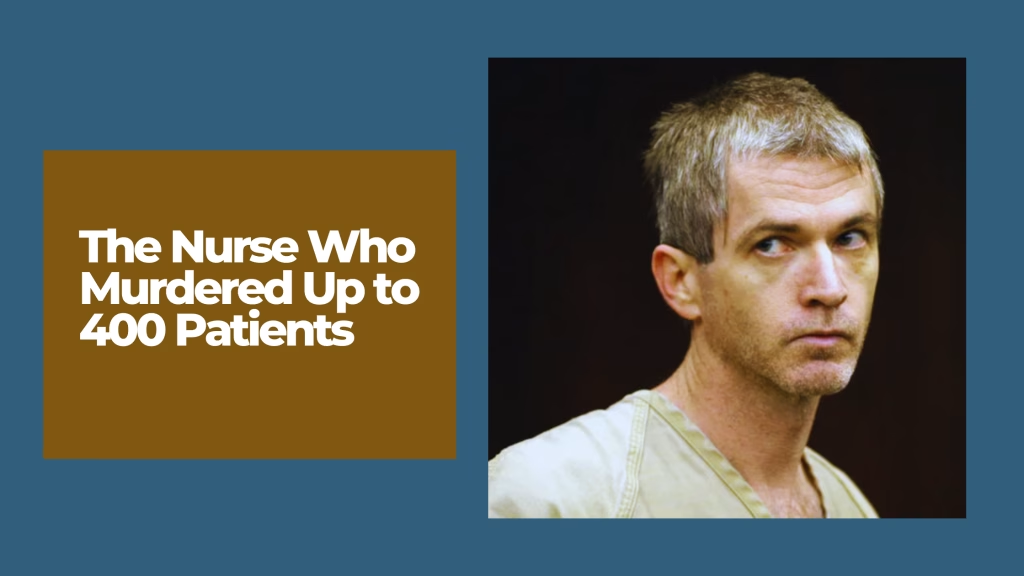
That nurse was Charles Cullen, and he’d just committed another murder in what would become one of the most prolific killing sprees in American healthcare history.
Who Was Charles Cullen?
Charles Cullen worked as a registered nurse for 16 years across nine hospitals and one nursing home in New Jersey and Pennsylvania. During that time, he confessed to killing around 40 patients—but investigators believe the real number could reach 400 or more. At one hospital alone, 69 suspicious deaths occurred during his employment.
What makes this case even more disturbing? Multiple hospitals suspected him of killing patients, but let him resign quietly and even provided positive job references. They were more afraid of lawsuits than of stopping a serial killer.
Born in 1960 as the youngest of eight children in an Irish Catholic family, Charles Cullen’s childhood was chaos from the start. His father died when he was just seven months old, leaving his mother to raise eight kids alone. His older brothers sold drugs from their bedrooms. Their boyfriends bullied young Charles relentlessly.
At age nine, he tried to poison one of these men with lighter fluid. When that failed, he attempted suicide by drinking chemicals from a chemistry set—the first of more than 20 suicide attempts throughout his life.
The Making of a Killer
By his senior year of high school, Cullen’s mother died in a car accident. The same hospital where he’d later train as a nurse—Mountainside Hospital in New Jersey—refused to return her body, claiming it had already been disposed of. For a devout Catholic boy who wanted to give his mother a proper burial, this was devastating.
Directionless and grieving, Cullen enlisted in the Navy. He actually excelled at first, working with Poseidon missiles on submarines and quickly rising to Petty Officer. But the pattern repeated: coworkers bullied him, and he spiraled. After multiple psychiatric hospitalizations and suicide attempts, the Navy medically discharged him in 1984.
Then something unexpected happened. Cullen enrolled in nursing school at the very hospital that had refused to return his mother’s body. He thrived there, making friends easily and even becoming president of his nursing class. He graduated in 1986 and immediately started working at the burn unit of St. Barnabas Medical Center—one of the most intense nursing environments possible.
He also met a woman named Adrienne, married her, and had two daughters. From the outside, Charles Cullen’s life finally looked normal.
But behind closed doors, something dark was growing.
The Warning Signs Everyone Missed
Adrienne started noticing disturbing behavior almost immediately. Cullen struggled with alcoholism, hiding bottles around the house. When their first daughter was born, he became obsessed with the baby and completely ignored his wife—treating people like temporary fascinations he’d eventually discard.
Then the family’s dogs started disappearing.
Adrienne’s beloved dog would be tied to a pole in the backyard for hours, screaming and crying. Animal control eventually took it away. When they got a puppy, it vanished—Cullen claimed it escaped while he was taking a walk, leaving their infant alone in the house. Their neighbor’s beagle, which loved to wander the neighborhood, also disappeared. When they found it dead in an alley, the vet confirmed it had been poisoned.
Adrienne was connecting dots that terrified her, but she couldn’t prove anything yet.
What she didn’t know was that her husband had already started killing at work.
The First Murders at St. Barnabas
On June 11, 1988, Charles Cullen administered a lethal dose of medication to a patient at St. Barnabas Medical Center. This was his first confirmed kill, and it definitely wasn’t his last.
Over the next four years, he overdosed approximately a dozen patients with insulin, digoxin (a heart medication), and other drugs that wouldn’t raise immediate red flags. The burn unit and critical care unit were perfect hunting grounds—patients were already on heavy medications with multiple health issues, making the cause of death nearly impossible to determine.
The hospital eventually noticed an alarming pattern: suspicious deaths, all from medication overdoses, and IV bags with far more needle punctures than normal. They found a hidden stash of these tampered bags. Security cameras went up in strategic locations. An internal investigation pointed directly at Cullen.
But here’s where the story takes an infuriating turn: they couldn’t prove it beyond a reasonable doubt, so they let him leave.
In January 1992, Cullen simply moved to Warren Hospital in Phillipsburg, New Jersey, and started killing again.
A Pattern of Death Across State Lines
For the next 11 years, Cullen worked at hospital after hospital, leaving bodies in his wake. At Warren Hospital, he murdered three women with digoxin overdoses within a month of starting. One victim even told her family about a “sneaky male nurse” who gave her an unexpected injection in the middle of the night. She died the next day. The hospital dismissed her concerns.
Meanwhile, his personal life was collapsing. Adrienne filed for divorce in 1993, making sure she got the papers served while he was at work—and ensuring he couldn’t come near her during her own surgery at Warren Hospital. She told her lawyer she knew he’d kill her if given the chance.
She was probably right.
Devastated by another loss, Cullen became obsessed with another nurse who’d shown him kindness during a psychiatric hold. When she rejected his advances, he stalked her. He drove 40 minutes to her apartment multiple times in one night, eventually breaking in to watch her sleep. He was arrested, but somehow Warren Hospital kept scheduling him for shifts.
A 91-year-old cancer patient reported that Cullen—who wasn’t her nurse—injected her with something at night. Doctors said it was a mosquito bite. She died the next day. Her son witnessed the whole thing and knew something was wrong. The hospital gave Cullen a polygraph test.
He passed.
The Pennsylvania Years: More Hospitals, More Deaths
By 1998, things were getting too hot in New Jersey. Internal investigations kept circling back to him. So Cullen crossed state lines to Pennsylvania, where background checks were handled differently, and his New Jersey employers gladly provided glowing recommendations.
At Liberty Nursing and Rehabilitation Center, he overdosed a man with a broken neck on insulin, a drug that causes violent seizures. When the nursing home investigated, they blamed an innocent female nurse and fired her. She had to hire a lawyer to clear her name, and she told them it was Cullen. They didn’t listen.
He moved through Easton Hospital, Lehigh Valley Hospital, and finally landed at St. Luke’s Hospital in Bethlehem. Coworkers loved him at first—he showed up early, worked holidays and weekends, and handled the grunt work without complaint.
Then strange things started happening. Medicine went missing. The sharps container—where used syringes and needles are disposed of—was filling up impossibly fast. One nurse opened it and found something horrifying: empty vials of a paralytic drug.
This medication doesn’t just kill you. It paralyzes you completely while you’re dying. You can’t scream, can’t move, can’t call for help. You just suffer in silent agony until your body gives out.
Nurses started watching the medication room. Everyone who entered left the door propped open and spent just a few minutes inside. Everyone except Cullen. He shut the door and stayed for extended periods. Halfway through his shift, someone overdosed.
The hospital investigated and caught him red-handed. Their response? They gave him a choice: resign with a neutral recommendation, or be fired with a bad one. He resigned, and they let him walk away.
Seven nurses went to the DEA with their concerns. Once again, no charges could be filed. St. Luke’s reported 69 suspicious deaths during Cullen’s time there, but the records are sealed.
Somerset: Where It All Came Crashing Down
In September 2002, Cullen started working at Somerset Medical Center in New Jersey. He made a close friend there—a no-nonsense nurse named Amy Ridgeway who appreciated that he never hit on her and always showed up ready to work.
When Amy collapsed from a heart condition and needed a pacemaker, Cullen was left alone. Within a short period, 13 patients died—all from drug overdoses with astronomical levels in their systems. One woman who’d been off digoxin for 24 hours died with levels of 9.8 in her blood. That’s impossibly high. Someone had injected her with massive amounts.
The hospital pharmacist called New Jersey Poison Control for help with dosage calculations. The director there realized what was happening and called the hospital, urging them to contact the police immediately.
The hospital waited three months.
In those three months, five more people died, and at least two more were nearly killed.
When authorities finally got involved, they ran a background check on Cullen and discovered Pennsylvania had been investigating him for the same thing. Hospitals across two states had suspected him of murder but refused to cooperate with police, citing liability concerns. Somerset even lied about when their medication records were deleted to avoid handing them over.
The Confession
Authorities used Amy Ridgeway to get to Cullen. They showed her the evidence, and she was devastated—but she agreed to wear a wire. On December 12, 2003, she met him at a restaurant and told him straight up: “I know you’ve been killing people.”
His face changed immediately. She said she’d help him turn himself in.
His response: “I’m not going down without a fight.”
They arrested him on circumstantial evidence, but he wouldn’t cooperate. So Amy visited him again and lied—she said the police were looking at her as his accomplice. He didn’t want her hurt for something she didn’t do.
It worked.
Initially, he confessed to one murder and one attempted murder in Somerset. Two days later, he said he’d killed 40 people throughout his career. Eventually, prosecutors could only prove 29 murders and attempted murders across New Jersey and Pennsylvania.
Experts believe the real number could be 300 to 400 victims. Many hospitals destroyed their records from his early years. Some deaths couldn’t be proven because patients had multiple health issues. And Cullen himself couldn’t remember specifics about most of the murders.
Why Did He Do It?
Cullen claimed he was “sparing” patients from suffering, preventing them from coding and dying traumatic deaths during resuscitation attempts.
This was a lie.
Every nurse who worked with him said the same thing: whenever a patient coded, Cullen was always the first one in the room, frantically trying to save them. Of course, he was—he’d caused the code himself, and he knew there was no reversal.
Many of his victims weren’t even suffering. They were in the hospital for minor issues and expected to go home soon. He killed healthy people, sick people, young people, and old people. There was no pattern except opportunity.
Some believe the trauma of losing his mother—and the hospital’s refusal to return her body—created a twisted need to “control” death in hospitals. Others think the constant bullying and rejection throughout his life created a rage that could only be satisfied by exerting power over the most vulnerable people imaginable.
The truth? We may never fully understand what drove Charles Cullen to become one of America’s most prolific serial killers.
The Aftermath and Legal Changes
In 2006, Charles Cullen was sentenced to 11 consecutive life sentences in New Jersey with no possibility of parole until the year 2403. He received seven additional life sentences in Pennsylvania.
He’ll die in prison. But the damage he caused extends far beyond his victims.
Hospitals had enabled him for years because laws didn’t require them to report suspicious healthcare workers. They feared lawsuits more than they feared a killer on their staff. After Cullen’s arrest, 37 states implemented new laws requiring background checks, fingerprinting for healthcare professionals, better employee review processes, and mandatory reporting of suspicious deaths.
Charles Graber, author of “The Good Nurse,” was one of the first people Cullen spoke to openly after his arrest. The book reveals details that never made it to trial—insights into how a seemingly normal nurse became a monster, and how the healthcare system’s fear of liability allowed him to keep killing for 16 years.
What Can We Learn?
This case should make us all more aware when seeking medical care. Research your hospitals. Ask questions. If something feels wrong—if a medication doesn’t seem right, if a healthcare worker’s behavior seems off—speak up. Be your own advocate.
Most doctors and nurses are heroes who save lives every day. But medical crimes do happen, and they happen more often than we think. Charles Cullen proves that the system designed to protect us can fail in catastrophic ways.
How many of his victims could have been saved if just one hospital had called the police instead of quietly letting him resign?