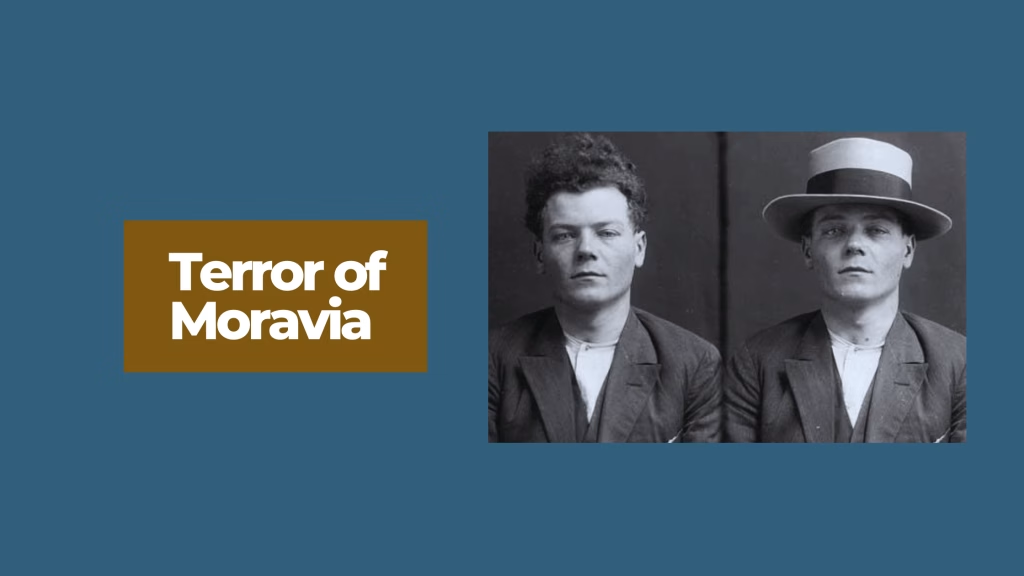
Martin Lechian shot police officer Rudolf Hák four times at close range on January 19, 1927. The officer had interrupted him during a robbery. So Martin pulled the trigger. Four bullets. Rudolf died on the street. Martin disappeared into the night like he always did.
Between December 1926 and April 1927, this 19-year-old committed 72 burglaries across Moravia. He murdered 10 people. Attempted to kill 7 more. The public called him a “brave cavalier who robbed the rich.” They wrote songs praising his courage. Meanwhile, police found bodies in his wake. Officers shot dead. Security guards executed. A newlywed expecting his first child was gunned down for no reason.
Martin Lechian wasn’t the elegant gentleman thief that newspapers made him out to be. He was a killer who shot anyone who got in his way. A deserter who escaped military service five times. A criminal who wore a mask and terrorized an entire region for 134 days straight. By the time authorities caught him in April 1927, he faced 104 criminal charges. Including 10 murders.
So how did a teenage delinquent become Czechoslovakia’s most feared criminal? And why did people celebrate him even as bodies piled up? Let’s break down the story of the Terror of Moravia.
Martin Lechian’s Early Life: Born Into Crime in 1907
Martin Lechian came into the world on October 31, 1907, in Osoblaha. A small town in the Moravian-Silesian region of what was then Austria-Hungary. We know almost nothing about his parents. No records survive describing his family life. What do we know? He caused behavioral problems from his earliest years.
Sent to Reform School at 14
By age 14, Martin was already beyond control. Authorities sent him to a reform school. A juvenile detention facility for troubled youth. He stayed there until his 18th birthday in 1925. The moment he walked out? He started stealing.
Police caught him quickly. Twice. Regional courts in Krnov punished him for theft. But the sentences were light. Short stays that taught him nothing except how to avoid getting caught next time.
From October 1925 to October 1926, Martin repeatedly slipped away from the police in Krnov. Officers could only note his many thefts in their records. They couldn’t catch him. Between May 1925 and April 1927, he committed 72 documented burglaries across Moravia.
Why People Loved Him
Here’s what’s disturbing about Martin Lechian’s story. The public adored him. They saw him as a Robin Hood figure. Someone who stole from the wealthy. A brave young man defying authority. They wrote songs celebrating his exploits. Called him elegant. Charming. Daring.
But the reality was completely different. Martin robbed everyone who had money. Rich or poor, it didn’t matter. He carried a pistol. Shot at anyone who resisted. Killed police officers without hesitation. There was nothing romantic about what he did.
The Military Deserter: Five Escapes in Two Years
Martin Lechian was conscripted into military service. Mandatory service was required of all young men in Czechoslovakia. But Martin had no intention of serving. He deserted five times. Each time, the authorities caught him. Each time, he escaped again.
The Final Desertion
His last recorded desertion happened on December 10, 1926. This time, Martin stayed on the run for 134 days. An impressive feat considering how wanted he was. Police across multiple regions were searching for him. His face was known. Yet he remained free.
During those 134 days, Martin transformed from a simple thief into something much worse. A killer.
The Crime Spree: 72 Burglaries and a Trademark Wet Cloth
Martin Lechian had a very specific method for his burglaries. He targeted safes. But not modern ones. He only broke into buildings with old safes from the second half of the 19th century. Why? Because Martin suffered from tuberculosis.
The Tuberculosis Problem
Martin had severe breathing problems. Old safes from the 1800s were constructed with a unique design. Between the walls, manufacturers placed dust or ash. This was supposed to protect the contents. But when someone drilled into these safes? The dust and ash would spray everywhere.
For Martin, with his damaged lungs, this was life-threatening. The dust triggered violent coughing fits. So he developed a solution. He always carried a wet cloth with him. Before drilling into a safe, he soaked the cloth. Then wrapped it around his nose and mouth.
After each robbery, police found these wet cloths. Left beside unprofessionally broken safes. It became his signature. His calling card.
The Criminal Partner
According to some sources, Martin met a girl from Krnov during his time on the run. Together, they robbed their way across Moravia. She helped him. Stood watch. Assisted with the burglaries.
Eventually, police caught them both during a “simple conversation.” Authorities never explained what that meant. But both were transported to a hospital in Opava. From there, Martin escaped on December 10, 1926. In the cold. Wearing only pajamas. With chains on his legs.
He ran 15 kilometers to Pustkovice. Still wearing the leg chains. Think about that for a second. Running 15 kilometers in winter. In pajamas. With metal chains binding your legs. That’s the kind of determination Martin had.
Meeting Schekel: A Dangerous Partnership
In Pustkovice, Martin recruited another companion for his crimes. A dangerous criminal known as Schekel. Together, they killed two guards during an escape from a facility in Opava. The very next day after reaching Pustkovice, they began their criminal rampage.
The Pub With a Password
Martin seemed impossible to catch. Bar fights. Robberies. Murders. All in one night. Police felt like they were chasing a ghost. Someone who could be in multiple places at the same time. When officers did catch him? He always slipped away.
Martin and his associates, including Schekel, met regularly at a local pub. Anyone who wanted to sit with them needed to know the password. “Red Rose.” If you didn’t know it? Martin simply shot you.
His companions also warned him of danger. They left signs on the underside of beer coasters. A simple system that worked. Martin could always count on support from people in the criminal underworld. Especially from someone named Kaspar and “Father Leci” (possibly a nickname or associate).
Christmas Day Split
On Christmas Day 1926, the gang split up. Martin stayed in Moravia. His cell moved to Slovakia. This separation would prove significant later.
The Murders Begin: Ten Dead in Four Months
One of Martin’s victims was Jan Antonín Stolpa. Shot dead in the suburbs of his hometown on March 8, 1927. The list of charges against Martin eventually mentioned 134 days of successful desertion from the military. Plus many worse crimes.
In total, Martin Lechian murdered 10 police officers. He attempted to kill 7 more. Let’s look at the victims we know about.
Rudolf Hák – The First Police Victim
The first victim was municipal police officer Rudolf Hák from Slavkov. Authorities shot him down on January 19, 1927. Martin was a poor shot. He needed to fire from close range to hit his targets. Rudolf had interrupted Martin during a robbery. So Martin shot him four times.
January 23: Two More Attempts
On January 23, in an unnamed location, Martin attempted to shoot a shop owner. Then a police officer. Both survived. But a month later in Warsaw, he murdered guard Francisco Matek.
The Train Incident
In mid-February 1927, one of the gendarmes from Opava noticed and identified Martin on a train. Martin didn’t think long. He started shooting. Then jumped from the moving train while it was still going full speed.
Authorities organized a search of the area. They offered a reward of 10,000 crowns for capturing the criminal. This caused Martin to start wearing a mask. But he continued robbing his way across Moravia.
The public still applauded his courage. People continued writing songs in his honor. They called him a brave cavalier who robbed the rich. But that sympathy ended when Martin shot Chancellor Antonín twice on March 8 in Moravian Sereď.
The Newlywed Chancellor
Antonín had just gotten married. His wife was expecting their first child. Martin shot him anyway. Right after that, he killed police commissioner Falkowski. Now, both the police and the gendarmerie were hunting him.
Martin got into several shootouts with authorities. During one near Polozyce, he was wounded. Still managed to escape. Finally, they caught him in the pub mentioned earlier. On April 24, 1927. This happened after he shot a security guard named Silnikowy at a train station in Krnov.
Other sources say he was caught in Nowy Jiczyn by officers Haller and Kanał.
The Trial: 104 Crimes, 10 Murders, Four Months in Court
Authorities charged Martin with 104 crimes. Including 10 murders. The charges described some as “partially complete” and others as “incomplete.” Incomplete meant attempted murders. Or participation in crimes without directly attacking someone. Like standing watch while others committed the actual violence.
The Escape-Proof Cell
Prison officials placed Martin in a reinforced cell. They hoped this time he couldn’t escape. They strengthened the walls with barbed wire. Put wire on the walls—covered doors with metal sheets.
Martin threatened police officers Binkowski and Starek. Said he would shoot them. The trial was very long. It lasted four months. The legend of the elusive thief began to fall apart once witness examinations began. Experts testified. Martin’s own behavior and testimony worked against him.
Playing Games in Court
The accused deliberately answered the prosecutor’s questions in misleading ways. Confusing. Complete lack of clarity about the case. He answered in incomprehensible ways that were hard to understand. Or simply said “I don’t remember.”
Martin couldn’t boast about the public that admired him anymore. No one was shouting bravo. Though we know even today that criminals often have their fans. However, several newspapers published glorifying articles.
One journalist wrote: “It’s unbelievable that Lechian doesn’t even look slightly like his deeds would suggest.”
The Final Escape: Killing a 20-Year-Old Guard
On the night of September 25-26, 1927, despite all precautions, Martin and another criminal named Paspalík managed to escape from the cell where they were being held. They stole a rifle. Mortally wounded a 20-year-old prison guard in the corridor.
The Prison Shootout
An alarm was quickly raised in the prison corridor. A regular shootout erupted. Officers fired over 100 shots. Martin surrendered only when he realized he couldn’t completely escape from the prison.
His last victim was named either French Kiss or Venus Freeze, depending on the source. This time, newspapers started writing about the murderer in superlatives again. Journalists pointed to the criminal’s incredible courage. This directly led to the birth of another legend.
But Martin’s exploits were finally captured once and for all.
Execution: Denied Mercy at Age 19
On October 3, 1927, seven days after the bloody prison shootout, the President of Czechoslovakia, Tomáš Garrigue Masaryk, signed a decision regarding Martin. He denied clemency.
The Last Night
The night before execution, Martin didn’t sleep. He ate an exquisite dinner. Then said, “In hell, I’ll have plenty of time.”
The murderer was executed in the prison yard in Opava on October 6, 1927, at six in the morning. He was 19 years old. Born in 1907, executed in 1927. His entire criminal career lasted barely two years. But at that time, he killed 10 people. Terrorized an entire region. Became a legend.
The Legend Creates Copycats: Two More Die Following Him
The legend and admiration for Martin brought him imitators. The first appeared six years after his execution. A man named François Kontak. He called himself Martin’s heir. Threatened to be even worse.
François Kontak
François only managed to shoot two gendarmes before his own companions killed him. The Gsxr brothers, men sentenced to death themselves, were afraid of François. So they executed him before he could do more damage.
Joffrey from Červený Kámen
The second follower of Martin came from Červený Kámen near Puchov. A boy named Joffrey. He was quickly wounded in a shootout. Then arrested in a hospital in Vino, where doctors were able to help him.
Both of Martin’s followers lived by the principle “live fast, die young.” Unfortunately, in their fast lives, they managed to kill several people.
The Real Story Behind the Legend
Newspapers described Martin Lechian as beautiful, slim, and laughing like a small child. An elegant thief and cavalier who boldly, even brilliantly, robbed the wealthy. He masterfully avoided the heavy hand of justice during hard times.
The Reality Was Different
The reality was completely different. Martin Lechian was a criminal who killed without hesitation. A deserter. A thief with tuberculosis who left wet cloths at crime scenes. Someone who needed to shoot from close range because he was a poor marksman.
He wasn’t robbing the rich to help the poor. He was robbing everyone. Killing police officers trying to do their jobs. Murdering newlyweds. Shooting security guards. Chancellor Antonín was just married. His wife was pregnant. Martin killed him anyway.
The romantic image was a creation. Built by newspapers looking for exciting stories. By a public tired of poverty and occupation. They wanted a hero. So they made one out of a murderer.
Why Did People Celebrate a Killer?
This is the most disturbing part of Martin Lechian’s story. Understanding why people wrote songs about him. Why are they called brave? Why did they see him as a hero?
Post-War Czechoslovakia
Czechoslovakia in the 1920s was a new country. Born from the ashes of Austria-Hungary after World War I. The region had been under foreign rule for centuries. Many people were poor. Resentful of authority. Distrustful of the police.
When someone like Martin came along? Someone who defied authority, robbed safes, and escaped from prison? People projected their own frustrations onto him. He became a symbol of resistance. Even though he was just a criminal killing people.
The Romanticization of Criminals
This pattern repeats throughout history. Jesse James in America. Ned Kelly in Australia. Robin Hood in England (though he’s fictional). Society loves to romanticize outlaws. Especially young, daring ones who die young.
Martin fit that template perfectly. Handsome (according to some descriptions). Young. Bold. Escaping impossible situations. The fact that he was murdering people? That got minimized in the retelling.
The Tuberculosis Factor: A Dying Man’s Rampage
One detail that often gets overlooked in Martin’s story is his tuberculosis. This wasn’t just a minor health issue. In the 1920s, tuberculosis was a death sentence. No antibiotics existed. No effective treatment.
Living on Borrowed Time
Martin knew he was dying. His breathing problems were severe. Every robbery with those dusty old safes made it worse. The wet cloths helped, but they weren’t a cure. He was slowly suffocating.
Did this influence his behavior? Did knowing he was dying anyway make him more reckless? More willing to kill? We can’t know for sure. But it’s worth considering that Martin’s crime spree might have been the desperate acts of someone who knew his time was limited.
He lived fast. Died young. At 19 years old, his story was over.
The Legacy: What Martin Lechian Left Behind
Martin Lechian died over 95 years ago. But his story still resonates in the Czech Republic. He remains one of the most notorious criminals in Czechoslovak history. Books have been written about him. Documentaries made. His name is still known.
The Real Victims
But what about the people he killed? Rudolf Hák, the first police officer. Francisco Matek, the guard. Chancellor Antonín, the newlywed. The 20-year-old prison guard whose name varies by source. Ten dead. Seven wounded. Hundreds traumatized.
Their stories are largely forgotten. History remembers Martin. The “Terror of Moravia.” The folk legend. But the victims? They’re just names in old police reports.
The Question of Glorification
Should we tell Martin Lechian’s story? Yes. History matters. Understanding how criminals operate matters. Seeing how society romanticizes violence matters. But we need to tell it honestly.
Martin wasn’t a hero. He was a killer with tuberculosis who shot people at close range because he couldn’t aim properly. Who left wet cloths at crime scenes? Who died at 19 after terrorizing Moravia for 134 days.
The songs people wrote about him? The praise for his courage? That was society’s sickness. Not something to celebrate.
Lessons From the Terror of Moravia
Martin Lechian’s story teaches us several things about crime, society, and how we create legends from monsters.
Society Creates Its Own Villains
Martin came from a reform school. No family support system that we know of. Sent away at 14. Released at 18 with no skills except stealing. Society failed him first. Then he failed society much worse.
This doesn’t excuse what he did. But it shows how broken systems create broken people. Who then breaks others.
Media Matters
The newspapers that glorified Martin? They helped create his legend. Made him seem romantic. Exciting. Brave. This inspired copycats. François Kontak and Joffrey both tried to follow his example. More people died because journalists wanted exciting stories.
Today, we still see this. Media coverage of criminals can inspire others. Create folk heroes from murderers. We need to be more careful.
The Danger of Romanticizing Outlaws
Martin’s story is compelling. Daring escapes. Shootouts. A young man against the system. It’s easy to see why people made him a folk hero. But we have to remember the ten bodies. The families were destroyed. The officers were just doing their jobs, shot dead.
Romance and reality rarely match. Martin Lechian, the legend, was excited. Martin Lechian, the reality was a tubercular teenager shooting people at close range.
Related Cases: