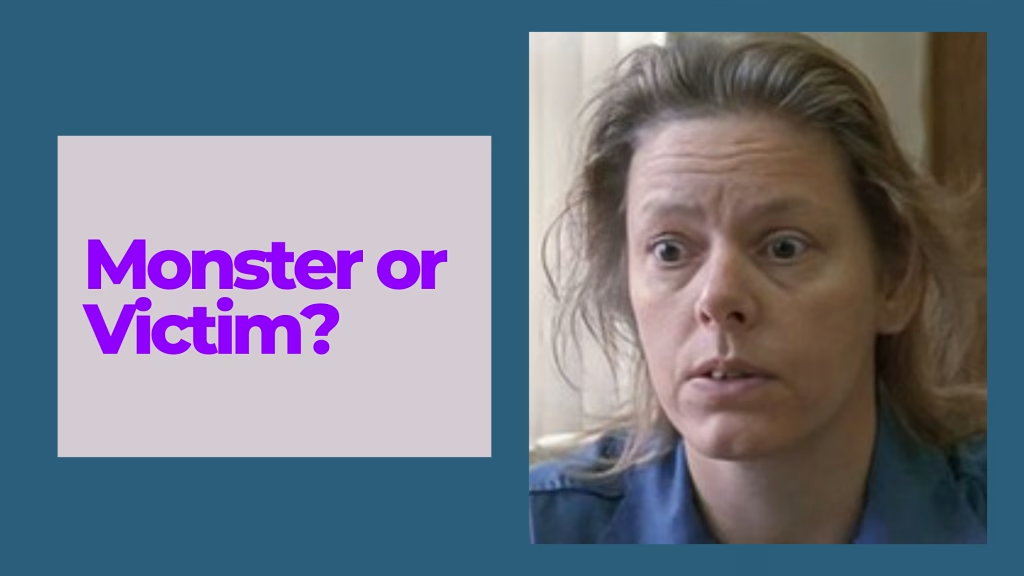
I’ve spent the last two weeks completely lost in Aileen Wuornos’s case. Court transcripts, old news clips, the raw police interviews. Every time I thought I understood her, another layer peeled back, and I was right back to square one. Was she a cold-blooded monster who killed seven men in cold blood? Or was she a broken woman pushed past the edge by a lifetime of abuse, rape, and survival on the streets? Honestly? After everything I’ve read, I still don’t have an answer. But I need to share what I found, because this story refuses to let me sleep.
Aileen Wuornos is the only female serial killer most people can name. Between 1989 and 1990, she shot seven middle-aged men along Florida’s highways. She claimed self-defence in every single case. Prosecutors called her a predator who robbed and murdered for pocket change. The media crowned her “America’s first female serial killer.” The truth, like always, sits somewhere in the messy middle.
A Childhood That Broke Her Before She Ever Had a Chance
Aileen Carol Pittman was born February 29, 1956, in Rochester, Michigan. Leap Day baby. Her teenage mother, Diane, abandoned her at four months old. Her father, Leo Pittman, was a convicted child molester already in prison. He hanged himself behind bars when Aileen was 13. She never met him.
She and her brother, Keith, were raised by their grandparents, Lauri and Britta Wuornos. Lauri was an alcoholic who beat the kids with anything within reach. Britta was emotionally distant. By age 11, Aileen was trading sex for cigarettes and food with neighbourhood boys. By 14, she was pregnant (after a rape, she always said). Her grandmother forced her to give the baby up for adoption. Shortly after, Britta died of liver failure. Lauri threw Aileen out.
At 15, she was living in the woods in abandoned cars during Michigan winters. Prostitution became a survival. Arrests for drunk and disorderly started piling up. When her brother Keith died of cancer in 1976 (he was 21), she got a small insurance payout. She blew it in weeks on booze and motels. Then she hitchhiked south.
Meeting Tyria Moore: The One Person Who Ever Loved Her
In 1986, at a Daytona gay bar called the Zodiac, Aileen met Tyria “Ty” Moore. For the first time in her life, someone chose her. They became inseparable. Ty knew Aileen turned tricks on Highway 19 to pay rent. She looked the other way.
For four years, they lived a strange domestic life: cheap motels, beer, arguing, making up. Aileen called Ty the love of her life. Ty called Aileen “Lee.” Friends said they fought like any couple, but the love was real.
Then, in late 1989, everything snapped.
The Killings: Self-Defence or Cold-Blooded Murder?
Between December 1989 and November 1990, seven men died along Florida’s I-75 corridor. All shot multiple times with a .22. All robbed of cash, jewellery, and cars.
- Richard Mallory, 51 – convicted rapist (a fact the jury never heard)
- David Spears, 43 – construction worker
- Charles Carskaddon, 40 – rodeo worker
- Peter Siems, 65 – missionary (car found, body never recovered)
- Troy Burress, 50 – sausage salesman
- Dick Humphreys, 56 – retired police chief
- Walter Gino Antonio, 62 – trucker/security guard
Aileen’s story never wavered: every man tried to rape her. She shot in self-defence. Prosecutors painted her as a predator who lured men with sex, then executed them for pocket money ($20-$200 a body).
The first trial (Mallory) sealed her fate. Defence couldn’t mention his rape convictions. The jury saw a remorseless killer. Death sentence. The rest followed like dominoes.
The Arrest & Betrayal: When Tyria Turned
January 1991. Police found Peter Siems’ car abandoned. Aileen’s palm print inside. Composite sketches from pawn shops matched her and Ty. Cops tracked Tyria Moore to Pennsylvania. They convinced her to call Aileen and get a confession on tape.
The calls are heartbreaking. Aileen begs Ty to come home. Ty keeps pushing: “They’re gonna pin it all on me unless you tell the truth.” Finally, Aileen breaks: “I did it, Ty. To protect us.”
January 9, 1991. Aileen walked into The Last Resort biker bar in Volusia County and ordered one last beer. Cops arrested her outside. She smiled for the cameras.
Trials, Death Row & Execution
Six death sentences. One overturned on appeal (Mallory’s retrial revealed his rape history). Aileen fired her lawyers. She wanted to die.
On death row, she unravelled. She claimed sonic weapons tortured her. She said the food was poisoned. In a 2001 letter, she wrote: “I’m the one who got tired of getting raped and beaten on the highways.”
October 9, 2002. Lethal injection. Last words: “I’ll be sailing with the Rock and return with Jesus on a spaceship.” She was 46.
Monster or Victim? The Question That Won’t Die
- She was raped repeatedly as a child and adult.
- She lived in constant fear on the highways.
- Richard Mallory had a violent rape history (hidden from the first jury).
- She never denied the killings.
- Showed genuine love for Tyria Moore.
- Killed seven men execution-style and robbed them.
I can’t reconcile the two truths. Neither could the courts. In the end, Aileen Wuornos became the poster child for America’s “first female serial killer.” But maybe the real story is simpler and sadder: a woman who believed no one would ever protect her, so she protected herself the only way she knew how.
And the system made sure she paid for it. What do you think? Was Aileen Wuornos a monster, a victim, or something in between? Drop your thoughts below. I read every single one. (If this case hit you hard, check out my deep dive on Israel Keyes – another killer who makes you question everything.)
Pingback: List of serial killers in the United States - Serial Killers Perspectives