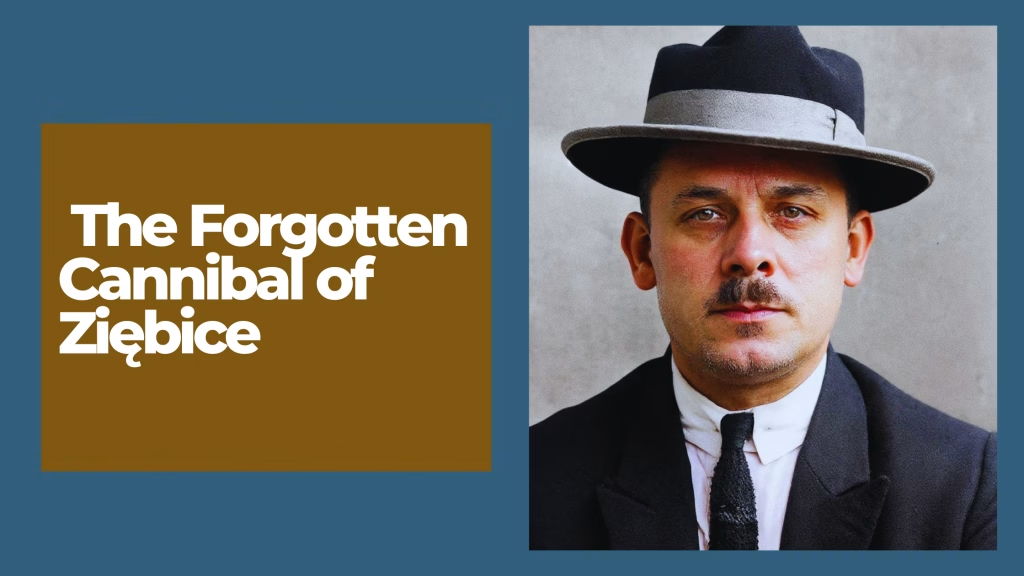
I’ve been elbow-deep in Karl Denke’s case for weeks now, and honestly? I still feel queasy every time I open the folder. Because this isn’t your typical serial killer story. Between 1918 and 1924, in the small German town of Ziębice (Münsterberg back then), a polite, church-going innkeeper murdered at least 31 homeless travellers, chopped them up, pickled the meat in barrels, and sold it to his neighbours as “cheap pork.”
He kept meticulous records and labelled jars. He even saved thousands of human teeth in neat little boxes. And nobody noticed until Christmas Eve 1924, when a half-dead man stumbled out of Denke’s house covered in blood and screaming that the kindly landlord had just tried to axe him to death.
This is Karl Denke. The man neighbours called “Papa Denke.” The man who handed out sandwiches to the poor. The man who turned his cellar into an abattoir for human beings.
Karl Denke’s Early Life: The Quiet Boy Who Never Quite Fit In
Karl Denke was born on 12 August 1860 (some records say 1870) in Ziębice, a small town in what was then Prussian Silesia. His family was farmers. They were religious. They were poor.
From childhood, he was… odd. He rarely spoke and hated school. He tortured animals. At 12, he ran away from home and ended up in a reformatory. When he returned, he worked as a gardener’s apprentice, but people always said he seemed “distant.”
Everyone liked him went to church every Sunday, and gave food to tramps. Karl played the organ at the service, which was the last person anyone would suspect. He never married and never had close friends. Karl just drifted until his father died and left him a small inheritance. With that money, he bought a little house on what is now ulica Stawowa and opened a shop selling leather goods and cheap meat.
He never married and never had close friends. He just drifted until his father died and left him a small inheritance. With that money, he bought a little house on what is now ulica Stawowa and opened a shop selling leather goods and cheap meat.
Everyone liked him. He went to church every Sunday and gave food to tramps. Karl played the organ at services. For example, he was the last person anyone would suspect.
Post-War Germany: Starvation, Chaos, and the Perfect Hunting Ground
After World War I, Germany collapsed. Hyperinflation hit hard. A loaf of bread costs billions of marks. People ate rats. They ate wallpaper paste. They ate each other in whispers. Ziębice sat on a major railway line. Thousands of homeless men, women, and children passed through every week, looking for work or just trying to survive.
They were invisible. If one disappeared, nobody asked questions. Denke offered them a bed for the night. A hot meal. A little kindness. And when they accepted, he locked the door.
The Killings: How Karl Denke Turned His House into a Human Butcher Shop
Police later estimated at least 31 victims, but the real number is probably higher. Most were travelling labourers, drifters, ex-soldiers. Denke’s method was simple and terrifyingly efficient:
- Invite the victim in for food and a bed
- Hit them from behind with an axe or pickaxe
- Bleed them like livestock
- Butcher the body in his kitchen
- Pickle the meat in barrels with salt and vinegar
- Sell it door-to-door as “pork” or “bacon.”
He kept notebooks. Names. Dates. Weights. He labelled jars: “Herr Müller – 1922.” He saved buttons, belts, and shoes to sell second-hand. And he collected teeth. Thousands of them. Neatly sorted in wooden boxes. When police searched the house after his arrest, they found:
- 30 large barrels of pickled human flesh
- Hundreds of pieces of cured meat hanging from hooks
- Two tubs of prepared lard (human fat)
- A crate containing 480 teeth
- Dozens of identity papers
Neighbours had been eating human meat for years.
The Day It All Ended: Christmas Eve 1924
On 21 December 1924, a man named Vincenz Olivier knocked on Denke’s door looking for a room. Denke invited him in, offered tea, then attacked him with an axe. Olivier fought back, screamed, and managed to escape, covered in blood. He ran straight to the police station, shouting that “Papa Denke tried to murder me.”
Police searched the house that night. They found the barrels. The meat. The teeth. Denke was arrested on the spot. Two days later, on 23 December 1924, he hanged himself in his cell with his own suspenders. He never explained why.
Trial? There Was No Trial.
Because Denke killed himself, there was no confession, no courtroom drama, no psychological evaluation. The case was quietly closed. Local businesses selling meat shut down overnight. The town changed its name from Münsterberg to Ziębice after the war, partly to escape the stigma. The house on Stawowa Street was demolished in the 1930s. Today, a small plaque marks the spot. Most tourists walk past without noticing.
Monster, Madman, or Just Desperate? The Question Nobody Can Answer
This is the part that keeps me up at night. Germany was starving. People really did eat anything to survive. Was Denke a psychopath who used hunger as cover? Or was he a starving man who crossed a line and then couldn’t stop? We’ll never know. He left no letters. No manifesto. Just barrels of flesh and boxes of teeth.
Final Thoughts: The Cannibal Nobody Talks About
Karl Denke isn’t famous like Dahmer or Bundy. His name doesn’t trend on TikTok. But in the quiet town of Ziębice, old people still cross the street when they pass the spot where his house once stood. Thirty-one confirmed victims. Probably dozens more.
All sold as Sunday dinner. If that doesn’t make your skin crawl, I don’t know what will. What do you think? Starving madman or pure evil? Drop your take below. I read every comment. And if this one left you hungry for more forgotten cases, check out my piece on Joe Ball, the Texas alligator man who fed his victims to gators.